Buckeye Christian Fiction Christmas Book Lovers Party

15137497_10211384662236491_7544221234790747291_o

How far should Carrie go to help one of the Yankees responsible for destroying nearby Chattanooga while her dear father fights for the Confederacy in far-off Virginia?

stranger-cover_-new-appleIf you like Civil War history or histfic, give this story a try! Available in ebook, Kindle Unlimited, and paperback.

A Stranger On My Land is the book that Sandra Merville Hart will be highlighting during her time at this Facebook Party. Join Michelle Levigne, Sandra Merville Hart, Saundra Staats McLemore, Tamera Lynn Kraft, Carole Brown, Sharon A. Lavy, and Teresa Hooley Slack at a Facebook Party on Thursday, November 17th, from 6 pm to 9:30 pm Eastern. We’d love to chat with you at the Buckeye Christian Fiction Christmas Book Lovers Party!

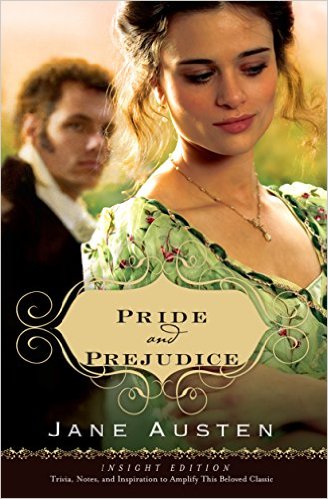
Pride and Prejudice by Jane Austen – a Review

51jiiqyoml-_sx326_bo1204203200_Elizabeth Bennet fights her growing attraction for the proud yet noble Mr. Darcy in this heartwarming novel.

This version of the classic novel by Jane Austen has added notes in the margin that explain historical or cultural aspects of the story that the modern reader might not know. It also includes tidbits from Austen’s life, romance tips, faith themes, and comments about the characters.

These notes enhanced my enjoyment of the novel so much that I read this version at least twice a year.

I definitely recommend this particular version to lovers of historical romance.

-Review by Sandra Merville Hart

Amazon

Stewed Carrots

img_2400

I know that a recipe for stewed carrots from an 1877 cookbook isn’t the most exciting dish, but this dish added a bit of flavor and interest to the vegetable.

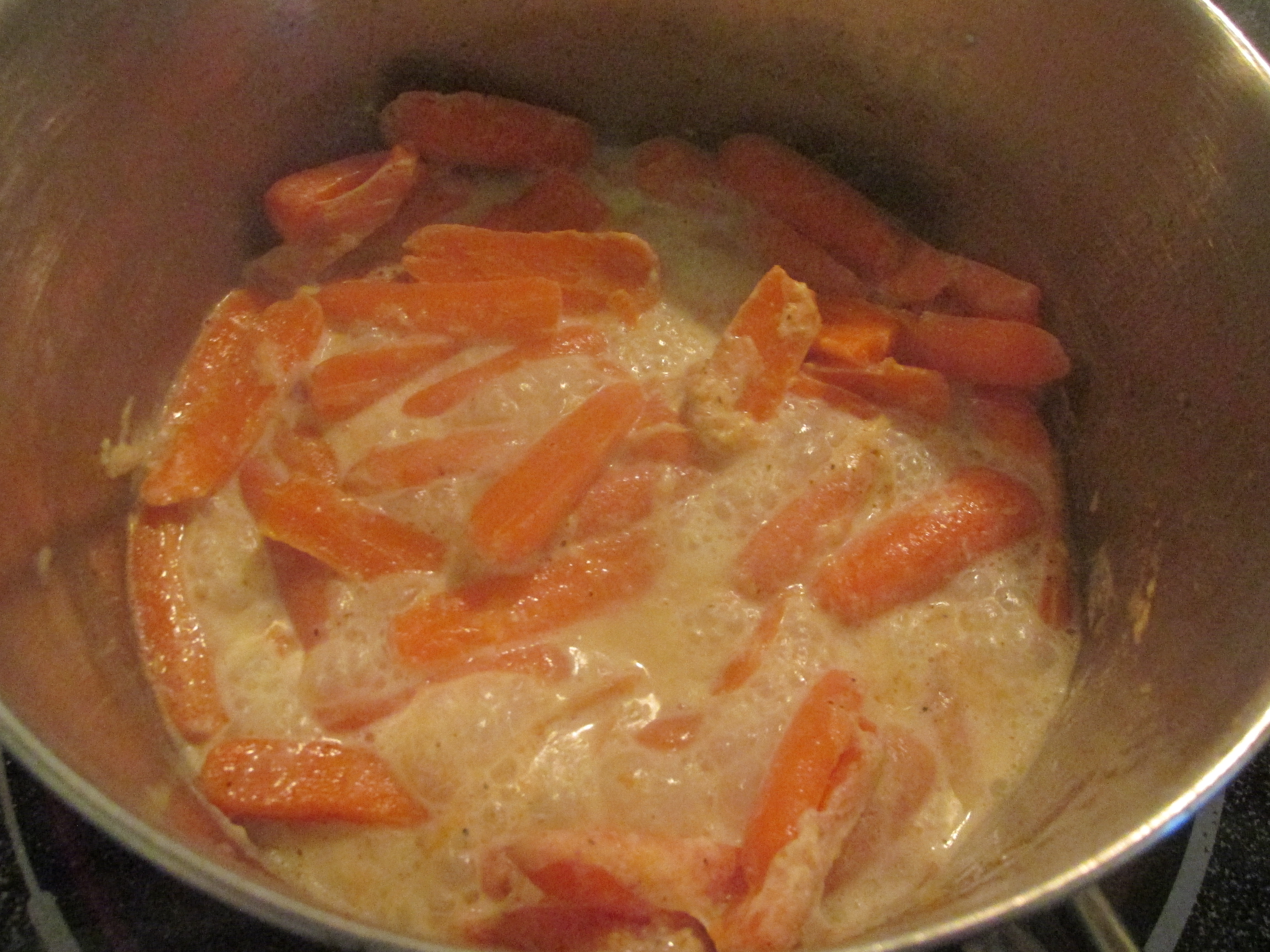
img_2392The carrots I had on hand were the peeled baby carrots. I sliced a half pound of these once lengthwise. Though I usually steam this vegetable, I boiled them as directed by Mrs. C.T.C. on a medium high heat. They were tender and ready for the next step in about a half hour.

In another saucepan, melt two tablespoons of butter and add about a cup of milk. Salt and pepper to taste and then cook over medium low heat for about 10 minutes, stirring often.

img_2394Remove the carrots by the pan with a slotted spoon into a serving dish. Dissolve a tablespoon of flour in about twice as much water and add to the creamy sauce left in the pot. (Use less flour if you don’t want the sauce to be as thick. Next time I will try a teaspoon of flour for pourable consistency.)

Stirring constantly, allow the gravy to boil at least a minute. Then pour it over the carrots and serve.

Both my husband and I liked carrots prepared this way. If you want to jazz up carrots at supper one evening, consider trying this recipe. The preparations took about an hour.

Enjoy! I’d love to hear if you try this recipe.

-Sandra Merville Hart

Sources

Compiled from Original Recipes. Buckeye Cookery and Practical Housekeeping, Applewood Books, 1877.


Mark Twain Learns the Cost of Traveling West

bonneville-1210139_960_720

Mark Twain and his brother stopped in Great Salt Lake City while on a stagecoach trip to Nevada in the early 1860s. While at the Salt Lake House, a fellow asked if Twain wanted his boots blacked. Twain agreed and paid him a silver five-cent piece when done.

rupee-1442402_960_720The man laid the coin in his hand and stared as if at a novelty. Stagecoach drivers, mountaineers, and other local folk gathered near to survey the nickel.

Returning the money, the fellow suggested that Twain store his coins in his pocket-book instead of his soul—that way it wouldn’t get so shriveled up!

It was a humiliating lesson that commodities costing far less in the eastern United States were not as cheap in the West. The amount Twain gave was a fair price where he grew up, but not in Great Salt Lake City.

A penny’s worth of goods was available in the East; it bought the smallest amount of purchasable products. The silver nickel was the smallest coin used west of Ohio.

background-21657_960_720Nothing cost less than a dime in Overland City and, as Twain learned the hard way, everything cost at least a quarter in Great Salt Lake City.

Cigars, peaches, candles, newspapers, and chalk pipes—items that normally cost Twain a nickel—went for twenty-five cents in that western city.

Twain and his brother brought along silver coins stored in a shot-bag; the level reduced at an alarming rate at those prices. Though it seemed as if they blew their money on riotous living, their expense records proved that not to be the case.

The brothers quickly learned the realities of residing in the pioneering West. High costs of freighting goods to the area escalated the prices. Pioneers grew accustomed to paying a minimum of twenty-cents for everything, even blushing to remember paying only a nickel for the same items.

The fellows had a good laugh at Twain’s expense that morning at the hotel, perhaps because the same thing happened to them when they were first confronted with the exorbitant prices in the West.

-Sandra Merville Hart


Sources

Twain, Mark. Roughing It, Penguin Books, 1981.

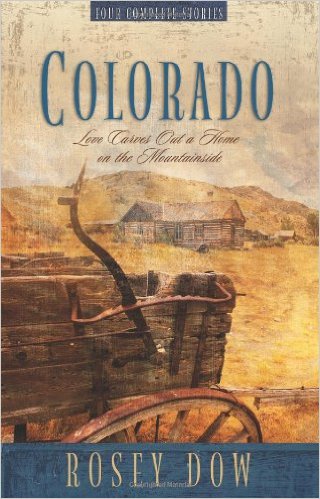
Colorado by Rosey Dow – a Review

51l2sdahhwl-_sx318_bo1204203200_

Four heartwarming novellas make up this series by Rosey Dow.

The main characters you learn to love in the first book, Megan’s Choice, are found in other novellas. This allow us, as readers, to spend additional time with lovable characters that we aren’t ready to part with.

Megan Wescott needs a well-paying job to cover the cost of her younger brother’s medical bills. Unfortunately, the only work she can find requires her to leave Baltimore and head west with Steven Chamberlain as his new wife.

Em, who refused to leave the family when the War Between the States ended, will stay with Jeremy. Megan knows Em will care for her brother, but how can she bear to leave? Yet with Jeremy’s bills mounting, she has little choice but to marry a stranger in the hopes of saving her brother.

I loved all the main characters of each story so much that I’ve read the whole book several times. I definitely recommend this series to lovers of historical romance.

-Review by Sandra Merville Hart

Amazon

Salem Election Cake

img_2422

I ran across two recipes for Election Cakes in an 1877 cookbook. Both boasted that the recipes were over 100 years old. A recipe from the Revolutionary War era–what a fun discovery!

Election Day was a festive occasion as early as 1771. Pioneers celebrated the day with parades, balls, religious ceremonies, and food.

Some traveled far to vote. While folks awaited election results, they socialized. The best bakers loved to demonstrate their skills by participating in banquets. Ladies served huge Election Cakes with coffee and cider.

To get an idea of the quantity provided, one recipe called for thirty quarts of flour and fourteen pounds of sugar! Meant to feed a crowd, these cakes originally were a variation of fruitcake and bread.

My cookbook contained two different recipes for these cakes: Salem Election Cake and Old Hartford Election Cake. Wine, brandy, citron, and raisins were a few of the ingredients in the Hartford cake. The Salem recipe looked deceptively simpler so I tried to make this.

img_2414The original recipe, a simple listing of ingredients without instruction, calls for four pounds of flour—far too much for my needs so I cut that down to two cups.

It also called for a pint of yeast. The Hartford recipe gave measurements for distillery yeast; cooks had to use twice as much of home-brewed yeast. I ended up using far too much for the amount of dough.

My first attempt failed. The second try went better, but the cake failed to rise.
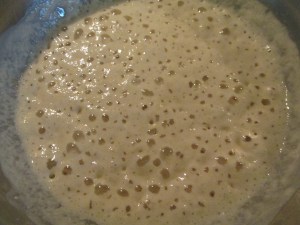
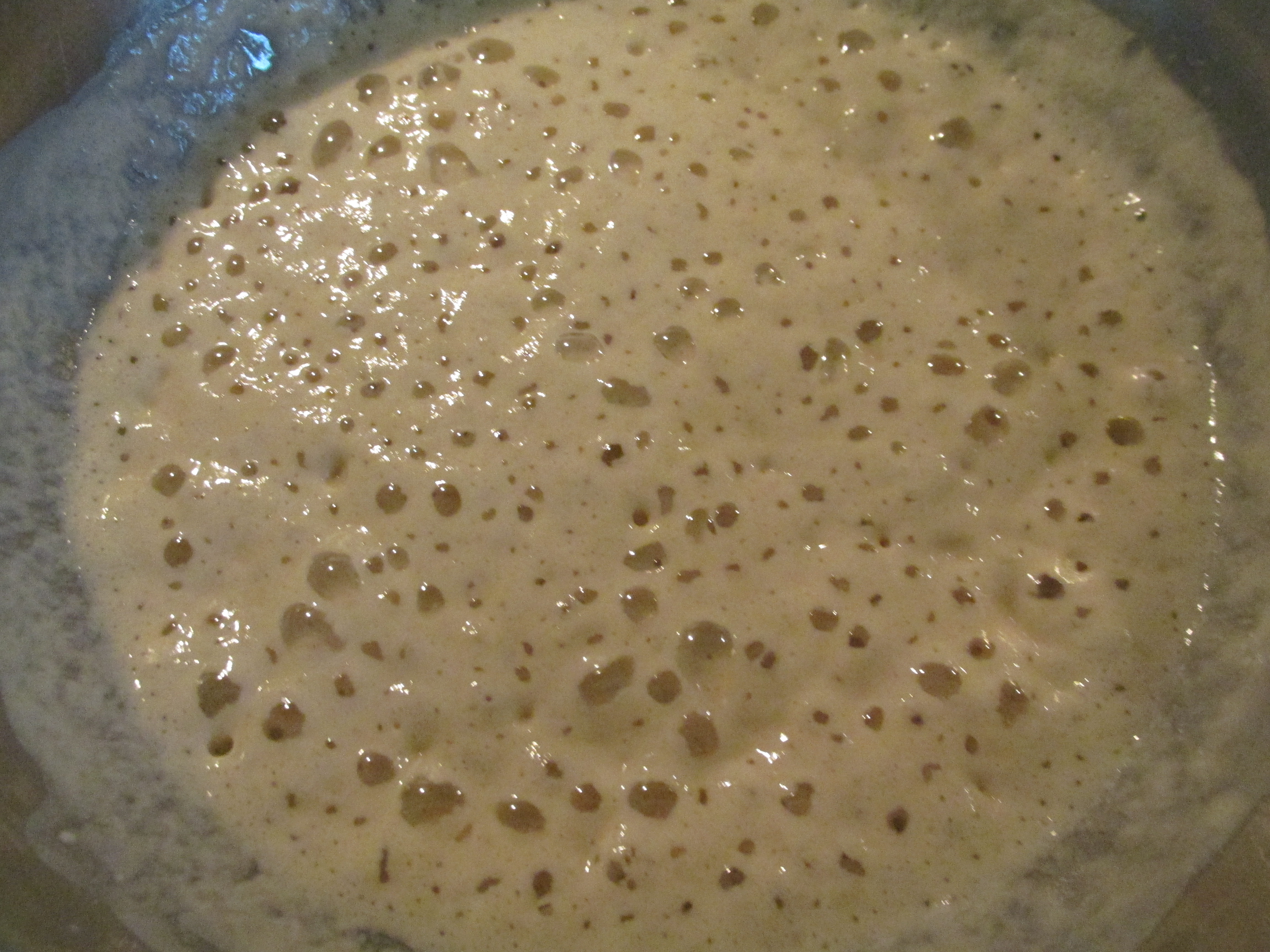
img_2417Then I found a recipe for sponge using our modern yeast on What’s Cooking In America. To ¾ cup warm water, two teaspoons of active dry yeast were added. After stirring, I added ¾ cup all-purpose flour and 1 tablespoon of sugar. This mixture was beaten for 2 minutes. I covered the bowl with plastic wrap and set in a warm place. It was bubbling in about 30 minutes.

While waiting for the sponge, ¾ cup of sugar was creamed with 4 tablespoons of butter. Two beaten eggs were mixed into the creamed sugar.

The original recipe simply calls for “spice.” This leaves the spices and measurements to the imagination.

In a separate bowl, I combined 2 cups of flour, 2 teaspoons cinnamon, 1 teaspoon nutmeg, ½ teaspoon ground cloves, ½ teaspoon ginger, and 1 teaspoon salt.

Though the cake is described as a fruitcake, there is no mention of adding fruit.

After the sponge reached the bubbling stage, I added it to sugar mixture and stirred it together. Then the dry ingredients were stirred in a little at a time.

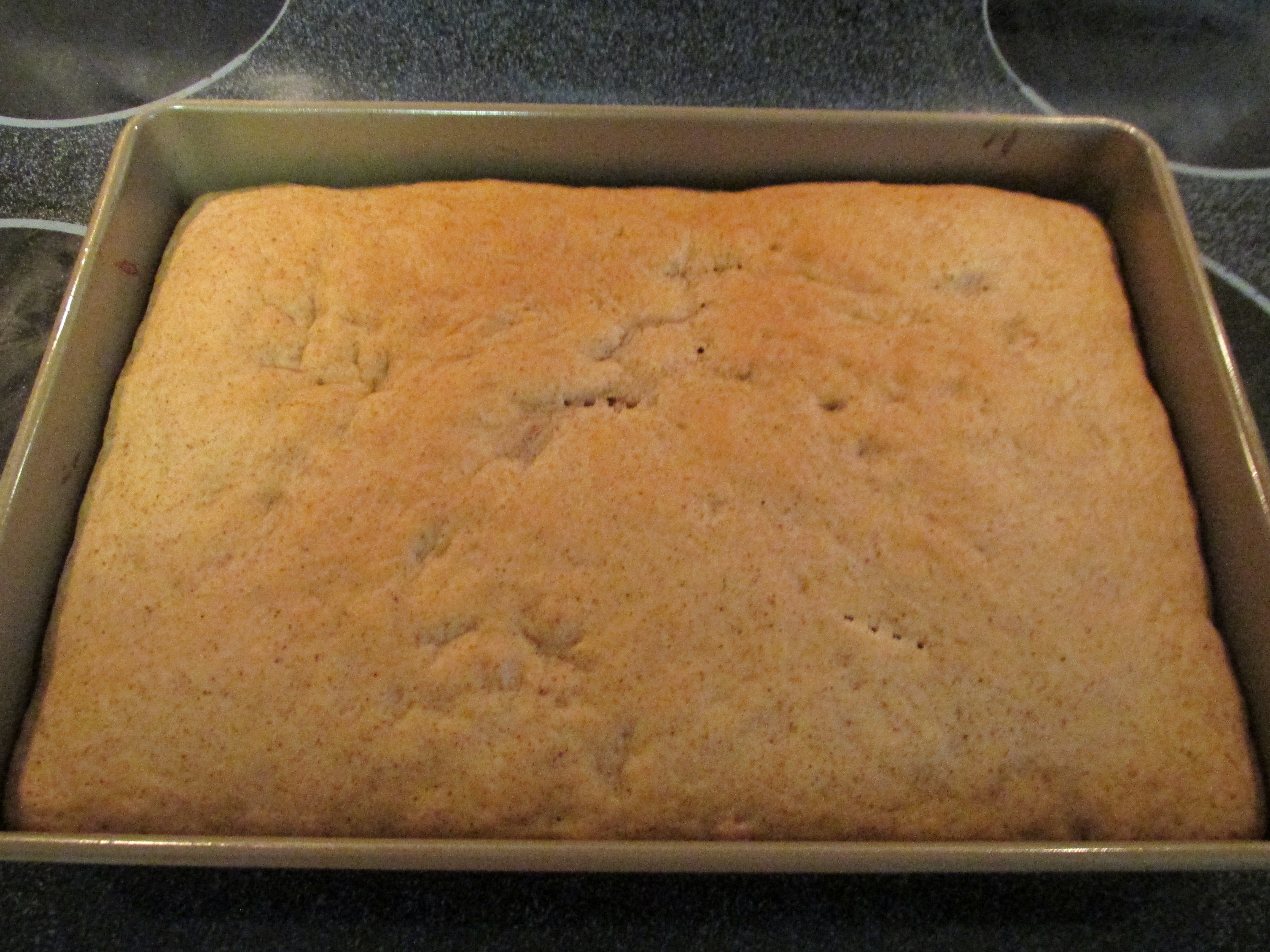
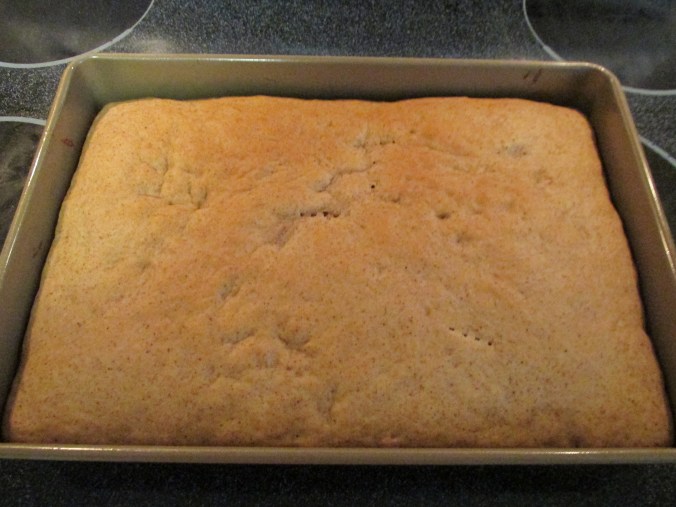
img_2420Place the cake into a pan before the final rise. I used a 13×9 pan. This looked way too large but the cake rises. It was covered with plastic wrap and set on a warm stovetop for three hours. The dough had doubled in size.

The cake baked in a 350-degree oven for twenty minutes. I liked the texture but it wasn’t spicy enough. Plums, raisins, and currants—well floured—were a few of the fruits in some early recipes. Adding one of these may be enough make a more flavorful cake.

Since this is cake/bread, no frosting was suggested in my cookbook. The addition of fruit might be enough.

Election Cakes seem to have gone the way of Election Day parades and balls. The recipe began disappearing from cookbooks around the 1940s.

Enjoy! I’d love to hear if you try this recipe.

-Sandra Merville Hart

Sources

Compiled from Original Recipes. Buckeye Cookery and Practical Housekeeping, Applewood Books, 1877.

“Election Day Cake and History,” What’s Cooking in America, 2016/10/09  https://whatscookingamerica.net/History/Cakes/ElectionCake.htm.

“Salem Dames, Election Cake, and More!” Salem Food Tours, 2016/10/09 http://www.salemfoodtours.com/2012/11/08/salem-dames-election-cake-and-november-news/#.V_rVVeArKM8.

“When Elections were a Piece of Cake,” Connecticuthistory.org, 2016/10/11  http://connecticuthistory.org/when-elections-in-hartford-were-a-piece-of-cake/.

Mark Twain Briefly Holds Property at Lake Tahoe


lake-tahoe-1606969_960_720

The Homestead Act of 1862 allowed United States citizens to file a claim for free federal land, up to 160 acres. This privilege allowed heads of households or adults 21 and over to pay a small registration fee and then live on that property continuously for five years. After that they owned the land. If the owner wanted quicker ownership, he paid $1.25 per acre after a six-month residency.

Mark Twain, along with a friend, set out for Lake Tahoe at the end of August with an axe strapped to his back. Brigade members, who were friends of theirs, had timber lands along the lake shore and a camp with provisions. Twain intended to take advantage of the law and build a wooden ranch while staying at the Brigade’s camp. Visions of wealth and dreams for a bright future put a spring in his step.

lake-tahoe-177933_960_720Twain described the bracing air at Lake Tahoe as being “the same the angels breathe.” While fishing in a boat, the clear water made the young men feel as if they floated on air.

After exploring the area, the friends claimed about three hundred acres of dense yellow pine timber land by posting notices on a tree. The next order of business to hold the land was to build a fence, or in this case, cut down trees so they fell to form an enclosure. After the men cut three trees apiece, they decided to “rest their case” there while hoping it was enough to meet the requirement.

lake-tahoe-1697573_960_720Then they turned their attention to building a log home that would be the envy of the Brigade property owners. The first log took so long to trim that the friends decided to build a sapling home. That proved to be a lot of work as well so they settled on a brush house and began living on their new property.

fire-1650781_960_720One evening, Twain lit a fire and then went to retrieve his frying pan to cook bacon for supper. In that short time, the fire took off “galloping all over the premises!” He and his friend, Johnny, retreated to a boat to watch helplessly as dry pine needles lit with fierce speed. Flames roared up nearby ridges.

wildfire-1105209_960_720The fire mirrored in the lake where a horrified Twain sat in his boat. His house and fence were burned up with no insurance. Provisions were gone but the blankets had been in sand and so were saved.

They returned to the Brigade’s camp and ate their provisions. Then Twain and Johnny returned to Carson to explain what happened to the Brigade owners, who forgave them after the pair paid the damages.


-Sandra Merville Hart


Sources

“Homestead Act,” History.com, 2016/09/29 http://www.history.com/topics/homestead-act.

“Homestead Act,” The Library of Congress, 2016/09/29 https://www.loc.gov/rr/program/bib/ourdocs/Homestead.html.

Twain, Mark. Roughing It, Penguin Books, 1981.

The Substitute Wife by Amanda Barratt – a Review

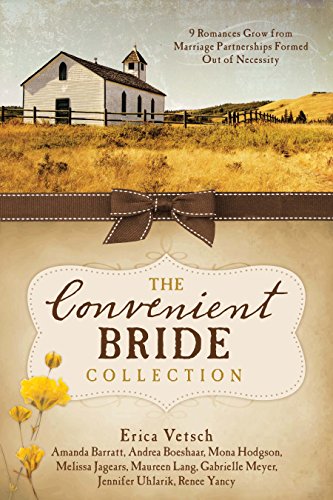
51clsivd2hlPart of the Convenient Bride Collection

The Substitute Wife by Amanda Barratt

Grace is the plain sister, the unnoticed one who can never hope to match the beauty of her sister, Audrey. Grace works as Audrey entertains her fiancé, Dr. Raymond McNair.

When Audrey leaves a note for the family and Raymond next to her wedding gown not to look for her, the humiliation felt by all leads to Grace walking down the aisle with Raymond.

Grace’s hopes that her new husband will fall in love with her are dashed when the unthinkable happens.

The setting and characters are believable and lovable in this enjoyable historical romance.

-Review by Sandra Merville Hart

Amazon