
by Sandra Merville Hart
When my husband was a child, his mother would light an Advent candle every evening as the family gathered for supper. She did this for four weeks, beginning on the fourth Sunday before Christmas. Only one candle burned the first week. On the second week, another candle was lit every evening. There were three burning in the third week and four in the fourth week. The candles were arranged in a wreath prominently displayed. He recalled that, by the end, the first candle was nearly gone.
As a child, my family didn’t celebrate this holiday tradition. How did this tradition begin?
Adventus is the Latin word for “coming”. Advent was a time when early Christians prepared their hearts and minds to celebrate the birth of Jesus. In the 4th century, St. Athanasius wrote of Christians preparing for a period of time leading up to Christmas.
By the time of Pope St. Gregory the Great in the 6th century, Advent started on November 12th, which was the day after the feast of St. Martin, and lasted until January 6th, the Day of Epiphany. St. Gregory shortened the Advent season to four—some historical sources suggest it was five—Sundays preceding Christmas.
Today, Advent traditionally begins on the fourth Sunday before Christmas. For each of the four weeks, a new candle is lit to focus on a different theme. Saying a prayer, sharing a devotion, or reciting scripture may accompany the candle-lighting.
The candles are arranged in a wreath fashioned from evergreens to symbolize everlasting life. The wreath’s circular shape symbolizes God’s unending love for us.
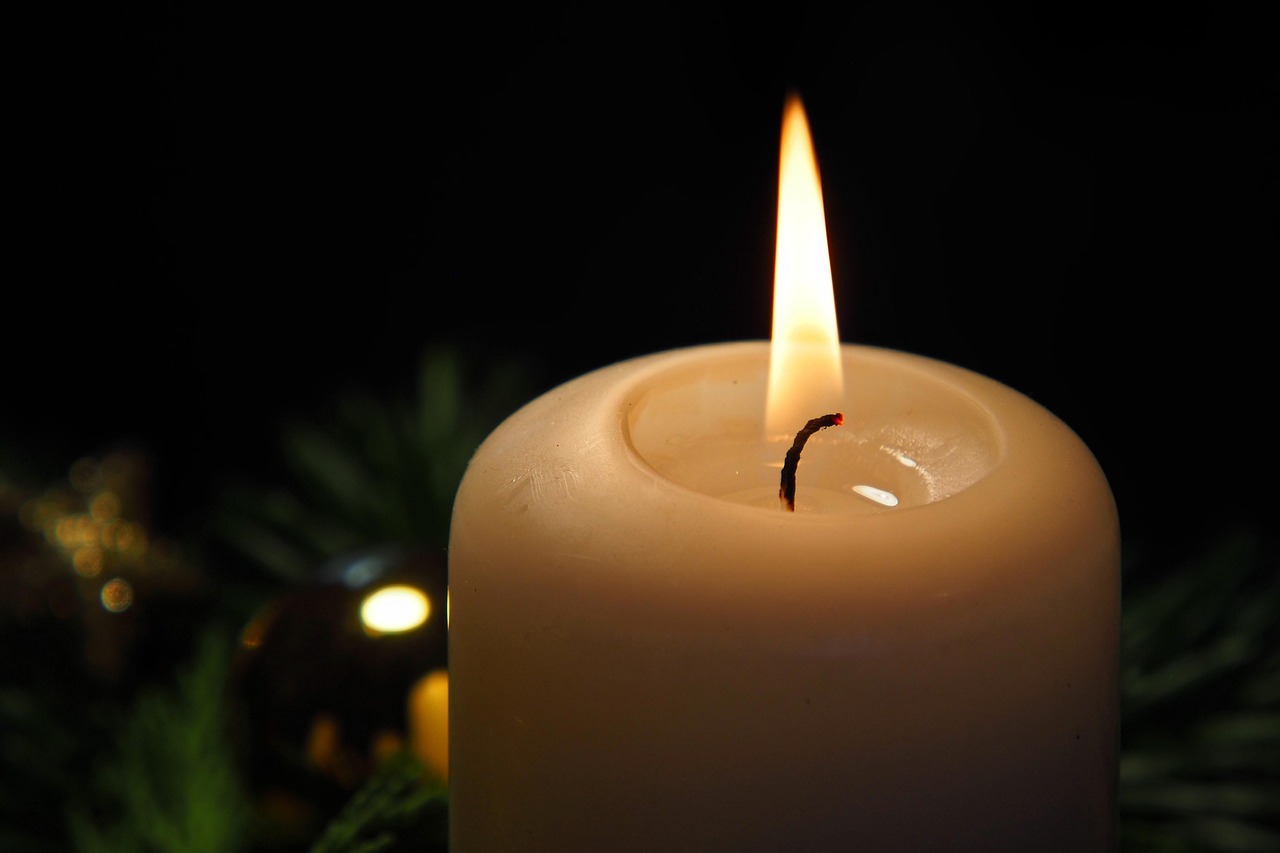
Candle colors are often three purple and one that is rose or pink. An optional fifth white candle in the middle of the wreath, known as “Christ’s Candle,” is lit on Christmas Day.
Each week, the focus is on a different theme that can vary. Below are some common themes.
Week 1, First Sunday, Purple candle, also called the “Prophet’s Candle”: Hope
Even youths grow tired and weary
and young men stumble and fall;
but those who hope in the Lord
will renew their strength.
They will soar on wings like eagles;
they will run and not grow weary,
they will walk and not be faint.
Isaiah 40:30-31 (NIV)
Week 2, Second Sunday, Purple candle, also called “Bethlehem’s Candle”: Peace
For unto us a child is born, to us a son is given,
And the government will be on his shoulders.
And he will be called Wonderful Counselor, Mighty God, Everlasting Father, Prince of Peace.
Isaiah 9:6 (NIV)
Week 3, Third Sunday, Pink or rose candle, also called the “Shepherd’s Candle”: Joy
And there were shepherds living out in the fields nearby, keeping watch over their flocks at night. An angel of the Lord appeared to them, and the glory of the Lord shone around them, and they were terrified. But the angel said to them, “Do not be afraid. I bring you good news of great joy that will be for all the people. Today in the town of David a Savior has been born to you; he is Christ the Lord. This will be a sign to you: You will find a baby wrapped in cloths and lying in a manger.”
Suddenly a great company of the heavenly host appeared with the angel, praising God and saying,
“Glory to God in the highest, and on earth peace to men on whom his favor rests.”
Luke 2:8-14 (NIV)
Week 4, Fourth Sunday, Purple candle, also called the “Angel’s Candle”: Love
“For God so loved the world that he gave his one and only Son, that whoever believes in him shall not perish but have eternal life.”
John 3:16 (NIV)
Love is patient, love is kind. It does not envy, it does not boast, it is not proud. It is not rude, it is not self-seeking, it is not easily angered, it keeps no record of wrongs. Love does not delight in evil but rejoices with the truth. It always protects, always trusts, always hopes, always perseveres.
1 Corinthians 13:4-7 (NIV)
The Advent season celebrates Jesus’s birth, which was His first coming, and also hearkens to His Second Coming when He will return for His followers.
Lighting the Advent candles brings much symbolism as well as centuries of tradition to help Christians prepare their hearts for Christmas.
Sources
“Advent.” Bible Project, 2025/11/29 https://bibleproject.com/guides/advent/.
Britannica Editors. “Advent Calendar.” Encylopaedia Britannica, 2025/11/29 https://www.britannica.com/topic/Advent-calendar.
Compiled & Edited by Crosswalk Editorial Staff. “Advent: The Beautiful Meaning, Purpose, and Traditions Explained.” Crosswalk, 2025/11/29 https://www.crosswalk.com/special-coverage/christmas-and-advent/the-beautiful-meaning-and-purpose-of-advent.html.
“Did St. Gregory the Great invent the season of Advent?” Aleteia, 2025/12/03 https://aleteia.org/2022/11/29/did-st-gregory-the-great-invent-the-season-of-advent/.
Richie, Laura. “Understanding the Meaning and Symbolism of the Advent Wreath & Candles,” Crosswalk, 2025/11/29 https://www.crosswalk.com/special-coverage/christmas-and-advent/advent-wreath-candles-understanding-the-meaning-history-tradition.html.
“St. Martin’s Day,” Wikipedia, 2025/12/03 https://en.wikipedia.org/wiki/St._Martin%27s_Day.
Walker, Kristi. “What is the Meaning of an Advent Calendar?” Christianity.com, 2025/11/29 https://www.christianity.com/wiki/holidays/what-is-an-advent-calendar.html.
 Sandra Merville Hart
I never experienced this during my years growing up but I love this tradition. One year, I shared the advent candles at children’s church during the 4 Sundays in Dec
Thanks for sharing. I wish you a blessed season.
LikeLike
Thanks, Connie! I loved digging into this centuries-old tradition. May you have a blessed holiday season.
LikeLike