United States Sanitary Commission

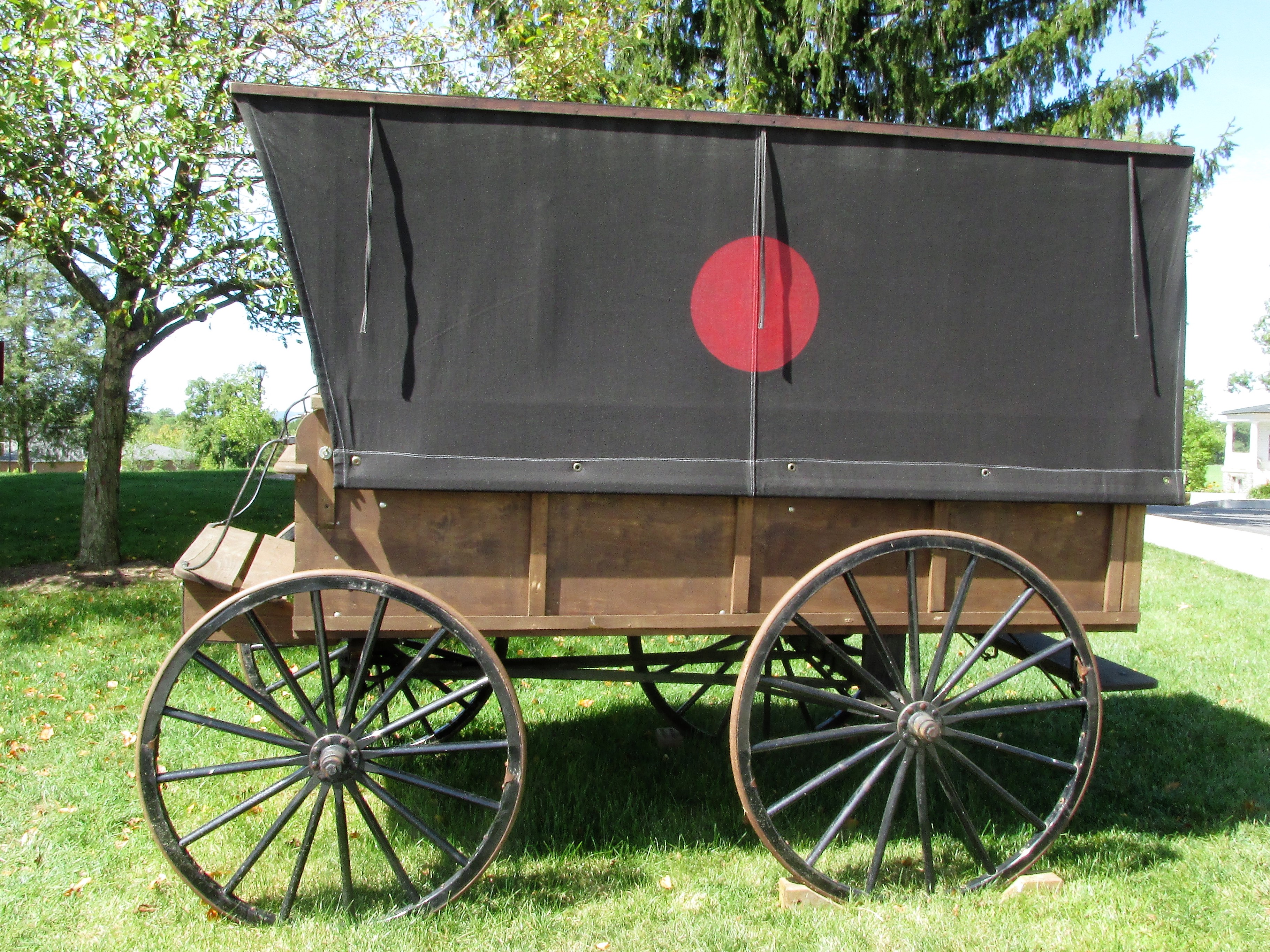
Ambulance outside Lutheran Seminary, Gettysburg.


Authorized by the War Department in June of 1861 to aid Union military, the United States Sanitary Commission supported sick and wounded soldiers. The organization was patterned after the British Sanitary Commission used during the Crimean War.

The Sanitary Commission’s central office was located on Pennsylvania Avenue and 15th Street inside the United States Treasury Building, just east of the Executive Mansion (White House.)

Massachusetts clergyman Henry Whitney Bellows served as the United States Sanitary Commission’s (USSC) only president. Landscape architect Frederick Law Olmsted—the designer of New York City’s Central Park—was the first executive secretary. New York lawyer George Templeton Strong served as treasurer. Their goals included coordinating citizen relief work and advising politicians about recruiting and training medical workers, which included female nurses. USSC was divided into three departments.

The Preventive Service Department improved living conditions for soldiers by inspecting military hospitals and army camps. Concerned with preventing and treating diseases, they also published medical tracts for doctors.

The Department of General Relief relied on citizens’ donations to buy food, clothing, blankets, and medical supplies for wounded soldiers.
The Department of Special Relief aided soldiers returning to civilian life. Families of disabled soldiers also received help.

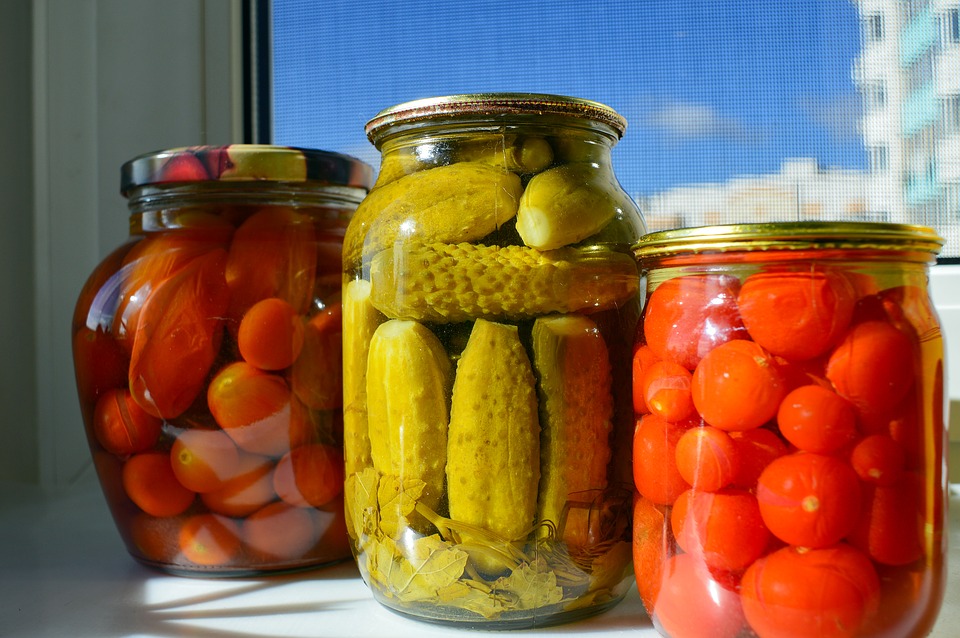
To fight scurvy among the soldiers, USSC encouraged donations of vegetables, including fresh and pickled vegetables.

USSC set up hospitals and staffed them. With the help of local chapters, steamboats were converted to hospital ships. They established soldiers’ homes.

Large cities and local communities held Sanitary Fairs to raise money to aid soldiers through USSC. Through thousands of volunteers, the Commission raised about $25 million (equivalent of over $400 million in 2018.) This impressive amount aided Union soldiers and the Northern cause.

-Sandra Merville Hart

Sources

Moore, Frank. Women of the War, Blue/Gray Books, 1997. (originally published 1866).

Williams, Rachel. “The United States Sanitary and Christian Commissions and the Union War Effort,” National Museum of Civil War Medicine, 2018/12/27 http://www.civilwarmed.org/commissions/.

“United States Sanitary Commission,” Ohio History Central, 2018/12/27, http://www.ohiohistorycentral.org/w/United_States_Sanitary_Commission.

“United States Sanitary Commission,” Wikipedia, 2018/12/27 https://en.wikipedia.org/wiki/United_States_Sanitary_Commission.
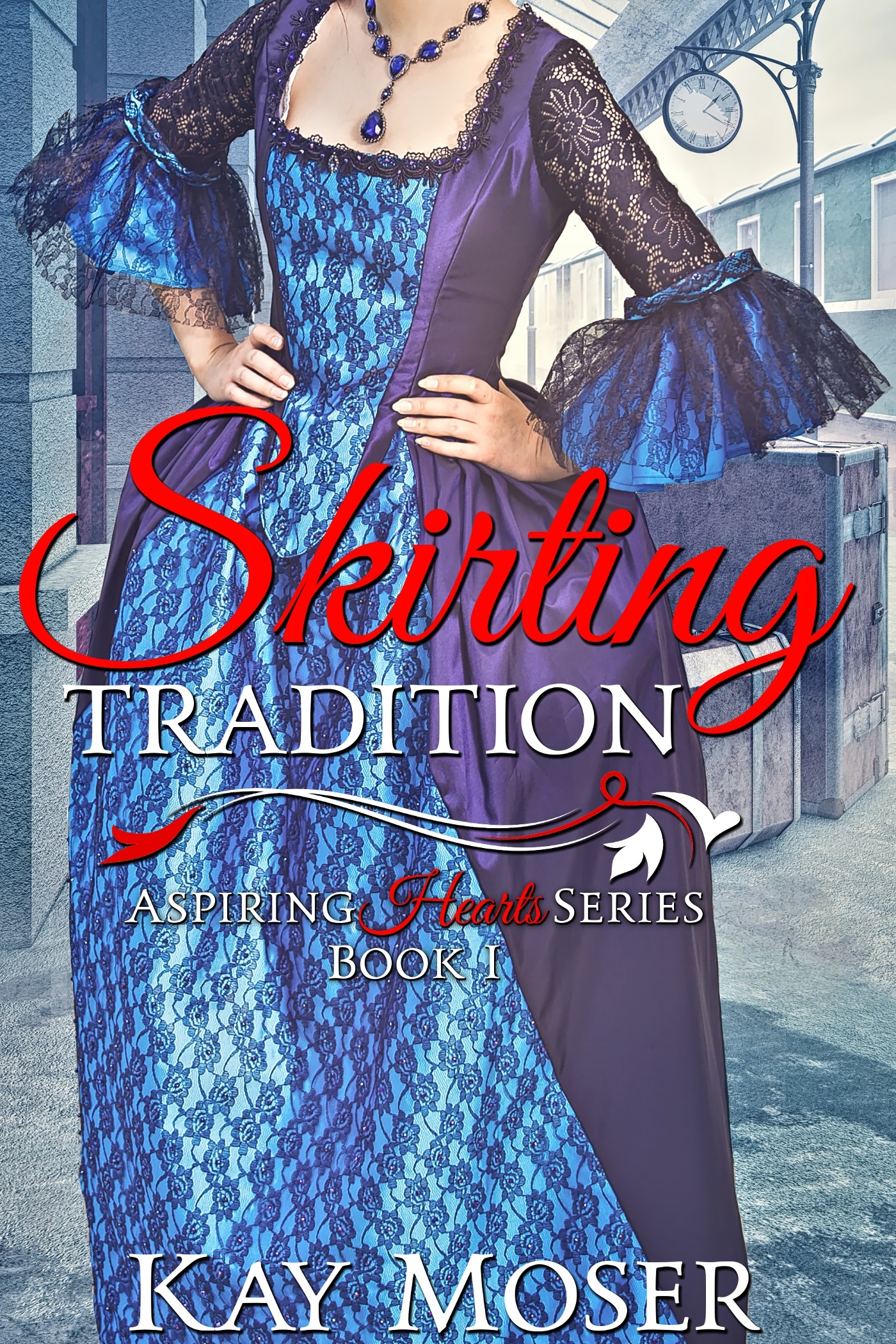
Skirting Tradition by Kay Moser


Book 1 of the Aspiring Hearts Series

This novel captured my interest immediately.

Sixteen-year-old Sarah Novak dreams of becoming a teacher yet that seems impossible. Her pa sends her to town to work because the family and farm needs her pay. He searches for a man for her to marry and figures one of the sons on the adjoining property is a good fit.

A chance meeting with Mrs. Victoria Hodges, an artist and newcomer to Riverford, begins to turn things around for Sarah though not without turmoil for both ladies.

Sarah doesn’t want to admit that Lee Logan, a banker from Fort Worth, has caught her eye because marriage is not in her future. She plans to teach.

I found myself pulling for both Sarah and Victoria through the numerous obstacles that threaten to thwart their goal of winning a scholarship to college.

This first book in the series is not really a romance. The story is told from two perspectives—Sarah and Victoria—and exposes readers to the difficulties that strong women faced in pursuing careers in the late 19th century. Characters deal with heartaches and struggles in an honest way.

I look forward to reading the next book in the series.

Recommend!

-Sandra Merville Hart

Lighthouse Publishing of the Carolinas   – Use coupon code SandraMHart for a 20% discount on Lighthouse Publishing books!


Molasses Cookies Recipe from 1877

When my sister asked me to bring lots of cookies to her Super Bowl party, I took that as an invitation to try a few old-fashioned recipes. The 1877 baker who shared this cookie recipe is Miss J. O. DeForest of Norwalk.

Miss DeForest advised bakers to add “flour enough to roll out.” No measurements. One of the problems with following older recipes is that they leave out important details. In trying to figure out how much flour was needed, I had to make the batter twice. Perhaps I grumbled a little, as I dumped the first batch in the garbage, that the reason Miss DeForest left out the measurement is that she couldn’t figure it out either. But, since I was alone in my kitchen, only my stand mixer and I know that for sure. It’s more likely that this baker was like my grandmother—an excellent cook!—who never measured anything.

Add 1 teaspoon of baking soda to 3 cups of flour. Mix or sift together and set aside.

Mix 1 ¼ cups of sugar and ½ cup butter until blended. (I used a mixer.) Stir in ¼ cup of molasses.

Whisk 1 egg and then mix it into the batter.

Add the flour mixture, a little at a time, to the wet ingredients.

Lightly flour the counter and rolling pin and then roll out the batter. Cut into desired shapes.

Spray a cookie sheet with cooking spray or line with parchment paper. Bake cookies at 350 degrees until lightly browned, about 11 – 14 minutes.

The cookies had a great texture. Even with only ¼ cup of molasses, that sweet tangy flavor really came through. If you don’t like molasses, you won’t like these cookies. This is not a common flavor these days, and most guests at the party flocked toward the other types. My husband liked them a lot.

Honey, molasses, and sugar were all used to sweeten foods in earlier centuries. As a little girl, I remember that my grandfather considered molasses a big treat.

I’d make these again—just not for another Super Bowl party.

I’d love to hear if you try it.

-Sandra Merville Hart

Sources

Compiled from Original Recipes. Buckeye Cookery and Practical Housekeeping, Applewood Books, 1877.


Civil War Women: Kady Brownell, Daughter of the Regiment

Kady Brownell, whose father was Colonel George Southwell, was born in a South African British army camp. After her mother died, the couple who raised Kady brought her to Providence, Rhode Island.

She fell in love with Robert Brownell while working as a weaver at a Providence mill. They married in April of 1861, the month the Civil War began. Robert mustered into the 1st Rhode Island Infantry.

Kady expressed her desire to fight alongside her husband to Governor William Sprague IV, the Governor of Rhode Island. Sprague, who did not believe the war would last longer than two days, intended to accompany the Rhode Island brigade into battle under the leadership of Colonel Ambrose Burnside. Sprague took Kady with him to Washington where she met up with her husband.

Colonel Burnside appointed Kady a Daughter of the Regiment and a color bearer. Robert was orderly sergeant in the 1st Rhode Island Infantry.

She actively participated with her husband in the First Battle of Bull Run, a Confederate victory, and then enlisted into the 5th Rhode Island Infantry along with her husband.

As color bearer, Kady carried the regiment’s flag into battle. The excellent markswoman also fought with Robert in several battles.

At the Battle of New Bern on March 14, 1862, their regiment fell under friendly fire in a dense forest. Kady waved their flag and ran ahead to show the Union soldiers firing on them that they were Rhode Island troops.

She stopped them but it was too late to save her husband from serious injury. Robert’s leg was shattered.

He recovered but the war was over for him. Kady didn’t want to remain a soldier without him. When they were both discharged, she became the only woman given discharge papers by the Union army.

-Sandra Merville Hart

Sources

“Brownell, Kady (b. 1842).”  Women in World History: A Biographical EncyclopediaEncyclopedia.com. 14 Dec. 2018<https://www.encyclopedia.com.

“Kady Brownell,” Wikipedia, 2018/12/14 https://en.wikipedia.org/wiki/Kady_Brownell.

Moore, Frank. Women of the War, Blue/Gray Books, 1997. (originally published 1866).

“William Sprague IV,” Wikipedia, 2018/12/14 https://en.wikipedia.org/wiki/William_Sprague_IV.

Restored Heart by Jennifer A. Davids

I enjoyed reading this historical romance!

The main story is set on The Ohio State University in 1884.

Anne Kirby has a broken heart. Her terrible secret has already scared off one man. She realizes that she will never be able to marry.

Peter McCord’s head reels at the news—his grandfather did not leave the family’s thriving business to him. Forced to flee, Peter ends up taking a job on a college campus.

Anne arranges to live with her uncle, a professor at The Ohio State University while she works at the school’s library. Yet her reasons for moving to Columbus have something to do with the secret she keeps locked inside. She can’t afford to fall in love with Peter.

There are several layers to this story. Likable characters and the exact details of Anne’s secret that remain a mystery until late in the story held my interest.

Fans and alumni of The Ohio State University should enjoy this nostalgic historical setting.

-Sandra Merville Hart

Christianbook.com


Sand Tarts Recipe from 1877

“Bring cookies to my Super Bowl party,” my sister told me. “Make a lot of them.”

She left it wide open for me to try old-fashioned recipes. I found this sand tarts recipe in an 1877 cookbook. I’d never eaten—or even heard of—this type of cookie so I compared it to a few recipes online. Modern recipes used confectioner’s sugar, with a few other changes as well. My purpose is to follow Miss Clara G. Phellis’s recipe as closely as possible.

Nothing ventured, nothing gained, right?

I made this recipe once using confectioner’s sugar, but the mixture was too dry to roll out. I tried again with sugar and it worked fine.

Add 1 ½ teaspoons of cinnamon to ½ cup of sugar. Mix together and set aside.

I used a stand mixer to cream ½ cup of butter into 1 cup of sugar in a mixing bowl until blended well. Whisk 1 egg and add it to the mixture. Then add 1 1/2 cups of flour a little at a time, mixing until all the flour is incorporated into the mixture.

(My dough was too dry so I had to add another egg, which made it slightly wet. If this happens for you, add flour, a little at time, for a final mixing.)

Roll out the dough in a thin layer and then cut the cookies into squares.

Bake on a cookie sheet at 325 degrees for 9 minutes.

While the cookies bake, use your mixer to whip two egg whites until creamy—but not stiff.

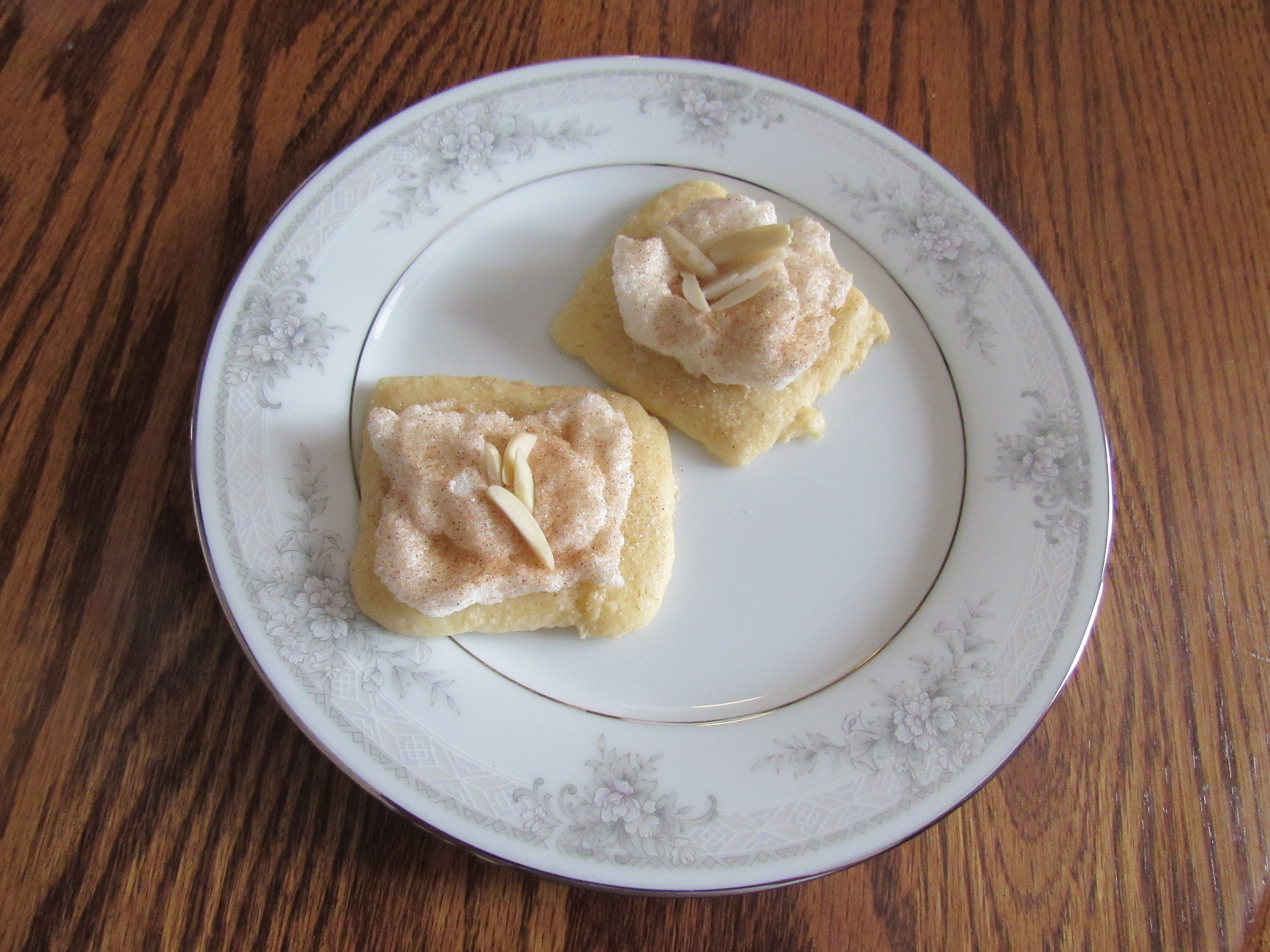
Remove the cookies from the oven after about 9 minutes. Put a dollop of meringue on each cookie or pipe it on. Then sprinkle with the cinnamon sugar. Add slivered almonds on top and return to the oven for a couple of minutes to lightly brown the meringue. (Bake longer for a crisper cookie.)

I liked it very much. The cinnamon sugar was a nice touch. Guests liked the soft texture of the cookie and the light cinnamon flavor.

Modern cookie recipes don’t use the meringue. Instead they are rolled in confectioner’s sugar and dropped onto the cookie sheet.

I’d love to hear if you try it.

-Sandra Merville Hart

Sources

Compiled from Original Recipes. Buckeye Cookery and Practical Housekeeping, Applewood Books, 1877.


Civil War Women: Anna Maria Ross, Cooper Shop

Not long after the Civil War started, Philadelphia citizens realized Union troops passing through their city needed to be fed. Two refreshment saloons were established there in 1861—Union Volunteer Refreshment Saloon of Philadelphia and Cooper Shop Refreshment Saloon.

Wounded soldiers also arrived in Philadelphia, prompting local women to open a hospital. Anna Maria Ross worked there as Lady Principal. The 12-bed Cooper Shop Hospital received the first patients on October 29, 1861. The Cooper Shop was located at 1009 Otsego Street below Washington Street.

Day and night, Anna dressed soldiers’ wounds. She also made certain that discharged soldiers received a donation to tide them over until receiving their army pay.

Union troops passed through Philadelphia at all hours. A signal gun fired when regiments came. Women living near the Navy Yard—many responsible for their own families—responded to the signal. They walked to the refreshment saloons, day or night, to cook for the soldiers.

The Cooper Shop alternated days with the Union Volunteer Shop. The 24-hour daily period ended at 6 pm. Even if it wasn’t their day to serve, shop leaders could divide the soldiers and send them to the other shop if more than 200 men needed meals.

Wounded from Gettysburg arrived in July and August of 1863, crowding the saloon hospitals. Hospital trains passing through Philadelphia also benefited from supplies at the saloon hospitals. Shop volunteers, like Mrs. Eliza G. Plummer, gave the wounded toast and tea.

Anna was one who saw a need for a Soldiers’ Home to care for Civil War veterans. Along with others, she planned a fundraising fair in June of 1863, which provided enough money to obtain a building. Then they needed to furnish it.

Anna traveled in Pennsylvania and New Jersey to gain support, raising around $2,000. The Soldiers’ Home was dedicated December 22, 1863. Unfortunately, Anna caught a chill and died before the dedication.

She can be proud of her efforts. Throughout the war, the Cooper Shop Refreshment Saloon fed about 400,000 soldiers. Its hospital treated about 7,500 wounded. Most patients were temporary though not all. For instance, their annual statement for the year ending May 25, 1864, reported that 85 patients remained from 1 week to 1 year.

The Grand Army of the Republic gave her a posthumous honor–Post 94 in Philadelphia.

-Sandra Merville Hart

Sources

Brockett, L.P. MD and Vaughan, Mary C. Woman’s Work in the Civil War: A Record of Heroism, Patriotism and Patience, Zeigler, McCurdy & Co., 1867.

Edited by O’Brien, Kevin E. My Life in The Irish Brigade: The Civil War Memoirs of Private William McCarter, 116th Pennsylvania Infantry, Savas Publishing Company, 1996.

Moore, Frank. Women of the War, Blue/Gray Books, 1997. (originally published 1866).

Ross, Anna M.,” House Divided: The Civil War Research Engine at Dickinson College, http://hd.housedivided.dickinson.edu/node/33456.

Union Volunteer Refreshment Saloon, foot of Washington St., Philadelphia, by Union Volunteer Refreshment Saloon, 1861.


Open Your Hymnal Again by Denise K. Loock

More Devotions That Harmonize Scripture with Song

What an insightful book!

This book is filled with devotional chapters about hymns. The author digs into the background of the song and then shares honestly with examples from her own life.

These meditations are written about old favorites like “I Am Thine, O Lord,” “A Mighty Fortress is Our God,” and “Just as I Am.” Christmas carols such as “Joy to the World,” “O Little Town of Bethlehem,” and “God Rest Ye Merry, Gentlemen” are also included in this book.

There is a Rest and Reflect section at the end of every chapter with a thought-provoking question and scripture reference to deepen personal study.

Great devotional book! I will look for more by this author.

-Sandra Merville Hart

Lighthouse Publishing of the Carolinas – Use coupon code SandraMHart for a 20% discount on Lighthouse Publishing books!

1870s Advice on Maintaining the Sitting Room

As the sitting room in the nineteenth century was the most used, the author of Buckeye Cookery and Practical Housekeeping advised homemakers to make it the most pleasant one in the home. This compares to the family rooms of today.

If mats were kept at the door, the room could get by with one cleaning a week.

Don’t lay Brussels carpet (a heavy wool rug with a strong linen backing) in the family’s room because they hold a lot of dust and are difficult to clean.

Moths often get under the carpet. To prevent this, mix coarse black pepper with camphor-gum. Spread in thick proportions all around the carpet edges.

When cleaning with oil-cloth, use warm water (no soap.) Mixing milk into the water improves the cleaning.

Have a soiled carpet in the winter? Sprinkle snow onto the stains and sweep before it melts.

Attach a scrap bag to the sewing machine for bits of cloth and thread to keep them off the floor.

“Wire doors and mosquito-nettings” allow fresh air inside the home while keeping out the flies.

Wash windows weekly. Wipe doors after sweeping.

Interesting advice!

-Sandra Merville Hart

Sources

Compiled from Original Recipes. Buckeye Cookery and Practical Housekeeping, Applewood Books, 1877.

Civil War Women: Jennie Hodgers as Albert Cashier

Born in Ireland, Jennie Hodgers emigrated to United States as a girl. At her stepfather’s prompting, she dressed as a boy to find a job. Jennie moved to Illinois after her mother died.

Jennie enlisted in the Union army in August of 1862 under the name Albert D. Cashier. Small in stature. Quiet. Sought privacy when bathing. Kept her coat buttoned to the chin to hide a missing Adam’s apple. Still, other soldiers didn’t notice anything unusual about Private Cashier.

Jennie fought courageously in forty battles, narrowly escaping capture at Vicksburg.

She mustered out with her comrades in the 95th Illinois Infantry on August 17, 1865. Jennie then faced a dilemma. She couldn’t read or write and the jobs available to her as a woman would keep her at poverty. Living as a man, she’d work as a laborer. She later began receiving a military pension.

So she lived as Albert Cashier and eventually began working for Illinois State Senator Ira Lish. In 1911, Senator Lish ran over her with his car. With a badly broken leg, she was taken to a doctor … who discovered her long-held secret.

Jennie implored the doctor for his silence. Unwilling to see the veteran lose her pension, he agreed.

Things might have progressed as normal after that—if Jennie’s leg had healed. When it didn’t, Senator Lish placed her to the Soldiers and Sailors Home, a home in Quincy for male veterans. Staff members there kept Jennie’s secret.

Unfortunately, her mental health declined along with her physical health. In 1914, she entered Watertown State Hospital for the Insane. They discovered her sex and forced her to wear dresses again.

Newspapers printed her secret. A charge of defrauding the government by collecting a pension was investigated. Her comrades came to her defense, testifying to her bravery as a soldier. She kept her pension.

Jennie was buried in her soldier’s uniform with the name “Albert D. J. Cashier, Co. G, 95 Ill. Inf.” on her tombstone.

The executor of her estate, W.J. Singleton, spent nine years after her death tracking down her real name.

In my Civil War novel, A Musket in My Hands, an ultimatum from their father forces two sisters to disguise themselves as men and muster into the Confederate army in the fall of 1864—just in time for events and long marches to lead them to the tragic Battle of Franklin.

-Sandra Merville Hart


Sources

“Albert Cashier,” Wikipedia, 2018/12/10 https://en.wikipedia.org/wiki/Albert_Cashier.

Freedman, Jean R. “Albert Cashier’s Secret,” New York Times, 2018/12/10  https://opinionator.blogs.nytimes.com/2014/01/28/albert-cashiers-secret/.

Massey, Mary Elizabeth. Women in the Civil War, University of Nebraska Press, 1966.


“Jennie Hodgers aka Private Albert Cashier,” National Park Service, 2018/12/10 https://www.nps.gov/articles/jennie-hodgers-aka-private-albert-cashier.htm.