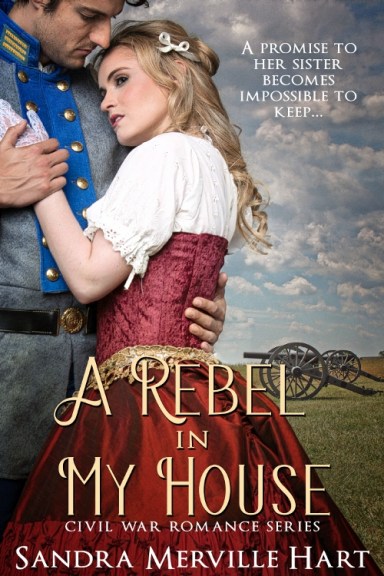
A novel of love and sacrifice, set during one of our nation’s most famous Civil War battles, the Battle of Gettysburg.
Available on Amazon.
I’d love to give my blog readers an opportunity to read the first few pages of my novel. Hope you enjoy the first scene!
Excerpt:
Friday, June 26, 1863
Two miles outside Gettysburg, Pennsylvania
Running feet on the dirt road outside quickened Sarah Hubbard’s heartbeat. Her fingers stiffened on her sewing machine and her back straightened.
Were they coming? Every conversation these days centered on the Confederate soldiers crossing into southern Pennsylvania.
“Miz Hubbard. Miz Hubbard, please let us in!”
Not soldiers but friends. Sarah’s body sagged at Elsie Craig’s voice, but why did she yell? Sarah dropped the gingham dress she’d been sewing and ran to throw open the front door. Alarmed at the fear lining Elsie’s dark face and eyes as she clutched the hand of her four-year-old daughter, Mae, Sarah scanned the horizon for Confederate soldiers. “Hurry inside.”
Elsie needed no second bidding. She guided Mae over the threshold and closed the door. “Miz Hubbard, you gotta hide us.” Her tall, thin body leaned against the door. “The Rebs are in town gathering up all the colored folks they can find. Someone said they’ll be taking them south as slaves and that they’re warning folks not to hide us.”
Sarah gasped. “Why do such a terrible thing?”
“Don’t make sense, does it? Some of us have lived in Gettysburg for years. Others like me have always been free, but it don’t seem to matter to the Southern army.” A long loaf of bread peeked out among jars and clothing in a well-laden basket Elsie set on the rug. She dropped to her knees and wrapped her arms around her trembling child. “I had to leave my house and most of my possessions, but I’ve got the most important thing right here.” She looked up at Sarah as she patted Mae’s shoulder. “Last week my Sam left for Pine Hill, the settlement up near Biglerville. With it being two miles off the main road to Carlisle, the Rebs won’t find him there. Sam never expected the army to come after women and children or he’d never have left us. I miss him something fierce. We’ll go to him when the soldiers get out of town.”
Tears etched tracks in a smudge on Mae’s cheek, tugging at Sarah’s heart as much as Elsie’s wide eyes and trembling hands. Sarah rushed to an open window and pushed aside the curtain a few inches. The Pennsylvania governor, Andrew Curtin, had declared a state of emergency two weeks earlier and called for local militia. Where was their help?
Birds chirped. A rooster crowed. The familiar rush of water on Willoughby Run, a nearby creek, didn’t need to drown out marching footsteps. No soldiers appeared on the country lane outside her white clapboard home beside the woods. Despite the calm view outside her window, Sarah shivered as if standing in a cold draft. How could two women and a child protect themselves from soldiers?
Elsie peeked around Sarah’s shoulder. “Can we hide here?”
“Of course.” She strove for a confident tone despite her shaky legs. “But where? My sister’s horse is in the barn. They will certainly search there.”
“Rebs are buying up livestock, so Mrs. Burke’s horse ain’t safe neither.” The pretty young mother’s gaze darted across the sparse room where two chairs and a drop-leaf table rested against the inner wall. A blue dress adorned the wall near the fireplace. She glanced toward the narrow wooden stairs that led to a loft bedroom. “The garret is the first place they’ll look.” She rubbed her shoe against a faded brown rug. “Does this rug cover a cellar door?”
“No, the opening is in the kitchen.” Sarah indicated the doorway with a shrug of her shoulder.
Elsie tugged Mae’s hand, and the little girl followed her through the opening.
Sarah joined them in the room that served as her kitchen and the sewing room. “There.” She pointed to the three-foot by four-foot wooden hatch that lay flush with the floor between the table and the large black stove. Her sewing machine table and chair sat close to the room’s lone window.
“Is the cellar big enough for us to hide there?”
“Yes. It covers the length of this room and extends into the yard.” Sarah lifted the door to reveal a ladder leading to a dark space below. She knew the location of each jar and can that lined the shelves just out of view along with flour-filled cotton sacks. Most of the meat lay deep in the ash pile behind the house, buried there when the Southern Army crossed the Mason-Dixon. The bulk of her precious fabric, wrapped in India rubber to protect it from the ashes, hid beside the meat.
Elsie stared at the ladder before raising her gaze to Sarah’s. “If you cover the door with the rug from the main room and move your sewing machine table on top, no one will know the cellar exists.”
“Good idea.” Sarah covered her mouth with her hand. What would the soldiers do to her if they discovered Elsie and her daughter hiding in her cellar? Send her to a Southern prison? She could only guess at their reaction. Not that it changed anything. She straightened her shoulders. Elsie had become a friend during the two years she worked for Sarah’s sister. She’d not abandon her now. “I will do it.”
Elsie’s tense face relaxed into a grateful smile. “Thank the Lord for you, Miz Hubbard.”
“I’m happy you came to me.” She enveloped her and Mae in a quick hug.
“Don’t tell no one we’re here.” Pride fought with dependence in her eyes. “There’s some loyal to the South who’d turn us in, some you might not expect. There’s others who just don’t consider what they say or do like they should.”
Sarah stared at her and wondered if Martha Burke, her only sibling and Elsie’s former employer, fit the latter group. “I promise. No one will know the two of you are here.”
Elsie pressed a palm to her heart. “We’re safe then, Mae. We’ll get below as quick as we can.”
“You’ll need your food for traveling to Sam. Take a loaf of bread and jelly down with you.” She gestured to three fresh loaves covered with a cloth. “No telling how long it will take the soldiers to come or if they will find my house. You may be there a few hours.”
Elsie carried her things down the ladder along with a lantern and matches. Everything was in the cellar by the time Sarah finished slicing a loaf of bread.
The ladies rolled up the heavy rug and toted it to the kitchen, and Sarah concealed the cellar door after her guests descended the ladder. Her hands then shook so badly that it took five minutes to shift the sewing machine table into place. Sweeping up the dust left behind by the rug took another several minutes.
She stepped back to survey the room. Elsie’s plan was a good one. Only frequent visitors would know a cellar nestled beneath the rug.
After a month of agonizing worry, Rebels were in Gettysburg. There had been so much conjecture about Southerners coming north—her worst nightmares were realized. She fought the impulse to close the windows and hide in the garret. Figuring soldiers would find closed windows a strange sight in the late June heat, she kept them open. Even though Elsie and her daughter were safely hidden, Sarah’s stomach continued to churn in fear for them—for herself. And how was she to save her sister’s horse? She drank a dipper of lukewarm water from a bucket. She should draw another bucket for Belle.
Oh no. Belle. Elsie said that Confederates wanted livestock. How had she forgotten the danger to her sister’s horse? Martha usually stabled it with a blacksmith in town but had moved the mare to Sarah’s barn when news came that Confederates approached Pennsylvania. Both sisters agreed that Sarah’s home, a couple of miles outside Gettysburg, was less likely to draw attention from soldiers.
Now Rebels might come to her home. Martha would be angry if they took her horse, but there wasn’t anyplace to hide the chestnut mare. She couldn’t leave with Elsie and Mae in the cellar and didn’t ride anyway. Her neighbors’ barns were just as vulnerable as hers.
Movement outside the window caught her eye. Six men in gray and one in butternut strode down the hill toward her home, a cloud of dust in their wake. Her chest tightened at the muskets in their hands. Two horses trailed after them. A sorrel mare, saddled and dusty as if someone had been riding it, resembled a neighbor’s.
She returned to her sewing machine to try to appear normal. Her heart hammered with fear as she fastened her gaze on her fabric. The footsteps grew louder.
Someone pounded on her wooden door. “Open up!”
“Coming!” She whispered a prayer for Elsie and Mae’s safety while scurrying to the door, fearing they’d kick it down if she tarried.
Her pulse raced at the sight of bearded Southern soldiers on her porch. Her gaze drank in their tattered, dirty clothing. Two were barefoot. Another had tied the holey remains of his shoes onto his feet with string. After lonely nights of worry, the feared enemy was at her very doorstep—with Elsie and Mae relying on her protection. Somehow, that knowledge strengthened her.
She tilted her chin. “Good day, gentlemen.” Perhaps treating them courteously would incline them to extend the same to her.
The oldest man, perhaps in his late thirties, tipped his gray kepi at her. “Howdy, Miss …”
A deep breath did nothing to calm her nerves. “Sarah Hubbard.”
“Miss Hubbard.” He inclined his head. “I’m Sergeant Willis. We’ve come to purchase all your extra food.”
“There is none for sale, Sergeant Willis. Thank you for stopping by.” She stepped back to close the door, but he blocked it with his foot. She gasped at the threatening behavior.
His steely gaze demanded her compliance. “I’m afraid I’ll have to insist, miss.” One soldier elbowed the door open wider. “You see, our soldiers are hungry.”
Clutching her throat, Sarah retreated back into her front room. If only her sister hadn’t insisted on keeping their mother’s dog in town. These men wouldn’t dare treat her disrespectfully with Butch growling at them. Then again, they might have shot her protective pet. Her mouth went dry. As matters stood, she faced the Rebels alone.
The sergeant sniffed the air. “Aw. You baked bread today.”
Her heart leaped to her throat as she thought of the loaf she’d given Elsie. Then she remembered two loaves remained above. She led the way to the kitchen on trembling legs. “Yes, I baked bread this morning.” Keeping a cordial tone might save her. “Would you like a slice?”
“We’ll take both loaves.” His gaze scoured both rooms from the doorway that separated them, then he nodded to two men in the back of the group. “Check the loft.”
Her deceased parents’ possessions were stored in Sarah’s old garret bedroom. She pressed her palms to her cheeks as the men ascended the stairs. Surely the trunk stuffed with old books, letters, and clothing didn’t interest these men. Her mother’s locket, wrapped in an embroidered handkerchief, lay tucked inside the folds of an old dress. They couldn’t justify taking that.
Sergeant Willis’ gaze traveled the room. “You got preserves?”
She closed her eyes, grateful that she had a stocked cupboard on the main floor. The officer didn’t have to know that most jars and cans lined the cellar shelves. She opened the cupboard beside the kitchen window. “I have blackberry jam.” She picked up a quart jar. “And this one is apple jelly.”
Two soldiers nudged closely enough that she backed away from their sweaty bodies. The youngest took the jar from her unresisting hand. “We’ll take everything on the shelf.”
Her mouth fell open at their brashness. Did they truly intend to take every morsel they discovered? For all they knew, all the food she possessed sat on these shelves. “What will I eat? Leave me something.” A glance at the unsympathetic faces around the room made her wish she didn’t face them alone.
One snatched the last corn muffin from a basket on the table. Crumbs slid down his shirt as he crammed it into his mouth.
“We’ll pay for the grub, Miss Hubbard,” Sergeant Willis said. “Confederate currency.”
“That money is not good here.”
He grinned. “It soon will be, but we can write a receipt if you prefer.”
She lifted her chin. Receipts were likely even more worthless. “I choose the currency.”
He laughed. “This one’s got spirit. Currency it is. You got any milk? Butter?”
“I’m hungry for eggs,” a pimply-faced soldier in back piped up. He cradled both loaves of bread in his arms along with his musket.
Hope rose at an opportunity to get them out of her home. “There’s a crock of butter, an egg basket, and a milk urn in the springhouse on the creek over there, Willoughby Run. I share it with a neighbor so I will show you which containers are mine.” She sidled past the men to the open front door, hoping they’d follow. There was not a peep from the cellar—not that anyone would have heard with the soldiers’ heavy tread as they searched the house.
“That won’t be necessary. We’ll need all of it.” The sergeant nodded to two fellows near the door.
As they stepped outside, the two soldiers made a strange call that reminded Sarah of a coyote. It sent shivers down her back.
“Hey, Sarge.” A bearded soldier of perhaps twenty poked his head over the loft opening. “Found a man’s clothes and a pair of boots in a trunk up here. You want ’em?”
“No.” Her body tensed at her father’s last remaining personal possessions in the soldier’s grubby hands. “Please don’t take them.”
The sergeant raised his eyebrows. “Miss Hubbard, you don’t have a father or brother in the Union Army, do you?”
She shook her head, thankful beyond words that he didn’t ask about a brother-in-law. “I want to keep the clothes as they belonged to my father. He died before the war.”
“Then he won’t need them anymore, will he?” He looked up at the loft. “We’ll buy them, Billy.”
The back of her neck turned hot. Her father hadn’t wanted a divided country, but they took his clothes anyway. At least they didn’t want the locket. The soldiers’ tattered clothing proved their need of the coats, blouses, trousers, and undergarments. Afraid of angering them with further protests, Sarah clamped her mouth shut.
“The boots are mine.” The man with shoes tied to his feet pulled a knife from his knapsack and cut the strings. He laughed when the shoes fell apart on the floor. “Won’t be needing these no more.”
The sergeant grinned and then turned to Sarah. “You got any cows? Chickens?”
There was no mention of a horse. She shook her head. “A neighboring family provides milk and eggs in exchange for seamstress work.”
“Don’t lie to us, miss.” His brow furrowed. “It won’t go well for you.”
She wished she could lie to the men robbing her. As it was, her inability to keep secrets placed her friends in danger. Please, God, don’t let him ask about Elsie and Mae. I can’t protect the horse, but I must protect them. “That’s the truth. There are no cows or chickens.” Her hands twisted into her apron.
The officer tilted his head as he considered her. “Check the barn.”
Her head jerked. “Please, leave the horse be. It doesn’t belong to me.”
“Ah, so you have a horse.” His eyes gleamed.
Four of the soldiers whooped uproariously and bolted from the house.
Her heart sank. “No, it belongs to my sister.”
“We’ll write a receipt for it.”
That made sense since livestock cost more than food and clothing. She met his gaze squarely. “A receipt for the horse. Currency for everything else.” The Southerners had won most of the recent battles and had now crossed the border. It might not hurt to have some Confederate money.
He inclined his head. “Agreed.”
Two soldiers had filled her best basket with the contents of her cupboard. They carried it outside, leaving Sarah alone with Sergeant Willis. He sat on a chair at the kitchen table, scraping the legs against the floor, then wrote on a scrap of paper.
Directly over the cellar.
Her every muscle tensed as his pencil scratched across the paper. If only they’d leave before any noises came from below. Each moment stretched to the breaking point. Every nerve screamed for relief as the officer counted his currency.
The sergeant stood and gave her the receipt along with a few bills. “It’s a pleasure doing business with you.”
Anger shot through her. They’d taken her food and worse, her father’s clothing. Taking Belle would infuriate her sister, who had been as jumpy as a frog since the war began. This man didn’t care if his actions deepened the wedge between her and her sister. He hadn’t given her a choice but he had paid her. It wouldn’t do to annoy him. She clamped her mouth shut and followed him to the porch.
Belle neighed when the men led her from the yard and headed west.
A receipt wouldn’t compensate her sister’s loss of a mare. She crushed the receipt in her fist.
The Confederates splashed through Willoughby Run and out of sight.
Sarah went back inside and slipped the front door lock into place with trembling fingers. She glanced at the money in her hand—four dollars for food that would have fed her for a month— then scurried to her bedroom and raised the loose floorboard under the bed. The bills went inside the cup of money hidden there. She smoothed the crumpled receipt and slipped the paper into her apron pocket to give to her sister. Her encounter with Southern soldiers could have been worse. Her misfortune didn’t compare to Martha’s. And certainly not Elsie’s. And they were all alive and unharmed.
Once the Southerners were out of earshot, she lifted the cellar door a few inches. “They left. You are safe.”
Mae covered her little face with her hands.
“I’ll praise the Lord from down here, Miz Hubbard.” Elsie’s voice trembled. “I heard them soldiers talking. Me and Mae will stay put.”
“I believe that is the wisest course in case more soldiers come.” She shuddered as she lowered the door. The food from her cupboard was gone. If others came, what would she give them? Her face tightened. Not her mother’s locket, that was certain. She climbed the garret stairs to fish out the necklace.
Only when the delicate metal with her parents’ portraits painted inside lay tucked beneath the high collar of her brown dress did her shoulders relax.




 Sandra Merville Hart