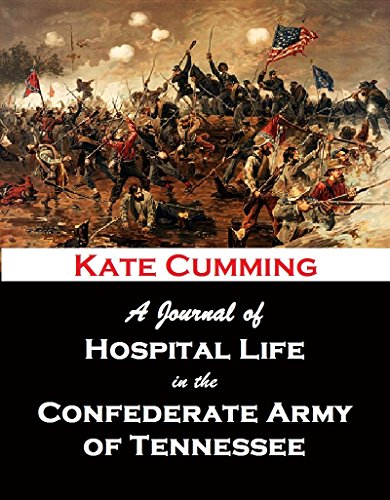
Civil War Women: Kate Cumming, Confederate Nurse and Diarist

In the 1840s, Kate Cumming’s family emigrated from Scotland when she was a child, eventually settling in Mobile, Alabama.

Her mother and two sisters went to England when the Civil War started. Kate stayed in Mobile with her father. Her younger brother enlisted in the 21st Alabama Infantry as part of Ketchum’s Battery. Kate gathered hospital supplies to support wounded soldiers.

In 1862, Reverend Benjamin M. Miller’s speech encouraging women to serve in the hospitals stirred Kate. Inspired by this speech and Florence Nightingale’s example, Kate joined forty other women in Corinth, Mississippi, to nurse Battle of Shiloh wounded—despite her family’s objections.

She briefly returned home that summer yet yearned to continue nursing the soldiers. She traveled to Chattanooga with two other women to volunteer at Newsome Hospital. Her nursing help was eventually accepted.

In September of 1862, the Confederate government began allowing nurses to be paid. Kate enlisted in the Confederate Army Medical Department. Despite her personal sadness at watching soldiers die and battling poor hospital conditions, she worked as matron with Dr. Samuel Stout, medical director for Army of Tennessee, in various locations in Alabama, Tennessee, and Georgia.

As a matron, Kate managed hospital departments, nursed soldiers, foraged for supplies, cooked, sewed, wrote letters, and supervised other workers.

She also maintained a detailed diary. This honest account of day-to-day nursing tasks and the men she served also shows tragedies Southerners faced in increasing measure as the war progressed.

After the war, Kate published her diary, A Journal of Hospital Life in the Confederate Army of Tennessee from the Battle of Shiloh to the End of the War: With Sketches of Life and Character, and Brief Notices of Current Events During that Period.

The author’s introduction was written in 1865—before publication. Kate is bitter about treatment from the North after the war’s end and urges all to unite. Her hope in publishing her diaries is to show Northerners how all have suffered. She wants reconciliation.

-Sandra Merville Hart

Sources

Cumming, Kate. Edited by Harwell, Richard Barksdale. Kate: The Journal of a Confederate Nurse, Louisiana State University Press, 1959.

Hilde, Libra. “Kate Cumming,” Encyclopedia of Alabama, 2019/04/11 http://www.encyclopediaofalabama.org/article/h-1101.

“Kate Cumming,” National Park Service, 2019/04/11 ttps://www.nps.gov/people/kate-cumming.htm.

“Kate Cumming,” Wikipedia, 2019/04/11 ttps://en.wikipedia.org/wiki/Kate_Cumming.

Rohrer, Katherine E. “Kate Cumming (ca. 1830-1909).” New Georgia Encyclopedia. 08 June 2017. Web. 11 April 2019.


 

Civil War Women: Sarah Morgan Dawson, Confederate Diarist

Sarah Morgan Dawson was twenty when she began writing in her diary on March 9, 1862. The Civil War raged near her family’s home in Baton Rouge, Louisiana. Her family had already known hard times. In 1861, illness claimed her father’s life and a duel claimed a brother’s life.

War threatened to divide her family. Three brothers fought for the Confederacy and another, though he sided with the Union, refused to fight against his brothers.

Baton Rouge fell into Union hands. Most citizens ran for their lives, including Sarah’s family. She returned a few times to gather possessions from her home, but found that the Union soldiers who occupied the city had ransacked it. The home was unrecognizable on her last trip—the soldiers had plundered valuables and destroyed what they left behind. Sarah didn’t return to her childhood home until after the war.

Made homeless by the war, her family wandered from Baton Rouge, staying with friends and strangers.

Food supplies dwindled. Sarah had money to purchase food yet some places had none for sale.

They stayed near the Confederate army, making friends with many soldiers. Sarah did all she could to help them. Her family had escaped with few clothes … and everyone else was in the same predicament.

A serious buggy accident injured Sarah’s back. The injury prevented her from walking more than a few steps. She clung to her faith throughout the difficulties that mounted almost daily.

Her Union-sympathizer brother urged them to stay with him in New Orleans, which was now under Union control. They had little choice. A hard train ride and then a schooner took them to New Orleans.

Upon their arrival, they had to take an oath of allegiance to the Union. A Southerner at heart, taking the oath broke Sarah’s spirit. Even worse, Sarah’s mother complained so passionately to the Union soldiers of all she’d suffered at their hands that she was almost arrested. Sarah’s brother smoothed things over and took them into his home.

At the beginning of 1864, Sarah’s heart broke to discover that two of her brothers died. They’d lost so much to the war that she hated the Union.

General Lee surrendered on April 9, 1865. Sarah’s diary entries stopped on June 15, 1865.

It was published and inscribed: “To those who endured and forgave”.

Sarah read her diary many years later and wanted people to know that through it all, God never failed her. “Whatever the anguish, whatever the extremity, in His own good time He ever delivered me. So that I bless Him to-day for all of life’s joys and sorrows—for all He gave—for all He has taken—and I bear witness that it was all Very Good.” –Sarah Morgan Dawson, July 23rd, 1896, Charleston, South Carolina.

-Sandra Merville Hart

Sources

Dawson, Sarah Morgan. A Confederate Girl’s Diary: Civil War Centennial Series, Indiana University Press, 1960.


Co. “Aytch” First Tennessee Regiment by Sam R. Watkins

Subtitles: Maury Grays, First Tennessee Regiment

A Side Show of the Big Show

Sam Watkins was a private in Company H (Company “Aytch”) of the First Tennessee Regiment. On May 11, 1861, this Confederate soldier left Nashville with his regiment and was still in the army when General Joe Johnston surrendered on April 26, 1865.

What sights he saw.

Sam didn’t write a history of the war. Instead he records anecdotes and experiences of life as a Confederate soldier. He speaks honestly of the horrors he experienced in battles, as part of General Braxton Bragg’s army, and in witnessing his comrades’ deaths.

He often remarks that “abler pens than mine” could do the story better justice. Sam, you did well. Readers like me felt your pain across the years. I felt the terror you must have endured when General Bragg ordered a reserve line to stand behind the fighting line and shoot anyone who ran away.

I felt your pride when a young woman invited “a tattered soldier” to supper and accepted your arm in escort.

I felt your gut-wrenching sadness to see your army decimated.

You showed that a general can resign with honor but when privates resign it is considered desertion.

Sam intended to include additional notes in a second printing of the book, but seems to have been unable to raise enough to fund the publishing costs. His great-granddaughter, Ruth Hill Fulton McAllister, included his notes in this edition. I love the poem included in the appendix—“A Land Without Ruins” written by Father Abram Joseph Ryan, the poet laureate of the Confederacy. Here’s a quote from the last stanza:

For out of the gloom future brightness is born,

        As after the night looms the sunrise of morn;

        And the graves of the dead, with the grass overgrown,

        May yet form the footstool of Liberty’s throne,

        And each single wreck in the war-path of Might,

        Shall yet be a rock in the temple of Right!”

An insightful look into the everyday life and thoughts of a Confederate soldier. Great book for lovers of the Civil War and American History.

-Sandra Merville Hart