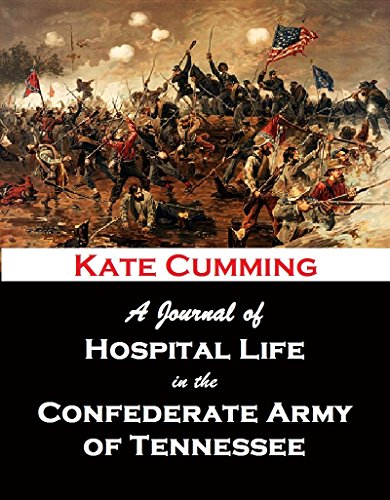
Civil War Women: Kate Cumming, Confederate Nurse and Diarist

In the 1840s, Kate Cumming’s family emigrated from Scotland when she was a child, eventually settling in Mobile, Alabama.

Her mother and two sisters went to England when the Civil War started. Kate stayed in Mobile with her father. Her younger brother enlisted in the 21st Alabama Infantry as part of Ketchum’s Battery. Kate gathered hospital supplies to support wounded soldiers.

In 1862, Reverend Benjamin M. Miller’s speech encouraging women to serve in the hospitals stirred Kate. Inspired by this speech and Florence Nightingale’s example, Kate joined forty other women in Corinth, Mississippi, to nurse Battle of Shiloh wounded—despite her family’s objections.

She briefly returned home that summer yet yearned to continue nursing the soldiers. She traveled to Chattanooga with two other women to volunteer at Newsome Hospital. Her nursing help was eventually accepted.

In September of 1862, the Confederate government began allowing nurses to be paid. Kate enlisted in the Confederate Army Medical Department. Despite her personal sadness at watching soldiers die and battling poor hospital conditions, she worked as matron with Dr. Samuel Stout, medical director for Army of Tennessee, in various locations in Alabama, Tennessee, and Georgia.

As a matron, Kate managed hospital departments, nursed soldiers, foraged for supplies, cooked, sewed, wrote letters, and supervised other workers.

She also maintained a detailed diary. This honest account of day-to-day nursing tasks and the men she served also shows tragedies Southerners faced in increasing measure as the war progressed.

After the war, Kate published her diary, A Journal of Hospital Life in the Confederate Army of Tennessee from the Battle of Shiloh to the End of the War: With Sketches of Life and Character, and Brief Notices of Current Events During that Period.

The author’s introduction was written in 1865—before publication. Kate is bitter about treatment from the North after the war’s end and urges all to unite. Her hope in publishing her diaries is to show Northerners how all have suffered. She wants reconciliation.

-Sandra Merville Hart

Sources

Cumming, Kate. Edited by Harwell, Richard Barksdale. Kate: The Journal of a Confederate Nurse, Louisiana State University Press, 1959.

Hilde, Libra. “Kate Cumming,” Encyclopedia of Alabama, 2019/04/11 http://www.encyclopediaofalabama.org/article/h-1101.

“Kate Cumming,” National Park Service, 2019/04/11 ttps://www.nps.gov/people/kate-cumming.htm.

“Kate Cumming,” Wikipedia, 2019/04/11 ttps://en.wikipedia.org/wiki/Kate_Cumming.

Rohrer, Katherine E. “Kate Cumming (ca. 1830-1909).” New Georgia Encyclopedia. 08 June 2017. Web. 11 April 2019.

 

Civil War Women: Sister Anthony, Angel of the Battlefield

Mary O’Connell’s family emigrated to Boston from Ireland in 1821 when she was about seven-years-old. After joining the Sisters of Charity, she became known as Sister Anthony.

In 1837, she began working at St. Peter’s Orphan Asylum and School for girls in Cincinnati. Later she was given charge of a new hospital, St. John’s Hotel for Invalids.

Camp Dennison, a Civil War training camp about fifteen miles from Cincinnati, required nurses for sick soldiers after the war began. Sister Anthony and five other nuns rode the train and then walked two to three miles to visit the regimental hospitals every day. To save this daily expense, the sisters stayed at a small wooden church near camp.

Requests for nurses prompted Sister Anthony and others to care for wounded on a hospital ship with Dr. George Curtis Blackman at the Battle of Shiloh. Dead and dying soldiers filled the decks. One overcrowded ship had seven hundred patients.

Because the sisters didn’t give preferential treatment, they were asked to care for wounded prisoners.

Sister Anthony helped bring wounded soldiers from the battlefield. She is credited with developing Battlefield Triage, earning President Lincoln’s praise.

After caring for wounded at Shiloh, she became known as the “Angel of the Battlefield.” Sister Anthony served at several battlefields, including Nashville, Cumberland Gap, Richmond, Lynchburg, and Culpeper Court House.

She didn’t distinguish between Union and Confederate soldiers. She knew generals on both sides and was acquainted with Confederate President Jefferson Davis.

Joseph C. Butler and Louis Worthington gave a large Cincinnati building at Sixth and Lock Street to Sister Anthony in 1866. The hospital, meant to honor her and the other sisters’ war service, had two stipulations: exclude no one because of religion or color and they were to name it “The Hospital of the Good Samaritan.”

St. Joseph Foundling and Maternity Hospital opened later that year. It’s not clear why the name changed.

-Sandra Merville Hart

Sources

“Battle Nurses,” Newspapers.com, 2019/03/30 https://www.newspapers.com/clip/18267260/civil_war_nurses_catholic_sisters_in/.

Graves, Dan, MSL. “Sister Anthony, Battlefield Heroine,” Christianity.com, 2019/03/30 https://www.christianity.com/church/church-history/timeline/1801-1900/sister-anthony-battlefield-heroine-11630652.html.

“Mary O’Connell,” Wikipedia, 2019/03/30 https://en.wikipedia.org/wiki/Mary_O%27Connell.

Wimberg, Robert J. Cincinnati and the Civil War: Off to Battle, Ohio Book Store, 1992.


Civil War Women: Susie King Taylor, Union Nurse and Teacher

Born into slavery in Georgia in 1848, Susie Baker lived with her grandmother in Savannah after turning seven. She and her younger sister and brother secretly attended school taught by black women.

In April of 1862, the Civil War had been going on for a year when Susie accompanied her uncle to Saint Catherine Island, seeking protection from the Union fleet there. They were taken, two weeks later, to Saint Simons Island. About 600 black men, women, and children lived there.

Susie received two large boxes of books and Bibles from the North. She used these to teach about 40 children on the island, making her the first black teacher in Georgia for free African American students. Several adults came to her in the evenings to learn how to read.

She married Edward King, a black noncommissioned Union officer, while on St. Simons Island.

Cases of varioloid (a form of smallpox) broke out among the soldiers. One soldier had to be quarantined in his tent with only his doctor allowed to see him. Having been vaccinated, Susie nursed him daily. She also faithfully drank sassafras tea, believing this kept her blood clean.

After the island was evacuated in October of 1862, Susie traveled with her husband and brothers’ regiment. She nursed the wounded, laundered clothes, and taught many black soldiers to read.

Shrapnel, bullets, and cannon balls wreak havoc on the human body. Susie’s compassionate heart allowed her to look past the gruesome wounds as she sought to relieve the men’s suffering. She bound wounds and gave water to the parched men, alleviating pain as much as she was able.

After the war, she and her husband returned to Savannah. She started a school for freed children. In 1866, Edward died before their first child was born. Susie had started two more schools by 1868.

A job as a domestic servant took her to Boston, where she met and married Russell Taylor.

Susie didn’t forget the soldiers. She helped organize Corps 67, a chapter of the Women’s Relief Corps, and served as President, Secretary, Treasurer, and Guard of this corps.

-Sandra Merville Hart

Sources

Butchart, Ronald E. “Susie King Taylor (1848-1912),” Georgia Encyclopedia, 2019/03/30 https://www.georgiaencyclopedia.org/articles/history-archaeology/susie-king-taylor-1848-1912.


Lardas, Mark. African American Soldier in the Civil War: USCT 1862-66, Osprey Publishing Ltd., 2006.


Taylor, Susie King. Edited by Malone, Margaret Gay. In My Own Words: The Diary of Susie King Taylor, Civil War Nurse, Benchmark Books, 2004.


Civil War Women: Harriet Tubman, Union Spy

Born into slavery on a Maryland plantation, Araminta Ross’s parents nicknamed her “Minty.” Minty later took her mother’s name, Harriet, to honor her.

At age twelve, she stepped between an overseer throwing a heavy object at a fugitive slave. It struck Harriet instead, breaking her skull. The injury caused headaches and narcolepsy that lasted all her life. She fell deeply asleep at random.

She married a free black man, John Tubman, around 1844.

Learning that she and two of her brothers were about to be sold, they escaped on September 17, 1849. Her brothers returned to the plantation, but Harriet pushed on, following safe houses on the Underground Railroad. She walked about 90 miles to freedom in Pennsylvania. Over the next few years, she rescued about 70 people, including her parents and other family members. Her husband had remarried and chose to stay in Maryland.

When the Civil War began, Harriet worked as cook, nurse, and laundress at Fort Monroe, Virginia. She assisted fugitive slaves there.

In May of 1862, soldiers and fugitives were dying of diseases when she arrived in Port Royal, South Carolina. Her knowledge of local roots helped significantly in treating their illnesses.

In 1863, Harriet, reporting directly to General David Hunter and General Rufus Saxton, commanded a team of espionage scouts searching for escape routes for slaves.

She found warehouses and ammunition and reported the locations to Colonel James Montgomery.

Late on June 2, 1863, Harriet led 150 black men, soldiers of 2nd South Carolina Battalion, on the Combahee River Raid. The surprise attack freed over 750 slaves.

After the war ended, Harriet and her family settled in Auburn, New York, and she continued to help folks in need.

-Sandra Merville Hart

Sources

Biography.com Editors. “Harriet Tubman,” A&E Television Networks, 2019/03/30 https://www.biography.com/people/harriet-tubman-9511430.

“Harriet Tubman,” History.com, 2019/03/30 https://www.history.com/topics/black-history/harriet-tubman.

“Role in the Civil War,” Harriet Tubman Historical Society, 2019/03/30 http://www.harriet-tubman.org/role-in-the-civil-war/.

The Editors of Encyclopaedia Britannica. “Harriet Tubman: American Abolitionist,” Encyclopaedia Britannica, 2019/03/30 https://www.britannica.com/biography/Harriet-Tubman.