by Sandra Merville Hart
On July 2, 1776, the Second Continental Congress adopted the Declaration of Independence at the Pennsylvania State House (now called Independence Hall) in Philadelphia—but it wasn’t unanimous.
There were many discussions among delegates in the weeks leading up to the adoption. All thirteen colonies sent delegates, but not all were ready to commit treason and risk their lives by voting for independence in May and June of 1776.
In May, the colonies that did not support independence were New York, Maryland, Delaware, New Jersey, and Pennsylvania, where the Continental Congress met.
Richard Henry Lee, a delegate from Virginia, proposed that Congress declare independence from Great Britain, and prepare a possible plan of confederation.
Lee’s resolution was debated. The five colonies still weren’t authorized to vote in favor of independence. Some delegates were so against the resolution in early June that they threatened to leave the Continental Congress if it passed. On June 10th, in light of this opposition, Congress postponed discussions for three weeks.
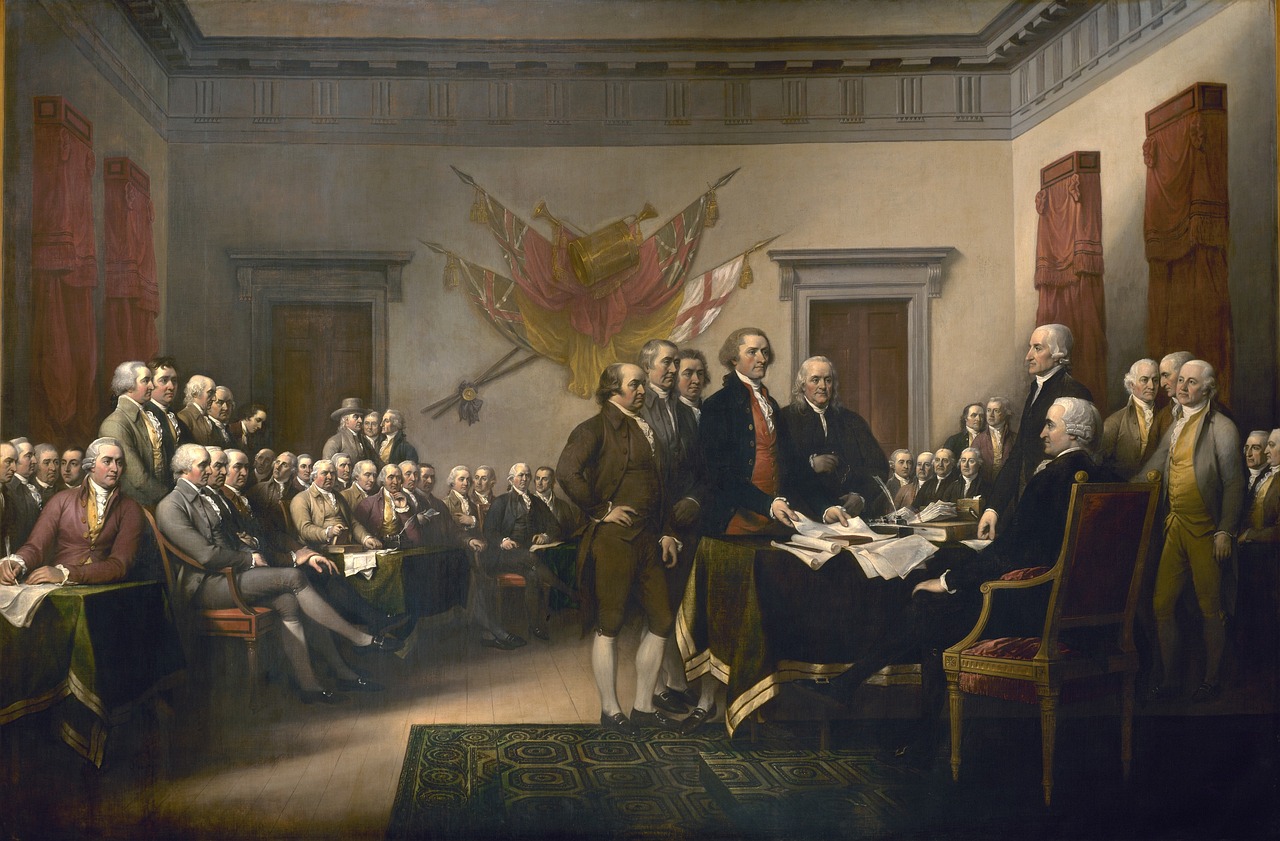
Yet they continued forward in the meantime. A Committee of Five—John Adams of Massachusetts, Thomas Jefferson of Virginia, Benjamin Franklin of Pennsylvania, Roger Sherman of Connecticut, and Robert R. Livingston of New York—were tasked with drafting a declaration on June 11, 1776. Thomas Jefferson wrote the document from June 11th to June 28th. The committee revised it for him to rewrite, and it was given to Congress on June 28th. The delegates edited the declaration for the next two days.
Delegates from Connecticut, New Hampshire, Delaware, and Pennsylvania received authorization from their colonies to vote for independence in mid-June.
That left New York and Maryland.
Samuel Chase, a Maryland delegate, went to the Annapolis Convention to persuade them in favor of independence. It worked. Maryland now supported separating from Great Britain.
Unfortunately, the approach of British troops convinced the New York Provincial Congress’s to evacuate on June 30th, without first authorizing New York’s delegates to vote for independence.
The New York Provincial Congress didn’t meet again until after the Continental Congress voted on July 2, 1776, when twelve colonies voted for independence and one colony, New York, abstained.
Even though the vote was cast on July 2nd, the Continental Congress continued to tweak the declaration’s wording.
Congress was finally satisfied with the Declaration of Independence on July 4, 1776, and it was approved.
As President of the Second Continental Congress, John Hancock signed his name in bold letters on July 4th, to ratify the document. He was the only delegate to sign the Declaration of Independence that day.
The heading of the original July 4th document sent to the printer read: “In Congress, July 4, 1776, A DECLARATION BY THE REPRESENTATIVES OF THE UNITED STATES OF AMERICA IN GENERAL CONGRESS ASSEMBLED.”
The New York delegates weren’t authorized to declare independence until July 10th. Their vote changed from abstention to approval.
On July 19, 1776, the Continental Congress voted to insert the word “unanimous” into the heading. It now reads: “In Congress, July 4, 1776, The unanimous Declaration of the thirteen united States of America,” because of New York’s changed vote.
John Adams, future second President of the United States and Signer of the Declaration, wrote to his wife after the vote for independence passed on July 2, 1776. He predicted that July 2nd would be celebrated by future generations as a great holiday to commemorate our country’s independence.
He envisioned it as a day that would be celebrated with parades, games, shows, bells, sports events, bonfires, guns, and illuminations all across the country.
Adams was right about the celebrations and the holiday. He just got the date wrong.
Happy 250th birthday, America!
Sources
“An Overview of the Declaration of Independence,” National Park Service, 2026/06/24 https://www.nps.gov/inde/learn/education/classrooms/resources-declarationoverview.htm.
Biography.com writers. “John Hancock,” Biography.com, 2026/06/24 https://www.biography.com/political-figures/john-hancock.
“Declaration of Independence: A Transcription,” National Archives America’s Founding Documents, 2026/06/24 https://www.archives.gov/founding-docs/declaration-transcript.
“John Hancock,” Constitution Center, 2026/06/24 https://constitutioncenter.org/signers/john-hancock.
“John Hancock,” National Park Service, 2026/06/24 https://www.nps.gov/people/john-hancock.htm.
“John Hancock,” Wikipedia, 2026/06/24 https://en.wikipedia.org/wiki/John_Hancock.
“John Hancock and His Signature,” National Archives Pieces of History, 2026/06/24 https://prologue.blogs.archives.gov/2019/09/12/john-hancock-and-his-signature/.
“United States Declaration of Independence,” Wikipedia, 2026/06/24 https://en.wikipedia.org/wiki/United_States_Declaration_of_Independence.
 Sandra Merville Hart