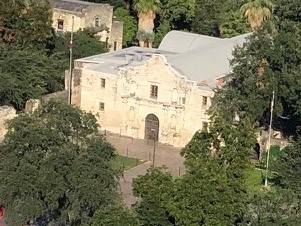
The Alamo, originally Mission San Antonio de Valero, was built as a Spanish mission in the 1700s and later was used by the Spanish as a fort. They called it the “Alamo,” a word for a poplar tree, especially the cottonwood trees growing in the area.
In 1835, the area which is now Texas was under Mexican rule. American pioneers were allowed to own land there if they were Catholic. Some converted to purchase the land yet remained Protestant in practice.
Leading up to this time, Mexico had gained independence from Spain and then changed Presidents several times. President General Antonio Lopez de Santa Anna was the current leader. There was a lot of unrest and Texans wanted their freedom.
Two hundred Texas volunteers attacked Mexican troops in San Antonio de Bexar under General Martin Perfecto de Cos and at the Alamo a quarter mile away on December 5, 1835. Cos surrendered, signing documents that gave all the arms, public property, and money in San Antonio de Bexar to the Texans and left. Some of the Texas volunteers moved into the fort while others went home.
Santa Anna marched his army (historical accounts vary on whether he had 1,500 or 8,000 soldiers) toward the Alamo in retaliation.
Anticipating the coming attack, Lieutenant Colonel William B. Travis and Colonel James Bowie took command of the Alamo by February. Though there was friction between the two leaders, Bowie led the volunteers and Travis commanded the regular army.
Travis sent repeated letters requesting men and supplies. The well-known David Crockett and 14 Tennessee Mounted Volunteers were among the few men who arrived at the Alamo in advance of the battle. By the time Santa Anna’s army began cannon and rifle fire on February 23, 1836, about 180 – 190 men protected the Alamo.
 Texans bravely held their ground for 13 days. At dawn on March 6th, they held off the first two charges by Santa Anna’s army. On the third charge, they went over the walls. Santa Anna’s orders were to take no prisoners. It was hand-to-hand combat but the Texan soldiers, being outnumbered, were killed. There were only a few survivors—a few family members of the soldiers.
There were casualties in the Mexican army. Many historians estimate this number at about 600.
While this was a great tragedy, the battle bought time for Sam Houston’s 800 men to be ready to fight Santa Anna at San Jacinto on April 21, 1836, where they captured Santa Anna and defeated his army. That battle guaranteed the independence of Texas.
As they fought, Houston’s men shouted, “Remember the Alamo!”
-Sandra Merville Hart
Sources
“Battle of the Alamo,” Wikipedia, 2020/01/03 https://en.wikipedia.org/wiki/Battle_of_the_Alamo.
History.com Editors. “The Alamo,” A&E Television Networks, 2020/01/03 https://www.history.com/topics/Mexico/alamo.
Nelson, Ken. “US History: The Battle of the Alamo for Kids.” Ducksters, Technological Solutions, Inc. (TSI), http://www.ducksters.com/history/us_1800s/battle_of_the_alamo.php. Accessed 3 January 2020.
Paul, Lee. “The Alamo: 13 Days of Glory,” HistoryNet, 2020/01/03 https://www.historynet.com/battle-of-the-alamo.
 Sandra Merville Hart