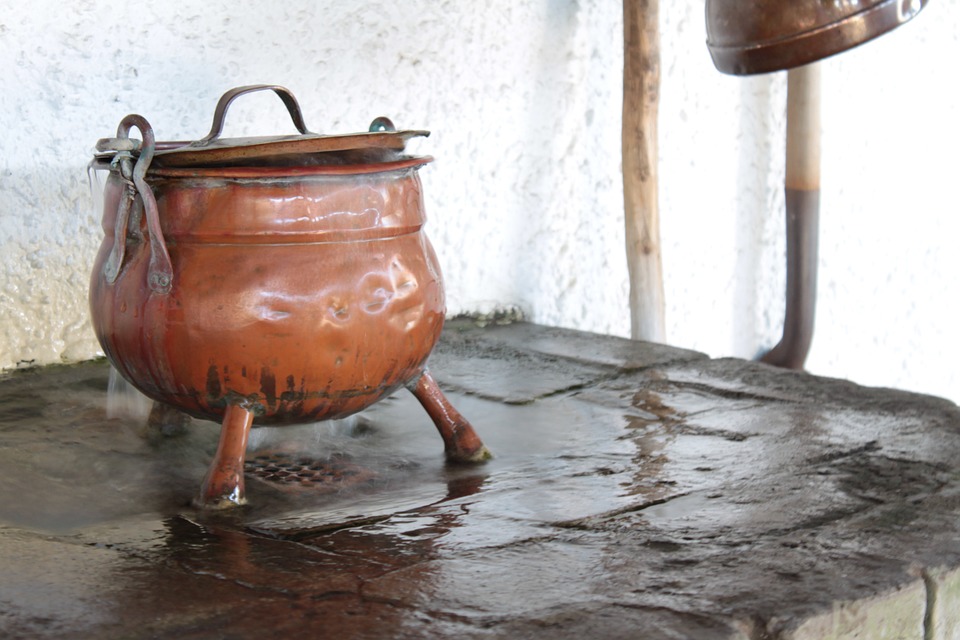
There is a secret to cooking with Dutch ovens over an open fire: properly placed coals control the interior temperature of the oven.
Begin by choosing a Dutch oven with legs for open fire cooking.
Avoid burned or raw sections or dried out foods by using charcoal briquettes or fire coals of that size. Charcoal has the advantage of even burning for longer periods.
Almost all baked goods bake successfully at 350 degrees. Coals must be carefully placed to achieve this temperature.
Consider the diameter of your Dutch oven to find the best number and allow two coals per inch for cooking. You will need the diameter plus two for the lid and two less than the diameter underneath.
For example, fourteen-inch ovens will have 16 coals on the lid (14 + 2) and 12 coals under the oven (14 – 2.)
The placement of the coals is vital to successful cooking. Arrange them in a circle under the oven on the outer rim. Putting them in the middle burns the meal.
It’s also important to arrange the coals evenly around the outer rim of the lid with four coals in the center. Two go on either side of the handle.
This provides and maintains 350 degrees for about two hours.
Adding one coal to the lid and underneath the oven increases the heat to 400.
The size of the oven you buy determines the kind of meal typically cooked inside it. For instance, 8” or 10” Dutch ovens are great for vegetables, desserts, and side dishes. Cook larger roasts, stews, breads, and chicken in 14” ovens.
Happy cooking!
-Sandra Merville Hart
Sources
Beattie, Roger L. “Seven secrets of Dutch oven cooking,” Backwoods Home Magazine, Inc., 2016/05/26 http://www.backwoodshome.com/seven-secrets-of-dutch-oven-cooking/.
“Choosing a Dutch Oven,” Dutchovendude.com, 2016/05/27 http://www.dutchovendude.com/cooking-select-dutch-oven.php.
 Sandra Merville Hart