Civil War Women: Jennie Hodgers as Albert Cashier

Born in Ireland, Jennie Hodgers emigrated to United States as a girl. At her stepfather’s prompting, she dressed as a boy to find a job. Jennie moved to Illinois after her mother died.

Jennie enlisted in the Union army in August of 1862 under the name Albert D. Cashier. Small in stature. Quiet. Sought privacy when bathing. Kept her coat buttoned to the chin to hide a missing Adam’s apple. Still, other soldiers didn’t notice anything unusual about Private Cashier.

Jennie fought courageously in forty battles, narrowly escaping capture at Vicksburg.

She mustered out with her comrades in the 95th Illinois Infantry on August 17, 1865. Jennie then faced a dilemma. She couldn’t read or write and the jobs available to her as a woman would keep her at poverty. Living as a man, she’d work as a laborer. She later began receiving a military pension.

So she lived as Albert Cashier and eventually began working for Illinois State Senator Ira Lish. In 1911, Senator Lish ran over her with his car. With a badly broken leg, she was taken to a doctor … who discovered her long-held secret.

Jennie implored the doctor for his silence. Unwilling to see the veteran lose her pension, he agreed.

Things might have progressed as normal after that—if Jennie’s leg had healed. When it didn’t, Senator Lish placed her to the Soldiers and Sailors Home, a home in Quincy for male veterans. Staff members there kept Jennie’s secret.

Unfortunately, her mental health declined along with her physical health. In 1914, she entered Watertown State Hospital for the Insane. They discovered her sex and forced her to wear dresses again.

Newspapers printed her secret. A charge of defrauding the government by collecting a pension was investigated. Her comrades came to her defense, testifying to her bravery as a soldier. She kept her pension.

Jennie was buried in her soldier’s uniform with the name “Albert D. J. Cashier, Co. G, 95 Ill. Inf.” on her tombstone.

The executor of her estate, W.J. Singleton, spent nine years after her death tracking down her real name.

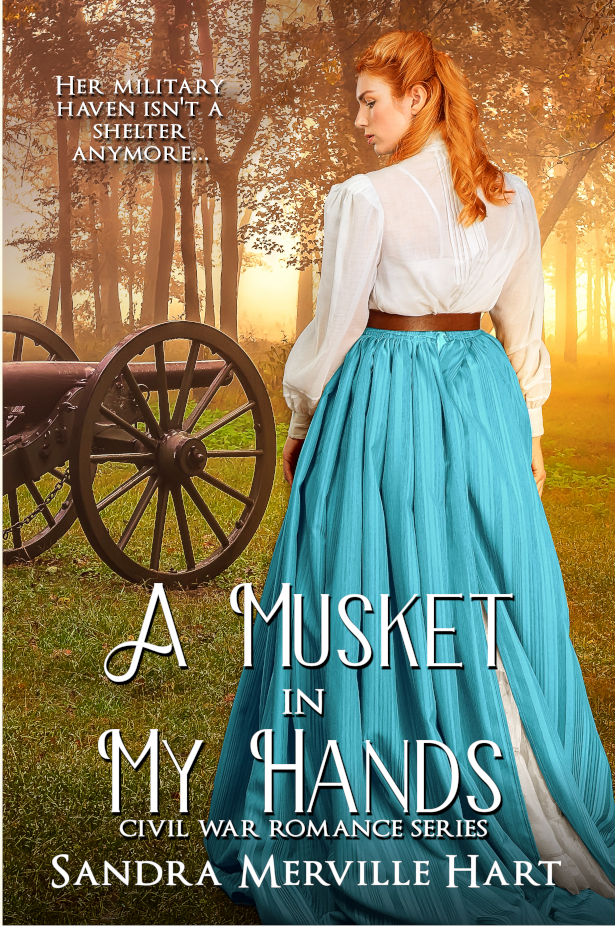
In my Civil War novel, A Musket in My Hands, an ultimatum from their father forces two sisters to disguise themselves as men and muster into the Confederate army in the fall of 1864—just in time for events and long marches to lead them to the tragic Battle of Franklin.

-Sandra Merville Hart

 

Sources

“Albert Cashier,” Wikipedia, 2018/12/10 https://en.wikipedia.org/wiki/Albert_Cashier.

Freedman, Jean R. “Albert Cashier’s Secret,” New York Times, 2018/12/10  https://opinionator.blogs.nytimes.com/2014/01/28/albert-cashiers-secret/.

Massey, Mary Elizabeth. Women in the Civil War, University of Nebraska Press, 1966.


“Jennie Hodgers aka Private Albert Cashier,” National Park Service, 2018/12/10 https://www.nps.gov/articles/jennie-hodgers-aka-private-albert-cashier.htm.



Civil War Women: Sarah Emma Edmonds as Franklin Thompson

At the age of sixteen in 1857, Sarah Emma Edmondson escaped an arranged marriage and an abusive father. She changed her last name to Edmonds. Emigrating to the United States from New Brunswick, she found a job more easily when disguised as a man, Franklin Thompson. When the war began, she lived in Flint, Michigan. Strong Union views led her to enlist in the 2nd Michigan Infantry as a male field nurse named Franklin Flint Thompson.

Emma nursed her comrades at such battles as the Battle of Antietam. She worked as a hospital attendant. She was also a mail carrier for her regiment, a dangerous job that often required horseback rides of over 100 miles.

A recurrence of malaria struck Emma in the spring of 1863. She requested a furlough, which was denied. Since she dare not visit the army’s medical staff for fear of discovery, she left camp in the middle of the night—Frank Thompson became a deserter.

Emma boarded a train to Oberlin, Ohio, where she recovered in a boarding house as Frank. Then she became a female nurse with the United States Christian Commission, where she served until the war ended. She wrote her memoirs in Nurse and Spy in the Union Army, first published in 1864.

There are no official records of Emma acting as spy for the Union army. She seems to have been talented at disguises. While a spy, she pretended to be Charles Mayberry, a Southern sympathizer; Cuff, a black man; and Bridget O’Shea, an Irish peddler.

After the war, Emma applied for a military pension. An Act of Congress finally cleared Franklin Thompson of desertion and she received the pension in 1884.

In 1897, Emma became the only woman admitted into the Grand Army of the Republic.

Emma left home to escape an arranged marriage, much as one of the sisters faced in my Civil War novel,  A Musket in My Hands. Two sisters disguise themselves as men and muster into the Confederate army in the fall of 1864—just in time for events and long marches to lead them toward the tragic Battle of Franklin.

-Sandra Merville Hart

Sources

Abbott, Karen. Liar, Temptress, Soldier, Spy: Four Women Undercover in the Civil War, Harper, 2014.

Blanton, DeAnne and Cook, Lauren M. They Fought Like Demons, Louisiana State University Press, 2002.

Massey, Mary Elizabeth. Women in the Civil War, University of Nebraska Press, 1966.

“Sarah Emma Edmonds,” Civil War Biography, 2018/12/10 https://www.battlefields.org/learn/biographies/sarah-emma-edmonds.

“Sarah Emma Edmonds,” National Park Service, 2018/12/10 https://www.nps.gov/people/sarah-emma-edmonds.htm.


Civil War Women: Malinda Pritchard Blalock as Sam Blalock

Malinda Pritchard Blalock is one of two women known to have fought for both the Confederacy and the Union during the Civil War. She expressed support for secession before the war started but her husband, William “Keith” McKesson Blalock, was pro-Union. Malinda soon shared his views.

The couple, who lived on Grandfather Mountain in North Carolina, feared Keith would be conscripted into the Southern army. To avoid this, he decided to muster into the Confederate army and then desert to join the Union army. He went with friends to the recruitment office and became part of the 26th North Carolina Regiment, Company F.

Sources disagree here as to whether Malinda signed up as his twenty-year-old brother “Sam Blalock” at the same time or if she disguised herself as a man and surprised him on the march.

The document still exists of her registering as “Samuel ‘Sammy’ Blalock” at Lenoir, North Carolina, on March 20, 1862. Her discharge papers have also survived, documenting a female soldier in the Confederate army.

Unfortunately for Keith and “Sam,” their regiment was stationed at Kinston, North Carolina—not in Virginia where it would be easier to desert.

About a month after they enlisted, Keith’s squad was given a night mission to find a particular Northern regiment. Skirmishing broke out and Malinda was shot in the shoulder. The surgeon who removed the bullet also discovered her identity. She was discharged.

Frantic that her secret was out, Keith found a patch of poison oak in the forest. Discarding his clothes, he rolled around in it and then returned to camp. By morning, a red rash covered his skin. Surgeons gave him a medical release. Malinda confessed that she was his wife and they left together.

Once Confederate forces learned that Keith had recovered they ordered him to return to his regiment. The Blalocks fled to Grandfather Mountain, finding other deserters there. They stayed with this group until Confederate troops found them.

The couple escaped to east Tennessee. Malinda pretended to be Sam again when they joined the 10th Michigan Cavalry. She served as Keith’s aide-de-camp.

Malinda, now pregnant, left the regiment to have her baby son in Knoxville. She rejoined her regiment two weeks later.

Keith and Malinda later joined Union Colonel Kirk’s voluntary guerrilla squadrons on scouting and raiding missions in North Carolina.

In my Civil War novel,  A Musket in My Hands, an ultimatum from their father forces two sisters to disguise themselves as men and muster into the Confederate army in the fall of 1864—just in time for events and long marches to lead them to the tragic Battle of Franklin.

-Sandra Merville Hart

Sources

Blanton, DeAnne and Cook, Lauren M. They Fought Like Demons, Louisiana State University Press, 2002.

“Malinda Blalock,” Wikipedia.com, 2018/12/10 https://en.wikipedia.org/wiki/Malinda_Blalock.

“Malinda Pritchard Blalock,” Rootsweb.com, 2018/12/10 http://sites.rootsweb.com/~ncmitche/sam.html.

Silvey, Ania. I’ll Pass for Your Comrade: Women Soldiers in the Civil War, Clarion Books, 2008.

Slappey, Kellie. “Sarah Malinda Pritchard Blalock (1839-1903),” North Carolina History, 2018/12/10 http://northcarolinahistory.org/encyclopedia/sarah-malinda-pritchard-blalock-1839-1903/.


Civil War Women: Mary Ann Clark as Henry Clark

Mary Ann Clark’s marriage hadn’t been easy. Her husband deserted her and her two children to go to California. According to her mother, Mary Ann suffered two nervous breakdowns when he wrote her that he was returning with a new wife. She divorced him.

At some point, she turned over the care of her two children, Caroline Elizabeth and Gideon P. Walker, to the care of Rev. Father Brady. Then Mary Ann disguised herself as a man (Henry Clark) and joined the Confederate army under General Braxton Bragg.

Clark was wounded at the Battle of Richmond, Kentucky, on August 30, 1862, captured, and imprisoned. Her identity was discovered while in prison. Union troops provided her a dress and asked her to swear to return to civilian life as a lady. Mary Ann agreed and wrote a letter to friends before leaving the prison, asking that they inform her mother of all that had happened to her.

Once free, she made her way back to the Confederate army—with one change. This time she rejoined as a female officer.

Southern newspapers called Mary Ann a heroine, yet they reported her story incorrectly. In their articles, they wrote that she followed her husband into the Battle of Shiloh where he was killed. The article went on to say that she buried him herself and then fought until she was captured.

Mary Ann didn’t follow her husband into war nor did she fight in the Battle of Shiloh.

In my Civil War novel, A Musket in My Hands, an ultimatum from their father forces two sisters to disguise themselves as men to muster into the Confederate army in the fall of 1864—just in time for events and long marches to lead them to the tragic Battle of Franklin.

-Sandra Merville Hart

Sources

Al-Jumaily, Sunshine. “’Tell Her What a Good Rebel Soldier I Have Been:’ Mary Ann Clark Disguised During the Civil War,” Kentucky Historical Society, 2018/12/10 http://history.ky.gov/landmark/tell-her-what-a-good-rebel-soldier-i-have-been-mary-ann-clark-disguised-during-the-civil-war/.

Blanton, DeAnne and Cook, Lauren M. They Fought Like Demons, Louisiana State University Press, 2002.

Howe, Robert F. “Covert Force,” Smithsonian.com, 2018/12/10 https://www.smithsonianmag.com/history/covert-force-70629819/.

“Mary Ann Clark, Confederate Soldier,” Civil War Talk, 2018/12/10 https://civilwartalk.com/threads/mary-ann-clark-confederate-soldier.104262/.


Women Wanted to Enlist as Civil War Soldiers?

It’s 1861. Before Abraham Lincoln can be sworn in as the new president of the United States of America, Southern states begin leaving the Union.

Everyone is on edge. What will happen next? Then the first shots are fired at Fort Sumter by the Confederates on April 12, 1861.

The Civil War had begun.

Early on, there were women on both sides who wanted to fight in the war as soldiers. Girls who tried to muster into the army by going to recruiting stations were praised by war journalists for their courage.

The Confederate Secretary of War received a letter from a group of over twenty women who offered to organize a volunteer regiment. These ladies from the Shenandoah Valley wanted to join the fight. Their offer was rejected.

Black women—residents of Northern cities like New York and Philadelphia—offered to serve their country as warriors if needed. Their request was refused by local officials.

Soldiers wrote home upon discovering women soldiers in their regiments during the war. Folks were aware of female soldiers fighting in both sides of the conflict.

In 1862, when a Southern woman was found in a Confederate training camp, a Georgia newspaper labeled her a “gallant heroine.”

Reporters and editors praised the patriotism of women soldiers throughout the war. Newspaper articles were reprinted in other cities, spreading the news.

In my Civil War novel, A Musket in My Hands, two sisters have no choice but to disguise themselves as men to muster into the Confederate army in the fall of 1864—just in time for events and long marches to lead them to the tragic Battle of Franklin.

-Sandra Merville Hart

Sources

“Battle of Fort Sumter,” Wikipedia, 2018/09/18 https://en.wikipedia.org/wiki/Battle_of_Fort_Sumter.

Blanton, DeAnne and Cook, Lauren M. They Fought Like Demons, Louisiana State University Press, 2002.

Massey, Mary Elizabeth. Women in the Civil War, University of Nebraska Press, 1966.

Silvey, Anita. I’ll Pass for Your Comrade: Women Soldiers in the Civil War, Clarion Books, 2008.