Confederate Spy Rose Greenhow in Boulevard of Confusion

by Sandra Merville Hart

Boulevard of Confusion, Book 2 of my new “Spies of the Civil War” series releases on May 10, 2022. Here’s a bit of the historical background for the story leading up to its release.

Though the series is about a fictional family, there are actual historical spies who touch the stories.

Boulevard of Confusion is set in Richmond, Virginia, the capital of the Confederacy in 1862. With its Southern setting, one might imagine all the citizens supported the Confederates. Surprisingly, a number of Union spies and Union supporters—called Unionists—lived in Richmond.

Just as the historical Confederate spy Rose O’Neal Greenhow played a part in Avenue of Betrayal Book 1, her story also touches the characters in Boulevard of Confusion Book 2.

Rose O’Neal Greenhow was perhaps the most famous female Confederate spy who lived in Washington DC when the Civil War began. She agreed to send messages based on a cipher. She built up a spy network of fifty people, the largest of the war.

Rose learned battle plans for Bull Run and passed this vital information to Confederate General Beauregard. The First Battle of Bull Run was a Confederate victory.

She was caught and imprisoned at Washington’s Old Capitol prison. The Federals decided to send her South.

On June 4, 1862, she arrived in Richmond, where she was taken to the best hotel. Confederate President Jefferson Davis called on her the next day, saying, “But for you there would have been no battle of Bull Run.” Rose wrote that his words made up for all she’d endured.

The following year President Davis sent her to Europe. She took letters from him to France and England. She received money from them to aid the South.

In October 1, 1864, Rose returned on the Condor, a blockade runner. Unfortunately, the USS Niphon, a Union gunboat, came close to their position on Cape Fear River. While Confederate soldiers from nearby Fort Fisher fired on the Union gunboat, Rose asked the captain for a lifeboat for herself and two other Confederate agents. Two hundred yards of rough waters were between the boat and the shore. Despite his initial refusal, she convinced the captain to provide a boat.

A powerful wave overturned the lifeboat. They swam for shore. Unfortunately, Rose had a bag of gold sovereigns tied around her waist underneath a heavy silk dress. Though she was a good swimmer, she drowned due to the extra weight while her companions made it to safety.

Her body washed ashore the next day. A Confederate soldier found the bag of gold and took it. A search party later found the body. When the soldier discovered Rose’s identity, he returned the sovereigns.

She was buried in Oakdale Cemetery in Wilmington with full military honors.

Rose’s story touches our fictional family again when she arrives in Richmond in June of 1862.

-Sandra Merville Hart

Sources

Monson, Marianne. Women of the Blue & Gray, Thorndike Press, 2018.

Winkler, H. Donald. Stealing Secrets, Cumberland House, 2010.

Zeinert, Karen. Those Courageous Women of the Civil War, The Millbrook Press, 1998.
Confederate Spy Rose Greenhow Influences Characters in Avenue of Betrayal

by Sandra Merville Hart

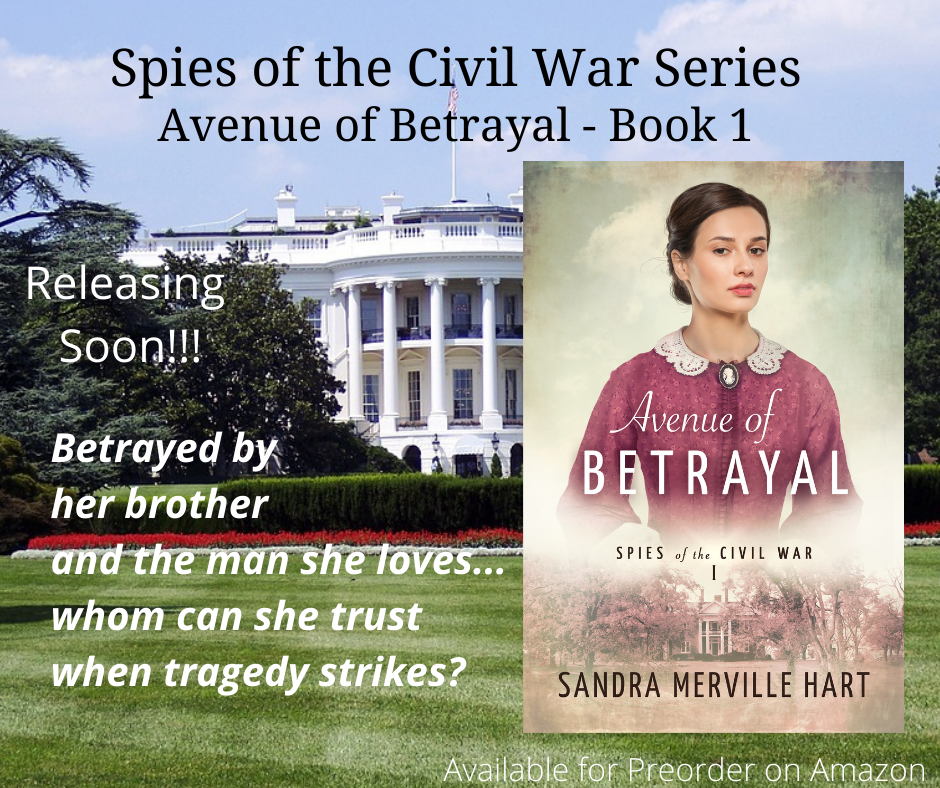
Avenue of Betrayal, Book 1 of my new “Spies of the Civil War” series, releases on February 8, 2022. Here’s a bit of historical background for the story.

Though the series is about a fictional family, there are actual historical spies who touch the stories.

Avenue of Betrayal is set in Washington City (Washington DC) in 1861, where a surprising number of Confederate sympathizers and spies live.

Perhaps the most famous female Confederate spy who lived in Washington DC when the Civil War began was Rose O’Neal Greenhow. When many other Southerner sympathizers left, the widow remained with her eight-year-old daughter, Rose. Colonel Thomas Jordan asked Rose to be an agent shortly before leaving the city to fight for the South. Spying to uncover troop movements and government communications appealed to her. She agreed to send messages based on a cipher he provided.

Coded messages were sent on a “Secret Line,” which involved several couriers in a chain that passed on messages in common places such as docks, taverns, and farmhouses.

Rose’s spy network from Boston to New Orleans was the largest in the war—48 women and 2 men. She learned battle plans for Bull Run and passed this vital information to Confederate General Beauregard. The First Battle of Bull Run was a Confederate victory.

Several other messages about Washington’s defenses and troop information were sent from Rose to Beauregard. Thomas A. Scott, Assistant Secretary of War, asked Allan Pinkerton, head of Lincoln’s Intelligence Service, to find Confederate spies and put Greenhow under surveillance.

About a month after the First Battle of Bull Run, Pinkerton discovered incriminating evidence. The home was searched. Rose and her daughter were placed under arrest at her home. Because she managed to get other secret messages out, they were moved to Washington’s Old Capitol prison. The Federals decided to send her South.

On June 4, 1862, she arrived in Richmond, where she was taken to the best hotel. Confederate President Jefferson Davis called on her the next day, saying, “But for you there would have been no battle of Bull Run.” Rose wrote that his words made up for all she’d endured.

Rose’s real-life story influences the fictional characters in Avenue of Betrayal.

Sources

Monson, Marianne. Women of the Blue & Gray, Thorndike Press, 2018.

Winkler, H. Donald. Stealing Secrets, Cumberland House, 2010.

Zeinert, Karen. Those Courageous Women of the Civil War, The Millbrook Press, 1998.
Civil War Women: Bettie Duvall, Confederate Spy

Washington D.C. resident Rose O’Neal Greenhow had been asked to discover troop movements and battle plans. She had information that Union troops had been ordered to attack Manassas. As a Confederate spy, she had a network of folks to deliver the coded message to Confederate General Beauregard. She gave the information to sixteen-year-old Bettie Duvall. (One source spelled her name “Betty.”)

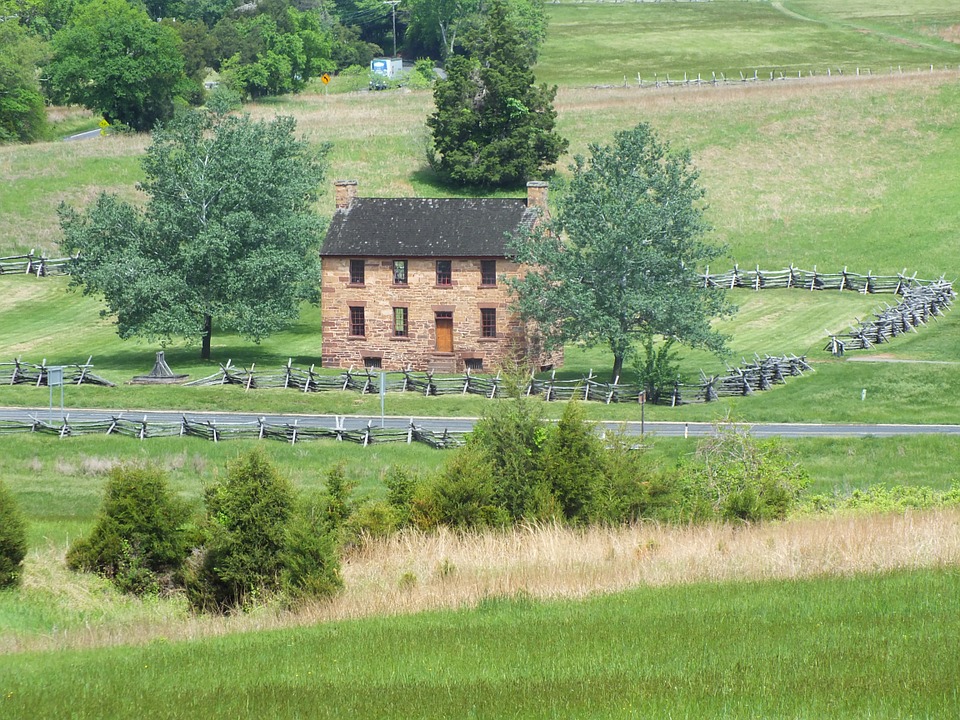
On July 9, 1861, Bettie, a beautiful Southerner, disguised herself by selling buttermilk and sweet cream at the city market. She left the city, alone, on a farm cart. She rode past the 1st Massachusetts Infantry headquarters. A dirt lane led her to a friend’s plantation near Langley where she stayed for the night.

The next morning, she relinquished the farm cart. Dressed in a stylish riding habit, Bettie rode horseback to her intended destination—the village of Fairfax Court House. Manassas was ten miles from the village.

She met Confederate soldiers at an outpost near Vienna. At her request to speak with Brig. Gen. Milledge Bonham, they took her to his headquarters in Fairfax Court House. Beauregard had just taken over command, but Bonham was his top aide.

At first, Bonham refused to meet her. Upon learning that the beautiful woman was prepared to take the message to General Beauregard herself, he agreed to talk with her.

He recognized her “sparkling blue eyes, perfect features, glossy black hair” as a Southern lady from the spectator gallery at Congress. He agreed to forward on her message.

To his astonishment, she removed the combs from her hair knot. Shaking her beautiful hair loose, she untied a small silk package about the size of a silver dollar from the long strands and gave it to him.

Beauregard learned from the message that an attack was ordered within a week.

The advance warning led to a Confederate victory at the First Battle of Bull Run.

-Sandra Merville Hart

Sources

Monson, Marianne. Women of the Blue & Gray, Thorndike Press, 2018.

Winkler, H. Donald. Stealing Secrets, Cumberland House, 2010.

Zeinert, Karen. Those Courageous Women of the Civil War, The Millbrook Press, 1998.

 

Civil War Women: Antonia Ford, Confederate Spy

Union officers often gathered at Antonia Ford’s family home in Fairfax Court House, Virginia. Like her father, the beautiful young woman was a secessionist. She learned of Union plans for the First Battle of Manassas and rode to warn the Confederate army. Southern officers held her under guard until her information was confirmed by other spies.

After this success, Antonia might have provided information to Brigadier General J.E.B. Stuart, who declared her an honorary aide-de-camp in October of 1861.

At 2 am on March 9, 1863, Cavalry Colonel John S. Mosby, along with 29 of his Confederate rangers, sneaked into Fairfax Court House and captured Union General Stoughton, several of his men, and horses.

Suspicions immediately shifted to Antonia, who had hosted Stoughton’s mother and sister in her home. The Secret Service sent a female undercover agent to the home, who spent hours talking with Antonia.

On March 15, Antonia was awoken by Secret Service agents. When she refused to pledge loyalty to the Union, they searched her house and found Confederate money and papers, letters from Federal officers, and J.E.B. Stuart’s order for her aide-de-camp. Charged with aiding and abetting Mosby’s capture of General Stoughton, she was arrested and held at Old Capitol Prison in Washington D.C.

While there, she met Union Major Joseph Willard, who worked to get her released. Willard was part owner of the Willard Hotel in Washington. They fell in love.

Antonia learned in May that she would be exchanged for Northern prisoners. She was arrested again with her father for not swearing allegiance to the Union. They were released on September 18, 1863 after both took the oath of loyalty to the Union.

Antonia married Major Willard on March 10, 1864, and moved to Washington.

-Sandra Merville Hart

Sources

“Antonia Ford Willard,” National Park Service, 2019/01/07 https://www.nps.gov/people/antonia-ford-willard.htm.

DiSilvestro, Roger. “Mosby’s Female Super Spy: Antonia Ford,” History.net, 2019/01/07 http://www.historynet.com/mosbys-female-super-spy-antonia-ford.htm.

Whitehead, A.M. “Antonia Ford (1838-1871).” Encyclopedia Virginia. Virginia Foundation for the Humanities, 27 May. 2014. Web. 7 Jan. 2019.