Evening Amusements for Old-Fashioned Themed Parties – Part 2

fabric-657008_960_720

I wanted to host an old-fashioned theme party for a few friends during the Christmas season. Read  Evening Amusements for Old Fashioned Themed Parties – Part 1 for food ideas.

The local library contained a book written in the 1880s on evening entertainments filled with various games, card tricks, forfeits, and even chemical surprises.

With a little planning, a dozen of us got into the spirit of the evening and enjoyed playing games that history seems to have forgotten.

I thought others might enjoy planning this type of evening so I’m sharing games we played with you.

The Game of Concert

  1. Elect a conductor who will lead an imaginary orchestra.
  2. Assign instruments, such as violin, harp, drum, trumpet, trombone, flute, cymbals, clarinet, tuba, bugle, fife, bass, etc.
  3. Conductor hums a tune and all join in noisily using their pretend instruments. The conductor waves imaginary baton and everyone ceases.
  4. Time for “solos.” Conductor makes motions to play a particular instrument. The person who has that instrument immediately joins in and pretends to play. If they don’t, they are out of the game.

Conductor continues with solos until everyone has played.

Historically, contestants earned forfeits for losing that were “paid” at the end of the evening. For our purposes, continue playing until only one player remains who claims the prize.

One of our guests had attended college to become a band leader but never found a job in that field. How fun to find out that tidbit early in the evening and be able to elect him as conductor!

He had to speed up to catch “band members” off guard. He did such a great job that everyone agreed that he won the prize.

Next time we will talk about more party games. Hope you can join in the fun!

-Sandra Merville Hart


Source

Planche, Frederick D’Arros. Evening amusements for every one; a collection of mirthful games, parlour pastimes, shadow plays, magic, conjuring, card tricks, chemical surprises, fireworks, forfeits, &c., illus. by George Cruikshank and others, Porter and Coates, ca 1880.

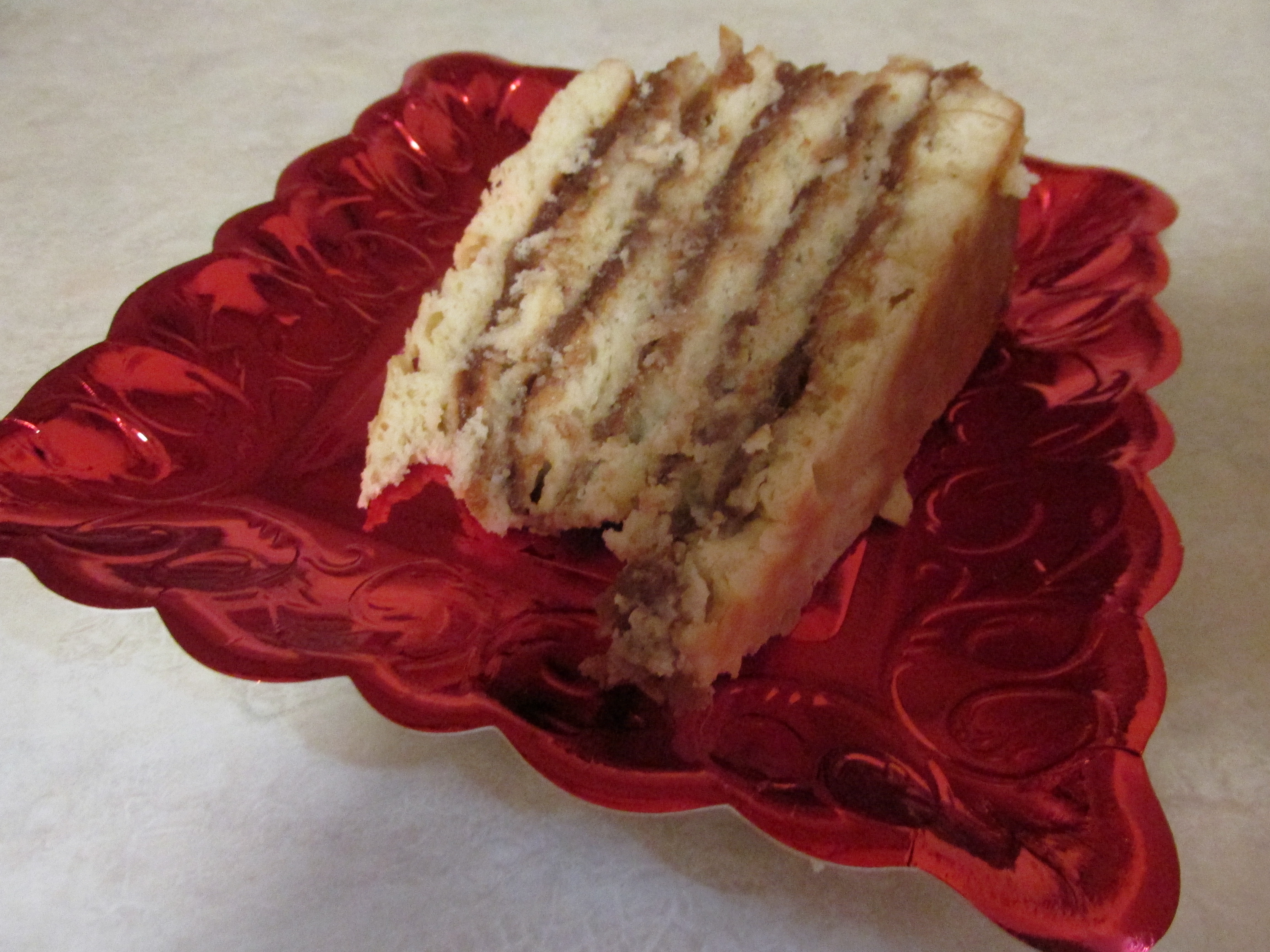
Old-Fashioned Stack Cake Recipe

blog-046

My grandmother made stack cakes every year at Christmas when I was little. She was an excellent cook and baker but wasn’t blessed with enough patience to teach her daughters and granddaughters how to make them.

She never measured anything. Cakes, biscuits, and pies were all made by sight and touch. She held salt in her hand to know how much to add. She rarely guessed wrong.

Unfortunately, she shooed us from the kitchen if we asked too many questions about how to make something. We tried to observe quietly but it was difficult to learn how to cook that way.

When she died, I feared that her wonderful recipe was gone forever. I tried to make it from memory and came fairly close on the apple filling but not the cake layers. I remembered them being thin, like a big soft cookie.

Both my sister and I found the recipe while visiting the Smokies.

blog-015For the apple filling between layers:

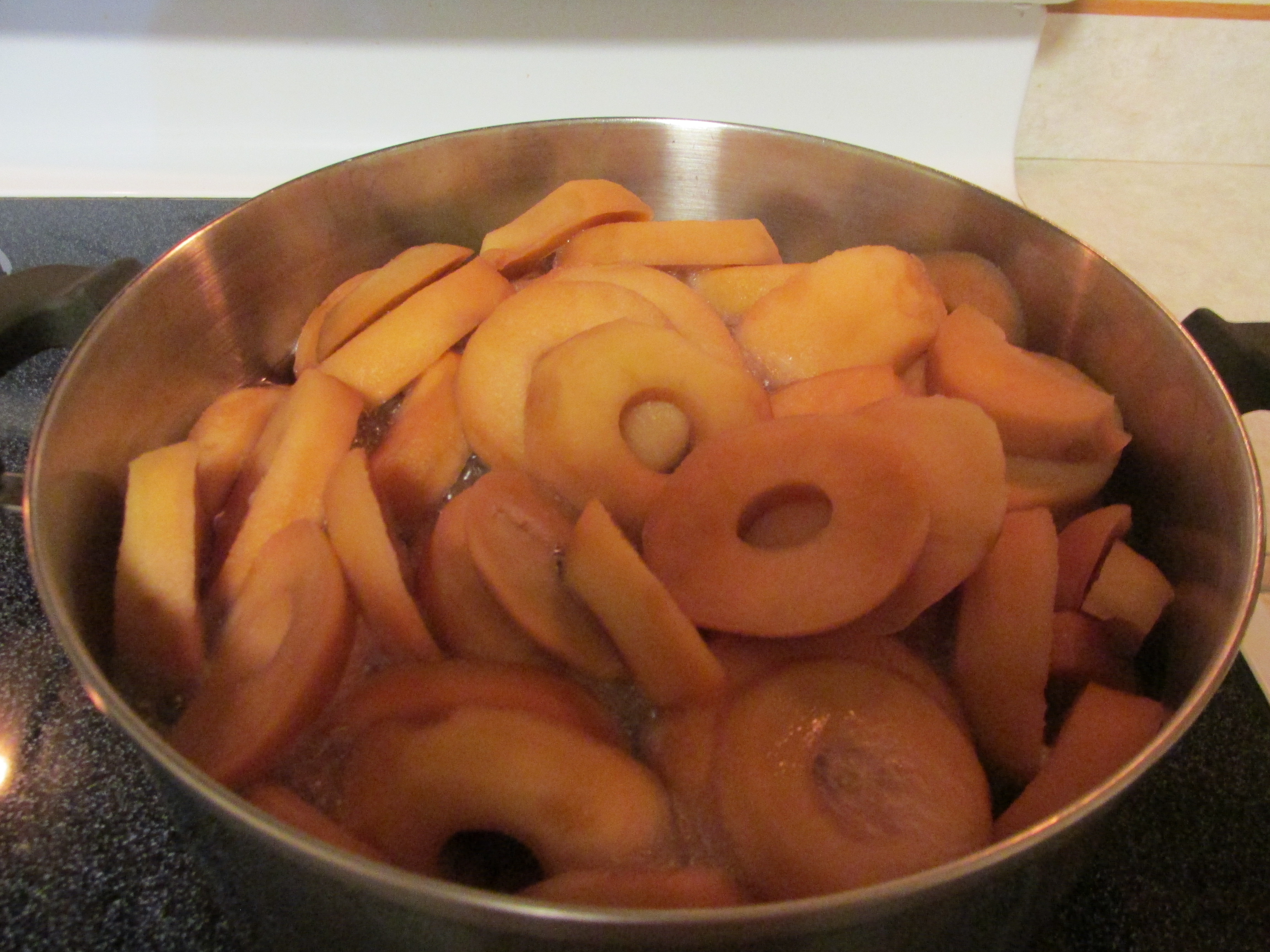
Arrange a pound of dried tart apples in a large kettle. Cover the apples with boiling water to soften. This make take a few hours or allow to sit overnight. I drained this water but I’m not sure it’s necessary.

Add enough water to almost cover the apples and cook over medium low heat about an hour or until tender. Drain almost all the water from the cooked apples and then mash. I kept about a cup of water in the pot with the fruit.

blog-018Add a cup of brown sugar, ¾ cup sugar, 3 teaspoons cinnamon, ½ teaspoon ground cloves, ½ teaspoon allspice, and stir well.

To make six cake layers:

Sift 3 ¾ cups all-purpose flour into a medium bowl. Add a cup of sugar, 4 teaspoons baking powder, ½ teaspoon baking soda, and 1 teaspoon salt. Mix together.

Beat two eggs in separate bowl and add to flour mixture. Then add a ½ cup soft butter, a cup of buttermilk, and 2 teaspoons of vanilla.

Mix into a soft dough and divide it into 6 parts. Spread about a ¼ cup of flour over a surface to roll out each layer. (The layers are so thin that I rolled it to about half the size needed, placed the dough into a cake pan prepared with cooking spray, and used my fingers to pat it to the sides.)

blog-029The instructions suggested baking in a 450-degree oven but I baked at 425 until lightly brown, about 11 to 12 minutes.

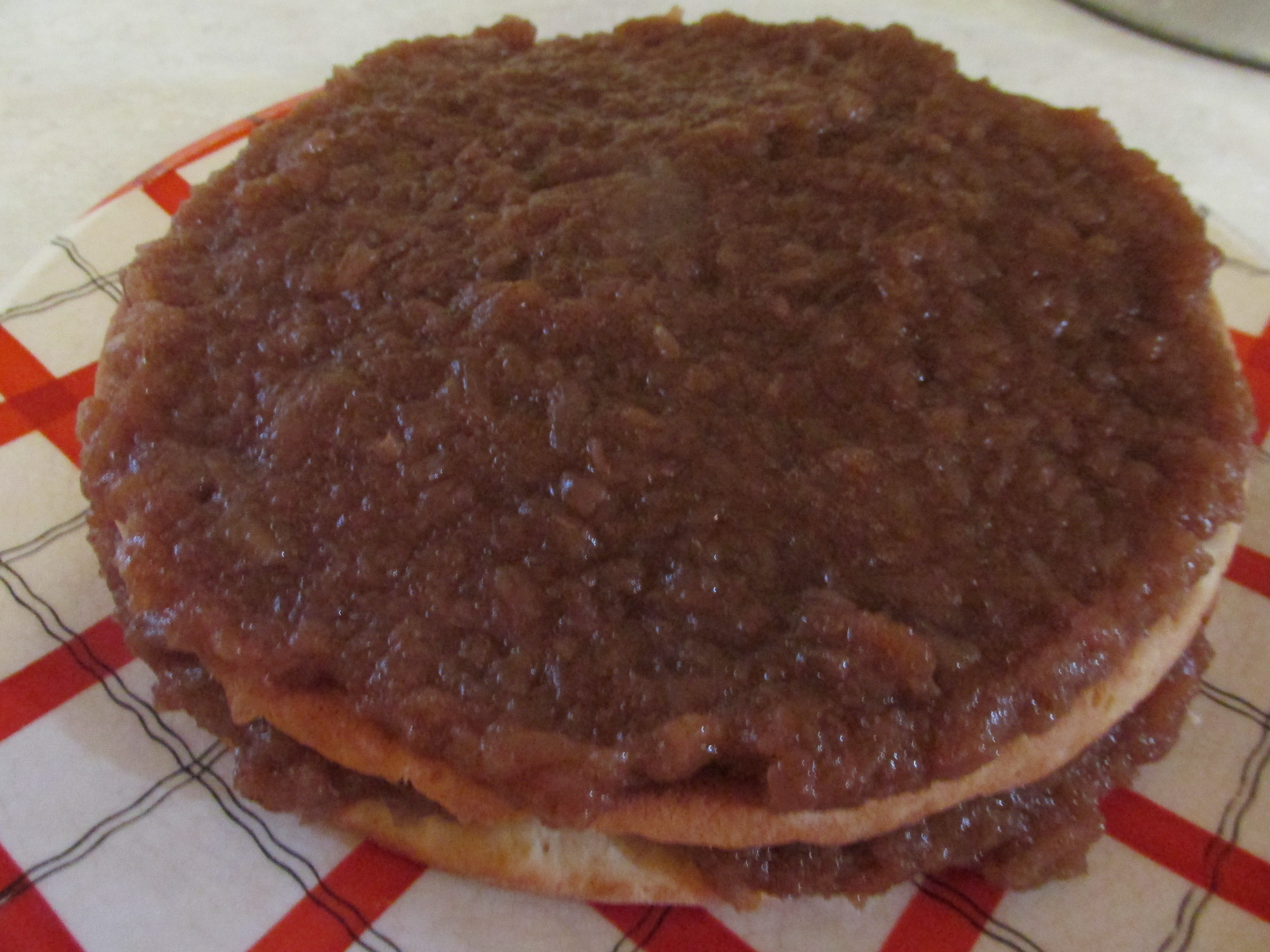
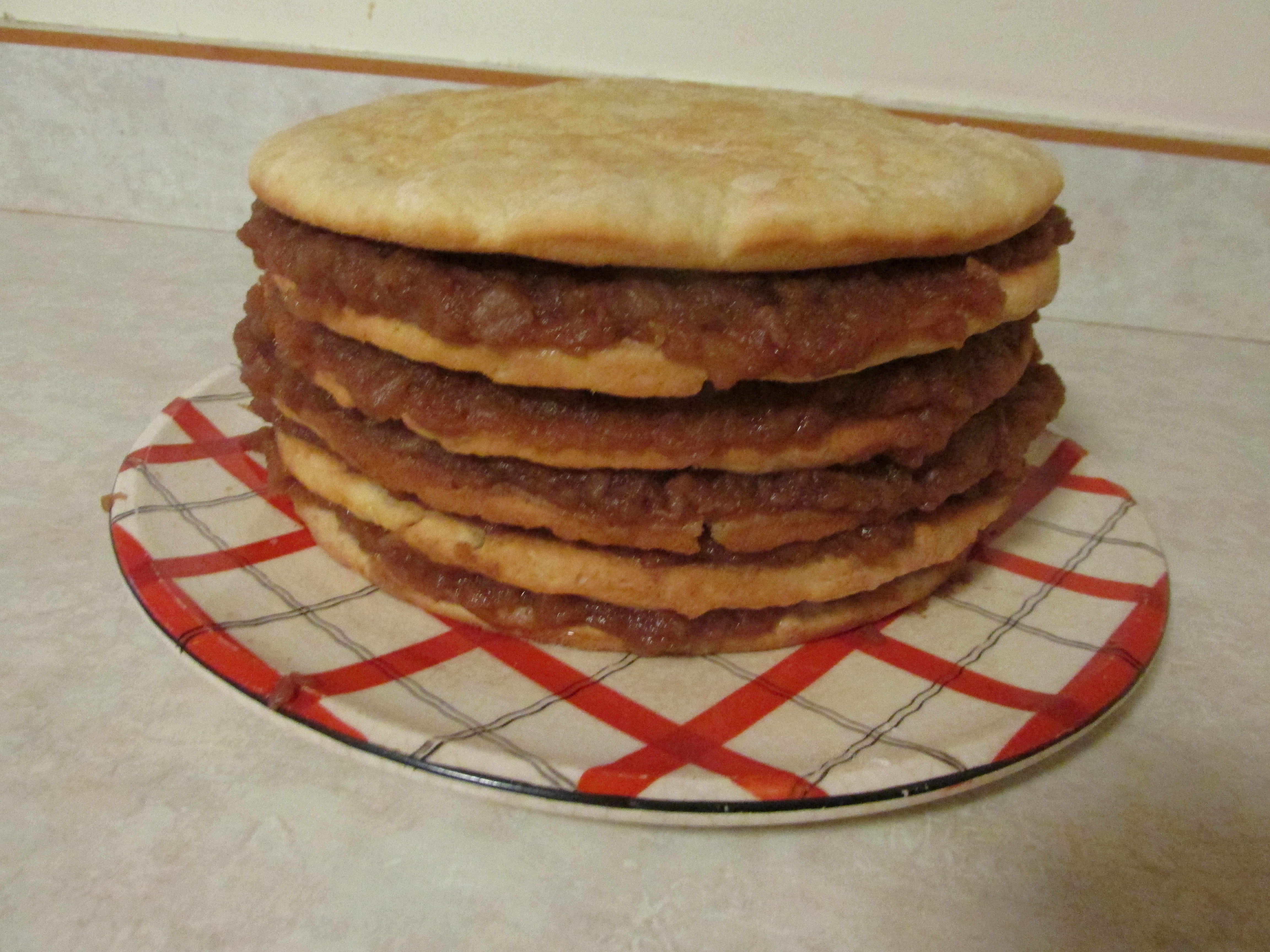
Spread each layer with the apple filling except the top layer. Cover and store at least half a day before serving.

My grandmother wrapped her cake in plastic wrap. Then she covered them with towels and stored them in a cool place about two days before slicing. I did the same in her honor.

blog-032My guests enjoyed the cake. It felt good to carry on my grandmother’s tradition.

-Sandra Merville Hart

Sources

The Tates. Hillbilly Cookin, C & F Sales, Inc., 1968.


Gumbo Recipe

blog-036

My husband and I invited a few friends over for an “old-fashioned” Christmas party.

I searched for a soup recipe and found one in an 1877 cookbook for Gumbo, submitted by Mrs. E. A. W.

Peel and cut two quarts of tomatoes into bite-sized chunks and set aside.

I couldn’t find a quart of fresh okra in the middle of winter. Frozen cut okra worked well.

Dice a large onion. Fry three strips of bacon in a skillet until they just begin to sizzle. Add the diced onion to the skillet and sauté them together with a wooden spoon.

The bacon should begin to break apart. If it doesn’t, cut it into bite-sized pieces when finished with the sauté.

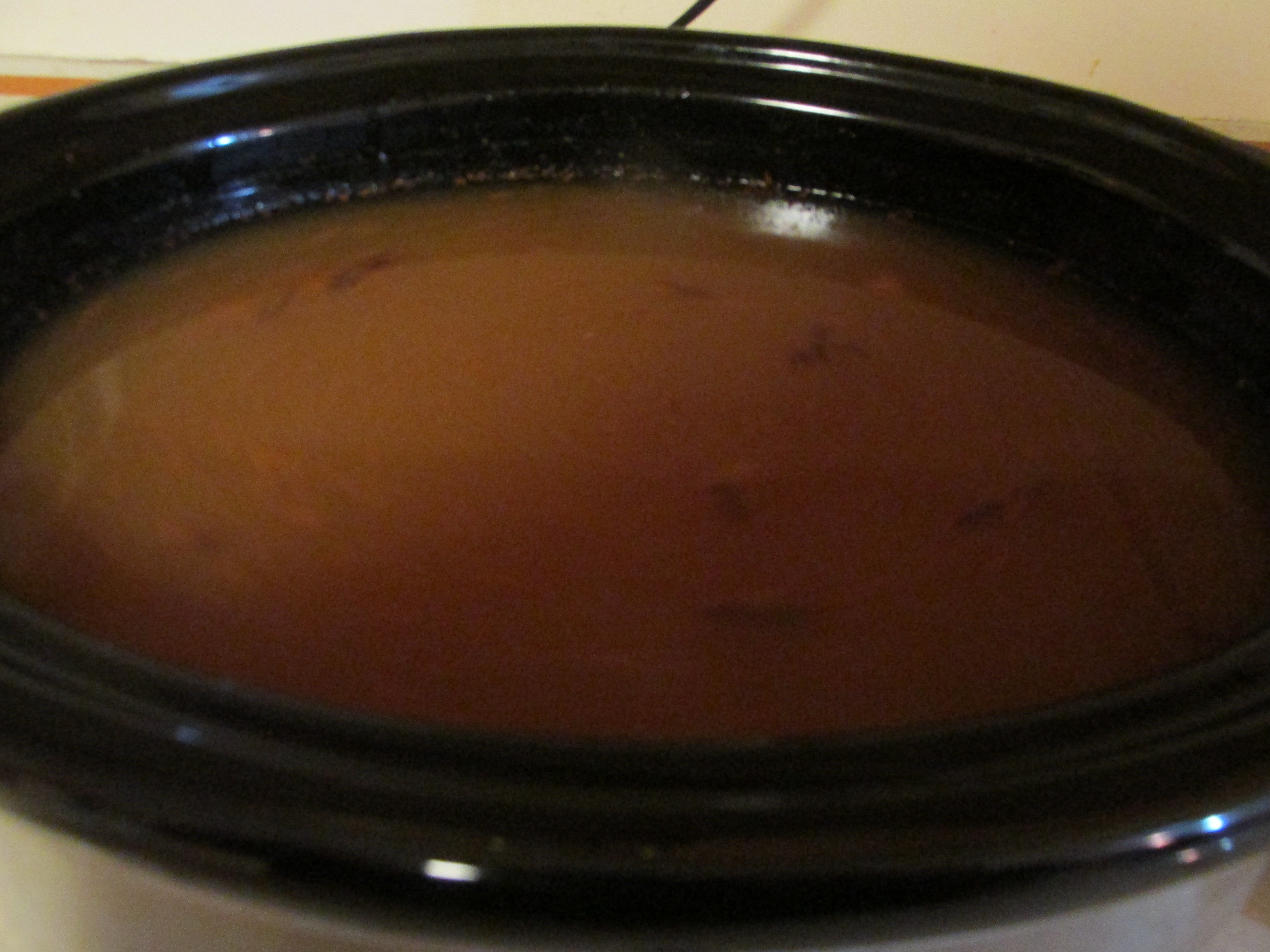
Pour this mixture into a large stockpot. This recipe filled my 7.5 quart pot. Add tomatoes, okra, two tablespoons parsley flakes, one teaspoon salt, and one teaspoon black pepper. I added chicken stock and then filled the pot the rest of the way with water.

I used medium heat until the gumbo started cooking, which took about thirty minutes at that quantity. Then the heat was lowered a bit to simmer for ninety minutes.

Our guests loved the soup. A dozen people ate a bowl with several returning for seconds. There was still enough gumbo to serve as lunch leftovers for a couple of days.

This is a comforting soup on a cold wintry day. Enjoy!

-Sandra Merville Hart

Sources

Compiled from Original Recipes. Buckeye Cookery and Practical Housekeeping, Applewood Books, 1877.


These Are the Times that Try Men’s Souls

colonial-378730_960_720

Thomas Paine, personal assistant to General Nathanael Greene, scanned the faces of his companions in the Continental Army on a cold day in December, 1776. The soldiers faced difficulties worse than separation from families and harsh winter conditions. The men were disheartened. How could an army one quarter the size of the British forces win freedom?

Paine understood their discouragement. Recently, three thousand Colonial soldiers bravely stood their ground against a foe of thirteen thousand outside the fort at Washington Heights (Manhattan) until the British threatened them with cannons. One hundred forty-nine Colonial soldiers were killed or wounded. Over twenty-eight hundred at the fort surrendered. The Colonial Army also abandoned another fort, Fort Lee, in New Jersey.

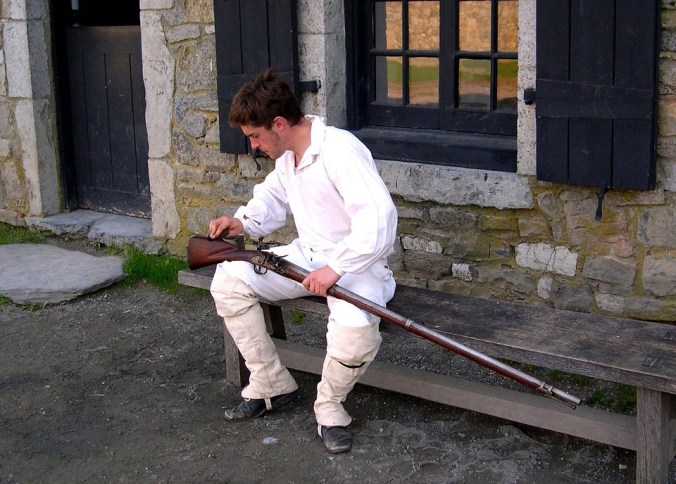
military-752464_960_720To make matters worse, General Howe’s British troops pursued General Washington’s retreating army across New Jersey. The soldiers marched through the colony for sixteen days until they reached safety across the Delaware River.

The loss of three thousand soldiers struck the struggling army a difficult blow. New York City and all of New Jersey were under British control. Eleven thousand colonial soldiers gave up and returned home between September and December. Army contracts would expire on December 31st.

Paine remembered the impact of his pamphlet, Common Sense. His words, published earlier that year in January, had been read by thousands. His writing somehow resonated with people in all walks of life.

All thirteen colonies must know of the recent British victories. Paine imagined those at home felt discouragement similar to the soldiers. After he pondered the situation, he sat down to pen these words:

“These are the times that try men’s souls: The summer soldier and the sunshine patriot will, in this crisis, shrink from the service of his country; but he that stands it now, deserves the love and thanks of man and woman. Tyranny, like hell, is not easily conquered; yet we have this consolation with us, that the harder the conflict, the more glorious the triumph. What we obtain too cheap, we esteem too lightly.” 

The American Crisis went to the heart of the problem from these beginning lines. The Pennsylvania Journal published Paine’s work on December 19, 1776.

george-34252_960_720General Washington commanded the pamphlet to be read to his discouraged men. Paine’s stirring words revived hope within their souls at a crucial moment. The results encouraged Washington. His plan for Christmas Day must succeed though he kept the details from his soldiers.

Regiments began assembling at specific crossing points along the Delaware River late in the afternoon of December 25th. Temperatures dropped causing the snow-covered ground to feel even colder.

Washington didn’t want delays because after the troops crossed the icy river, they must march to Trenton, New Jersey for a surprise predawn attack on the Hessian soldiers.

delaware-river-1472266_960_720Unfortunately some soldiers arrived late to their designated areas. Snow, hail, sleet, and rain hindered their crossing. They contended with ice jams on the river. Dark, stormy skies made navigation difficult.

All this affected Washington’s careful timetable. He almost abandoned the plan when faced with a three-hour delay. He trudged on.

Washington’s surprise attack worked. The Continental Army won their first major victory.

Would the results have been same without Paine’s passionate plea to stay the course? With all the obstacles that had to be overcome on that freezing Christmas Day and everything that led up to it, this author doesn’t believe so.

Do our words matter?

You decide.

-Sandra Merville Hart

Sources

“Crossing of the Delaware,” George Washington’s Mount Vernon, 2015/07/27 http://www.mountvernon.org/research-collections/digital-encyclopedia/article/crossing-of-the-delaware/.

“Ft. Washington Captured – Washington Retreats through N.J -1776,” HistoryCentral, 2015/07/27 http://www.historycentral.com/Revolt/Retreatnj.html.

Paine, Thomas. “The Crisis,” USHistory.org 2015/07/24 http://www.ushistory.org/paine/crisis/c-01.htm.

“Thomas Paine,” USHistory.org 2015/07/24 http://www.ushistory.org/paine/.

“Thomas Paine Publishes American Crisis,” History.com, 2015/07/28 http://www.history.com/this-day-in-history/thomas-paine-publishes-american-crisis.

 

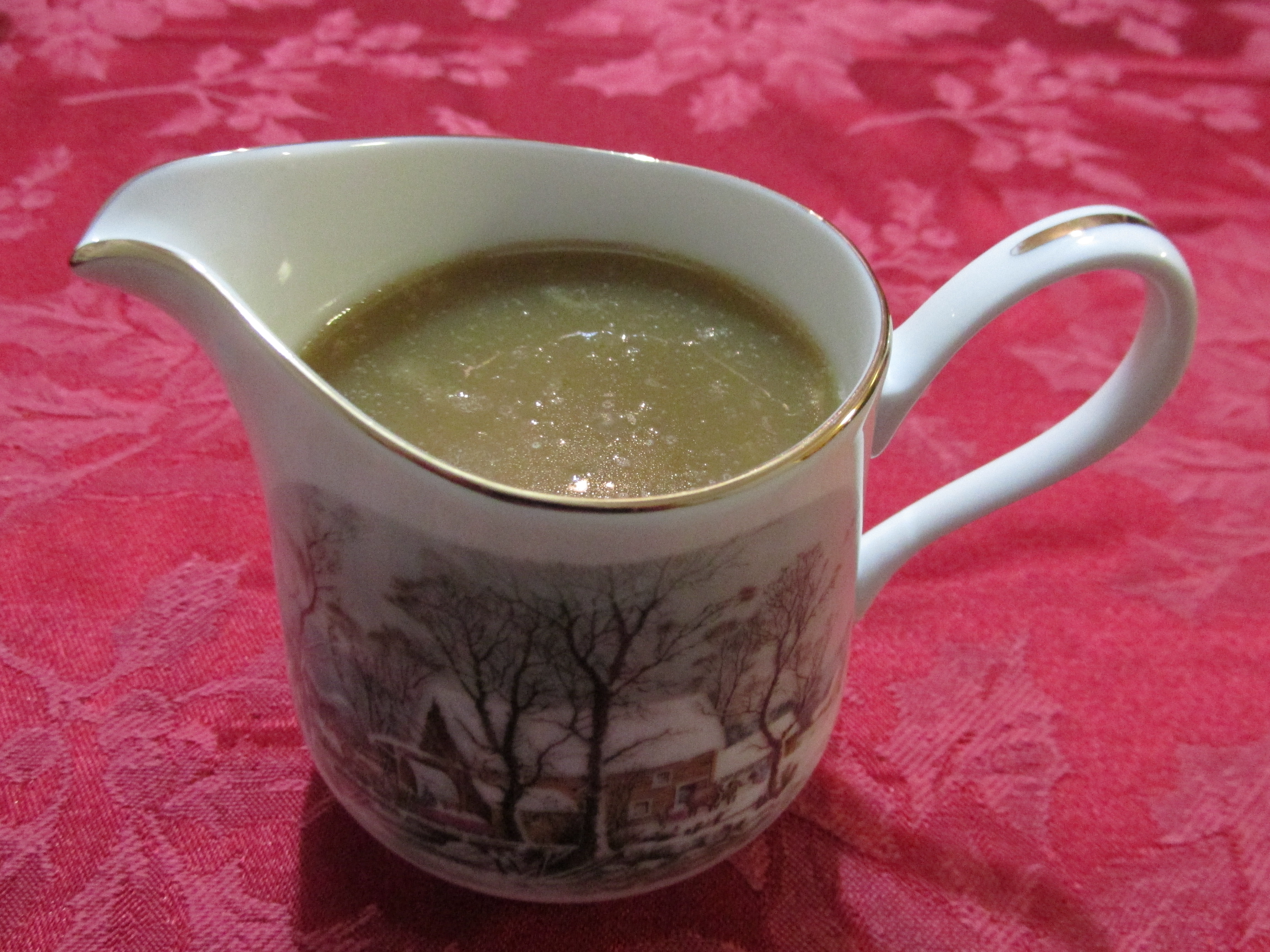
Simple Wassail Recipe

blog-041

My husband and I invited a few friends over for an “old-fashioned” Christmas party.

I wanted to serve wassail but couldn’t find a century-old recipe in any of my cookbooks.

I knew that wassail were warm mulled drinks from earlier research. Beverages became “mulled” when heated with spices and some type of sweetener.

Wassail later was made with mulled cider, cinnamon, nutmeg, ginger, and sugar. The toasted bread that topped the drinks centuries ago didn’t sound very appetizing so I decided against adding it.

Since I didn’t know the amount of spices used, I experimented with the following recipe. It turned out perfectly.

Wassail

1 gallon apple cider

2 sticks of cinnamon

¼ teaspoon ginger

½ teaspoon nutmeg

½ teaspoon whole cloves

Combine ingredients in a crockpot and turned the setting to low heat about two hours before serving. It may need to warm on high the last half hour until it reaches the desired temperature. Then return it to a lower setting to keep it ready to serve during the evening.

This was a yummy beverage on a cold evening!

-Sandra Merville Hart


Nothing that Glitters is Gold

calico-4535_960_720

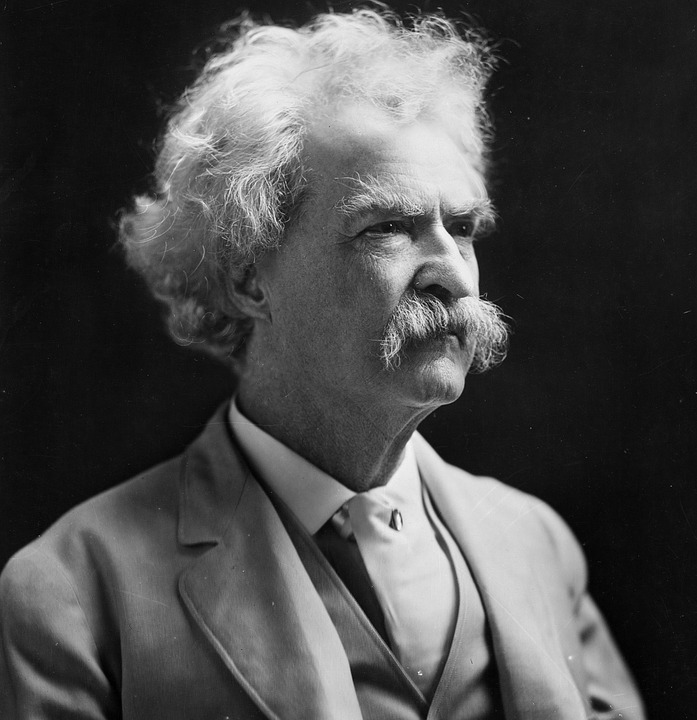
Mark Twain got bit by the fever sweeping the Nevada Territory—silver fever. Reports of great riches in Humboldt County where folks owned feet of silver mines spurred Twain and three other friends to set out on a two-hundred mile journey.

Fifteen days later, they arrived in Unionville during a snowstorm. Eleven cabins and a liberty pole made up the entire village set in a deep canyon. By building a small cabin, they added a twelfth dwelling to the tiny settlement.

minerals-1230032_960_720Twain expected to find silver glittering in the sun. While his companions searched for a mine, he went off on his own. Finally his efforts were rewarded—a stone fragment with shining yellow flecks. He felt almost delirious with joy. He would have been content with silver and he had found gold.

He marked the spot and left in a roundabout way so that anyone watching would not know where he had been. Then he went back to his new mine and picked up a few treasures to show his friends.

Back at the cabin, he couldn’t talk or eat; dreams filled his mind. With monumental news that they would all soon be wealthy, Twain waited for an opportune moment to share his joy with his friends.

He decided to tease them. Hadn’t they been searching for silver and not found any? Did that mean they should give it up and return home?

Mr. Ballou, the oldest and most experienced of the bunch, believed they should try a bit longer.

mark-twain-391112_960_720Twain couldn’t wait to tell them. He offered to show them something certain to interest them and dumped the treasure before them.

His companions scrambled for the stones to hold them close to the candlelight.

Mr. Ballou pronounced his opinion: granite rubbish and glittering mica. The whole pile wasn’t worth ten cents an acre in his estimation.

Twain’s dreams crumbled. They weren’t to be wealthy after all. He commented that all that glittered wasn’t really gold.

Ballou replied that nothing that glittered was gold. Twain learned the hard way that gold in its natural state is dull; only inexpensive metals fool the uninformed with shining outer surfaces.

Twain then observed: “However, like the rest of the world, I still go on underrating men of gold and glorifying men of mica. Commonplace human nature cannot rise above that.”

 -Sandra Merville Hart


Sources

Twain, Mark. Roughing It, Penguin Books, 1981.

The Christmas Truce

trench-62919_960_720

by Sandra Merville Hart

The war had been going on for five long months. Soldiers missed their families, their homes, and those special girls who awaited their return.

They also missed being warm and well-fed on this cold winter’s evening. Earlier in that December of 1914, Pope Benedict XV had suggested the armies suspend fighting temporarily to celebrate Christmas, a request denied by the countries at war.

The soldiers hunched in the long trenches across from their enemy, longing for warmth, longing for something to mark this day as Christmas Eve. No man’s land, the area between opposing armies, was only about 100 feet in places. In those spots, soldiers could hear each other. The smell of meals cooking in the enemy trenches often wafted over.

Then the lonely soldiers heard something unexpected on the moonlit night—not the sounds of rifles or cannons, but singing. The Germans sang a Christmas carol in their own language. Next, Allied troops from opposing trenches sang a Christmas tune. This continued until the Allies began the familiar carol, “O Come, All Ye Faithful.” German soldiers joined in with the Latin words to the song. It must have been extraordinarily comforting.

helmet-1465352_960_720British Captain A.D. Chater was writing a letter to his mom at 10 am the next morning when he witnessed an amazing sight: a German soldier waving his arms before he and a companion, weaponless, entered no man’s land.

A British soldier cautiously approached them. Within five minutes, officers and men from both armies filled the area. They shook hands and exchanged Christmas greetings.

The soldiers kicked around a soccer ball together. Some accounts mention playing football. A German barber cut a British soldier’s hair. They gave each other gifts of plum pudding, cigarettes, and hats. They posed for photos together and exchanged autographs.

Each side also took the opportunity to bury their dead, soldiers who had been laying in no man’s land for weeks.

Around 100,000 soldiers—two-thirds of the men there—shared in the unforgettable Christmas truce.

christmas-1010749_960_720Peace lasted in a few areas until after New Year’s Day.

The Christmas truce never happened again.

The faith and joy of the season crossed enemy lines one lonely Christmas. Fighting ceased for a moment in time.


Sources

Bajekal, Naina. “Silent Night: The Story of the World War I Christmas Truce of 1914,” Time Inc., 2016/10/26  http://time.com/3643889/christmas-truce-1914/.

“Christmas Truce of 1914,” History.com, 2016/10/26  http://www.history.com/topics/world-war-i/christmas-truce-of-1914.

Dearden, Lizzie. “Christmas Day Truce 1914: Letter From trenches shows football match through soldier’s eyes for the first time,” The Independent, 2016/10/26  http://www.independent.co.uk/news/uk/home-news/christmas-truce-of-1914-letter-from-trenches-shows-football-match-through-soldiers-eyes-9942929.html.


Oh, Bring Us a Figgy Pudding

img_2498


by Sandra Merville Hart

We sing the familiar Christmas tune, “We Wish You a Merry Christmas,” every year. I realized that I had never eaten Figgie Pudding at the holidays or on any other occasion.

Searching through my cookbooks written in the 1800s didn’t produce a recipe for the pudding, which made me wonder when folks sang the song originally. Yet if carolers refused to leave until they received a serving, the dessert must taste delicious.

img_2488The song is believed to date back to England in the 1500s. Carolers sang to their neighbors with greetings of the season. They hoped wealthy citizens would give them a treat, such as figgy pudding, to reward their entertainment.

The song, “Here We Come A-wassailing,” asked for a drink from rich neighbors’ wassail bowl, an invitation to warm themselves around the fire, and maybe a pork pie. “We Wish You a Merry Christmas” issues a specific request—Figgie Pudding.

Apparently, the tradition of making this dessert at Christmas had faded by the nineteenth century, but I was still wanted to make the pudding.

I found a modern recipe on the Food Network site. Click here  to see the recipe.

img_2497I made the pudding as directed. The cook said that the ratio of ingredients half-filled eight ramekins. Mine hold six ounces, so I’m not sure what size ramekins the cook used because there was a lot of batter leftover. The remaining batter went into a casserole dish, so this recipe will feed about a dozen guests.

My husband and I both enjoyed the rich pudding with a hint of chocolate. The creamy sauce on top enhanced the flavor. The dates and figs flavored every bite.

If you try this, I’d love to hear about it.

“We Wish You a Merry Christmas and a Happy New Year!”

Sources

“Warm Sticky Figgy Pudding,” Television Food Network GP, 2016/10/25  http://www.foodnetwork.com/recipes/warm-sticky-figgy-pudding-recipe.html

“We Wish You a Merry Christmas,” Carols.org.uk, 2016/10/25  https://www.carols.org.uk/we_wish_you_a_merry_christmas.htm.

“We Wish You a Merry Christmas,” Wikipedia, 2016/10/25  https://en.wikipedia.org/wiki/We_Wish_You_a_Merry_Christmas.