by Sandra Merville Hart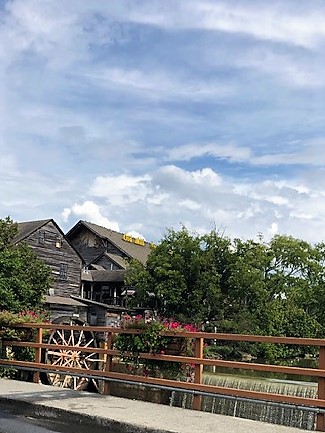
Like other tourists to the Smoky Mountains, my family has spent many happy days in Pigeon Forge, Tennessee. My parents, who used to live nearby, told me that it was a small tourist town into the 1970s. A recent vacation showed that every square foot along the main road is covered with restaurants, shops, motels, and shows. When did it change? And what is the history of the town?
Mordecai Lewis left Virginia and received 151-acre land grant from Governor Blount. In 1790, he built the area’s first forge on it. His son-in-law, Isaac Love, who inherited his property, built an iron forge along what’s now known as the West Fork of the Little Pigeon River in 1817. Iron bars, farming tools, and building equipment produced by this forge were sold throughout the country.
 William Love and his brothers, sons of Isaac, built Lewis Mill (today’s Old Mill) near the forge in 1830. Farmers brought wheat, corn, and oats to make flour at the gristmill.
Beech trees lined the river, attracting huge flocks of passenger pigeons to nest in its trees and feast on beechnuts. Sadly, the once massive flocks of birds are now extinct.
When William Love was appointed postmaster with the post office inside the mill, Pigeon Forge received its name for his father’s forge and the passenger pigeons.
The mill was sold to John Trotter before the Civil War. He used his mill to support the Union. Clothing for Union soldiers in Gatlinburg were produced by secret looms on the second floor. Trotter used the third floor as a hospital.
 The town’s population remained small—154 in 1907. Tourism increased in the mountains after the Great Smoky Mountains National Park was dedicated in 1940.
Rebel Railroad, Pigeon Forge’s first theme park opened in 1961. Klondike Katie, a coal-fired steam engine, was the main attraction. It changed ownership in 1970 and became Goldrush Junction. Another new owner in 1977 renamed it Silver Dollar City. Country singer Dolly Parton became a co-owner in 1982. Four years later, Dollywood opened.
Pigeon Forge became a city in 1961. Tourism boomed twenty-one years later. The city has grown rapidly to become a popular vacation location—a long way from a forge and a mill that was its claim to fame 190 years ago.
Sources:
“8 Huge Moments in Gatlinburg History and Pigeon Forge History,” Timber Tops Cabin Rentals, 2020/08/23 https://www.yourcabin.com/blog/moments-in-gatlinburg-and-pigeon-forge-history/.
Greve, Jeanette S. The Story of Gatlinburg, Premium Press America, 2003.
“History of Pigeon Forge, TN,” Smoky Mountain Navigator, 2020/03/23 https://www.smokymountainnavigator.com/explore-the-smokies/pigeon-forge/history-of-pigeon-forge-tn/.
“Our Old Mill: History in the Making,” The Old Mill, 2020/08/23 https://old-mill.com/our-history/.
“Smoky Mountain History: How Did Gatlinburg, Pigeon Forge and Sevierville Get Their Names?” Visit My Smokies, 2020/08/23 https://www.visitmysmokies.com/blog/gatlinburg/smoky-mountain-history-how-cities-got-their-names/.
“Step Back in Time at the Old Mill in Pigeon Forge,” Pigeon Forge.com, 2020/08/23 https://www.pigeonforge.com/old-mill/.




 Sandra Merville Hart