Epiphany is a word that some Christians use to describe the day that the Magi from the East found Jesus. The meaning of epiphany—a sudden, striking realization.
The Twelve Days of Christmas begin on December 25th, with a celebration of Jesus’ birth, and end on January 6th, which is traditionally celebrated as the day the Magi visited.
In the Middle Ages, Epiphany was also known as Twelfth Night or King’s Day.
In the mid-nineteenth century, Prince Albert and Queen Victoria of England transformed Epiphany into a family occasion that celebrated the Magi’s wonder at finding the Christ child.
In earlier times, the holiday season was celebrated beginning Christmas Eve to the Eve of Epiphany, when families sang songs and took down decorations. They attended church services on the Eve of Epiphany. Aromas from baked or simmered herbs reminded Christians of the Magi’s gifts.
Children left food for the wise men and hay for their camels that night. The food was usually gone the next morning, replaced by gold coins. This gift-giving was gradually replaced by Santa Claus in the United States and Father Christmas in England late in the 1800s.
Children in Germany dress up as Magi on January 6th and follow a child holding a star to find baby Jesus.
Epiphany is called “King’s Day” in parts of Mexico, Puerto Rico, Venezuela, and Argentina. Wise men leave gifts on the Eve of Epiphany. “King’s cake” is often served as part of the meal on Epiphany.
Children fill shoes with barley for the Magi’s livestock in Italy and Spain.
A ship sails into many Spanish seaports on the morning of Epiphany with the Magi on board. These wise men give candy to children lining the sidewalks.
It’s fun to discover the different traditions associated with the 12 Days of Christmas.
Sources
Collins, Ace. Stories Behind the Great Traditions of Christmas, Zondervan, 2003.
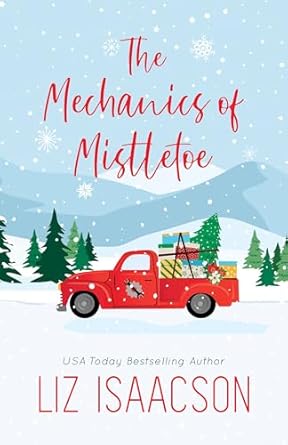
Bear Glover shares the ownership of a thriving Texas ranch with his cousin. The ranch is large enough to support his adult siblings and cousins. He loves his job yet he’s lonely. Sammy Benton caught his eye three years and he’s finally worked up the courage to ask her out.
Sammy runs her own shop in addition to raising her sister’s son, Lincoln. Her parents are getting older, requiring her help. Bear’s invitation thrills her. Unfortunately, their date doesn’t go well.
A tornado that wreaks havoc on their community brings them together. Sammy has been raising Lincoln on her own so long. Can she accept help without feeling weak?
This story was a page-turner. Our strong hero was so sweetly awkward about asking Sammy out that he drew me in immediately. Our heroine would do anything to keep from appearing weak.
The Texas community setting invited me in and made me want to stay a while. The families of the main characters were equally lovable, making me eager to read the next story in the series.
When I was a little girl, my dad insisted that I eat at least one spoonful of black-eyed peas for good luck on New Year’s Day. I didn’t like them. Eating even a spoonful seemed like a high price to pay for good luck in the new year.
Each year in December, I buy black-eyed peas to supplement our New Year’s meal—that is, when the grocery store doesn’t run out of them. That’s happened several times. Apparently, others are looking for the same good luck. I guess I’m just superstitious enough after hearing the saying year after year to worry when I don’t get them. We all need a little luck, after all.
Folks from the southern United States eat black-eyed peas on January 1st. Cornbread is another favorite in that section of the country. Eating green, leafy vegetables, supposed to resemble money, brings prosperity.
Citizens in Spain eat 12 grapes at midnight. Each grape represents one month of the year. If the fifth and sixth grape taste especially bad, May and June might be a little difficult.
Germans, Austrians, and Hungarians are among those who eat pork on New Year’s. Pigs signify progress. Roast pork, pig’s feet, and sausages are a few of the meals prepared.
Ring-shaped or round cakes are another tradition. Those who find a tiny treat baked inside will have good luck in the new year.
One of the foods to avoid on New Year’s Day is lobster. Eating these is thought to bring setbacks because they move backwards. Chickens scratch backwards. The superstition here is that eating chicken on January 1st may cause the diner’s thoughts to linger on the past.
It’s fun to look at our habits of celebrating the coming year in our meals. There are a lot of choices, but I think I will continue the tradition of black-eyed peas for our meal.
Lighting Christ’s candle, the fifth white candle in the center of the Advent wreath, was a celebration of Jesus’ birth for early Christians, as it is today.
Prophets foretold of His birth centuries before the event that changed the world.
For unto us a child is born, to us a son is given,
And the government will be on his shoulders.
And he will be called Wonderful Counselor, Mighty God, Everlasting Father, Prince of Peace.
Isaiah 9:6 (NIV)
When it was time, God sent His Son.
But when the time had fully come, God sent his Son, born of a woman, born under law, to redeem those under law, that we might receive the full rights of sons.
Galatians 4:4-5
I’ve often reflected on the multitude of angels praising God for the wondrous gift of His Son, a gift for all people everywhere. The angels must have filled the night sky around the shepherds. Can you imagine the wonder mingled with fear that overcame the shepherds the night that Jesus was born?
And there were shepherds living out in the fields nearby, keeping watch over their flocks at night. An angel of the Lord appeared to them, and the glory of the Lord shone around them, and they were terrified.
But the angel said to them, “Do not be afraid. I bring you good news of great joy that will be for all the people. Today in the town of David a Savior has been born to you; he is Christ the Lord. This will be a sign to you: You will find a baby wrapped in cloths and lying in a manger.”
Suddenly a great company of the heavenly host appeared with the angel, praising God and saying,
“Glory to God in the highest, and on earth peace to men on whom his favor rests.”
Luke 2:8-14 (NIV)
The shepherds had to see the miracle with their own eyes.
When the angels had left them and gone into heaven, the shepherds said to one another, “Let’s go to Bethlehem and see this thing that has happened, which the Lord has told us about.”
So they hurried off and found Mary and Joseph, and the baby, who was lying in a manger. When they had seen him, they spread the word concerning what had been told them about this child, and all who heard it were amazed at what the shepherds said to them.
But Mary treasured up all these things and pondered them in her heart.
The shepherds returned, glorifying and praising God for all the things they had heard and seen, which were just as they had been told.
Luke 2:15-19
Why did God send His Son for us?
“For God so loved the world that he gave his one and only Son, that whoever believes in him shall not perish but have eternal life.”
John 3:16 (NIV)
Wishing you and your loved ones a blessed Christmas.
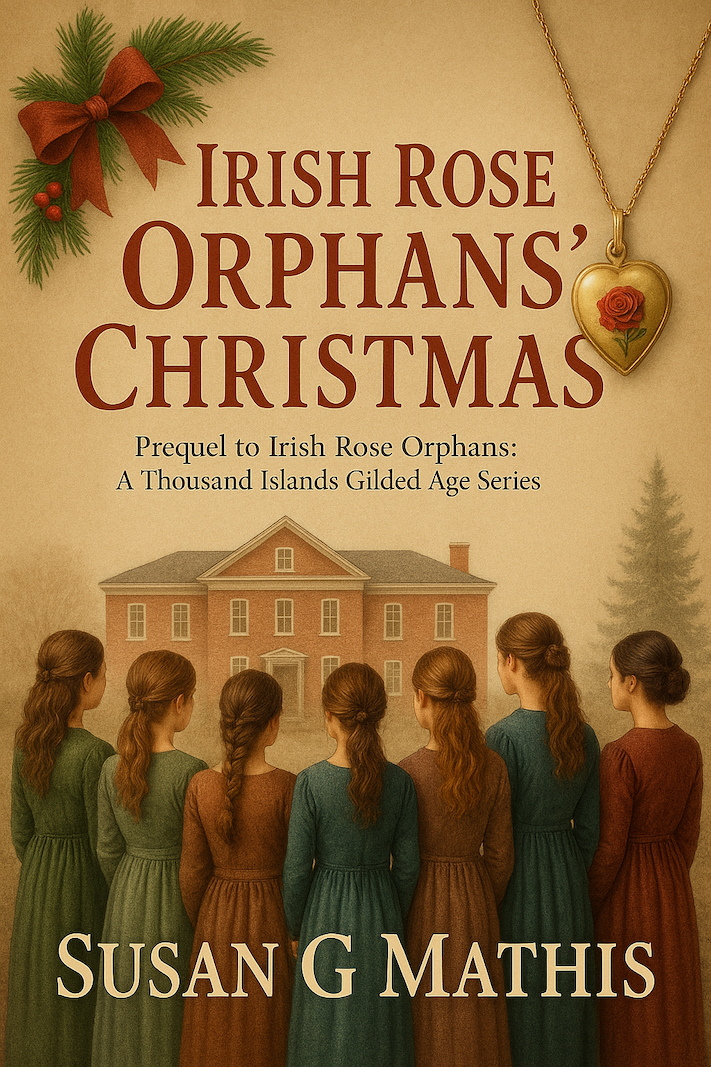
Prequel to Irish Rose Orphans: A Thousand Islands Gilded Age Series
Brooklyn, New York, 1876
Seven orphans living at The Irish Rose Orphan Asylum for Girls are told a few weeks before Christmas that they’ll be placed in new jobs after Epiphany. None of the girls, ages varying from 16 to 13, feels ready to leave the orphanage, even though things are far from perfect there with Sister Catherine.
Annie, 14, doesn’t want to leave her twin Tayrn with this terrible rift between them, but she doesn’t know how to bridge the gap.
Fiona, the oldest at sixteen, can’t reconcile with the whispers about her mother’s shame. At fourteen, Isabel has always been protective of her younger sister Gloria, and she struggles with their upcoming parting.
Vivian tries to lighten the mood when times get tough to mask her own insecurity. Cassie loves the precision of numbers because the losses in her life have been so difficult.
Each girl invited me into her pain, her struggles, from the first page. This story is told from the viewpoint of each of the girls, allowing readers a deeper connection.
This well-written story is a page-turner. It ended with an epilogue that gives us a glimpse of what happens in later books in the series. I’m hooked!
A great Christmas story! Highly-recommended.
I was given a free copy of the book by the author. A positive review was not required.
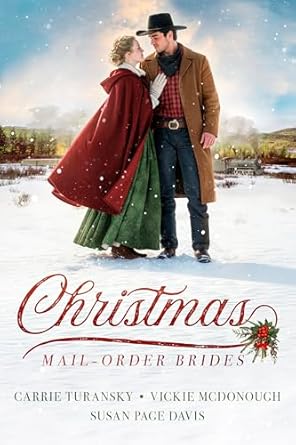
These three historical romances by different authors all have something in common—someone in each story either wants a mail-order bride or wants to be one. They have employed the services of Mrs. Mayberry’s Matrimonial Society for Christians of Moral Character in their search.
But sometimes the heart has its own ideas…
I loved the characters in Carrie Turansky’s A Trusting Heart. Annika Bergstrom travels to a Wyoming ranch to marry a widower in need of help raising his young daughter, but Chase Simms is mysteriously absent. Daniel, his brother, wishes their pa had talked to Chase before writing to the mail-order bride. In his brother’s continued absence, Daniel begins to fall for Annika. She can’t help wishing that Chase was more like his brother…
The action in Vickie McDonough’s The Prodigal Groom begins immediately. The main setting is in Cedar Springs, Nevada in 1882. My emotions were engaged early as I wanted Jolie Addams to flee the orphanage where a man the age of a grandfather wanted her to live with him as his maid. Jolie flees to Nevada from Iowa to marry a man she’s never met. She meets Clay Jackson along the way and must face a dangerous situation with him. That event turns her future on its head.
I was delighted when this collection comes full circle in Mrs. Mayberry Meets Her Match by Susan Page Davis. Amelia Mayberry, who has supported herself since her husband’s death by running a matchmaking service, finally has saved enough money to retire. The widow in her early fifties has only one job left—find her husband’s old friend a wife, as she had unsuccessfully tried to do two years before. Lennox Bailey has built a successful business in Sacramento. The widower’s married daughter’s family now includes Lennox’s only grandson. He agrees to a visit from Amelia, but he hopes she will not mention the mail-order bride she’d recommended. It had been a fiasco. Yet Amelia cannot leave a job unfinished…
All of these historical romances are feel-good stories set in the West at Christmas.
I enjoyed this collection of light-hearted, easy-to-read romances. Recommend.
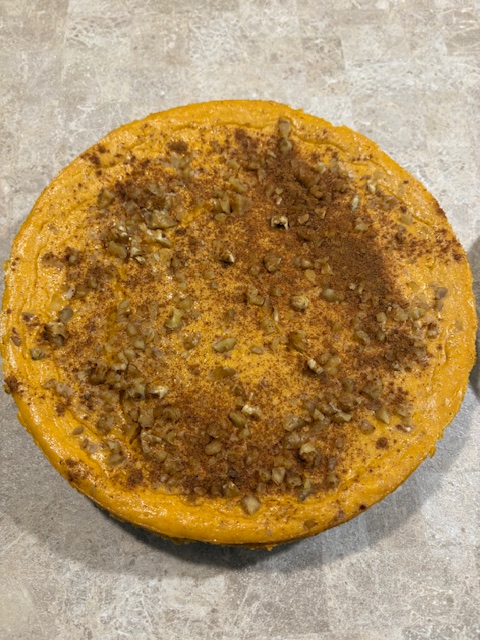
In the fall, I love to make desserts with seasonal flavors. I had discovered this great pumpkin cheesecake several years ago, but then I forgot about it. Last weekend, I made it for two different gatherings. Both friends and family loved it!
In fact, I asked my nephew if he wanted a piece of cheesecake for another day. When he declined, his wife called in from the living room, “What are you turning down?” She wasn’t about to say no to the dessert…and I was happy to leave two pieces with them.
Ingredients
CRUST:
¾ cup finely chopped walnuts
¾ cup graham cracker crumbs (about 12 squares)
¼ cup sugar
¼ teaspoon ground cinnamon
¼ teaspoon ground ginger
1/8 teaspoon ground cloves
¼ cup butter or margarine, melted
FILLING:
2 packages (8 ounces each) cream cheese, softened
¾ cup sugar
2 eggs
1 cup cooked or canned pumpkin
½ teaspoon ground cinnamon
½ teaspoon pumpkin pie spice
2 tablespoons chopped walnuts
Preheat oven to 350 degrees.
The crust takes the longest to prepare. I chose to finely chop the walnuts and the Graham crackers on a cutting board instead of using a food processor. It took only a few minutes.
In a medium mixing bowl, blend the sugar, cinnamon, ginger, and cloves into the cracker crumbs and walnut before adding melted butter. Mix well.
Pour the crust into an ungreased 10-inch springform pan. Press the crust into place with your fingers on the bottom layer.
Use a mixer to beat the cream cheese and sugar on a medium speed until smooth, which takes about a minute. Add eggs and beat on low speed until it’s blended. Stir in pumpkin, cinnamon, and pumpkin pie spice. Using a low speed, beat the batter until the mixture is combined, about 30 seconds.
Pour the batter onto the crust. Sprinkle ¼ teaspoon of cinnamon on top along with 2 tablespoons of chopped walnuts.
I typically serve this in the fall when pumpkin is readily available. Everyone gobbles up the delicious dessert whenever I serve it. They enjoy the seasonal flavors in this light, creamy cheesecake. It works well for holiday dinners.
While whipped cream is delicious on this dessert, I’ve noticed that most guests choose not to use it because it’s such a delicious, creamy cheesecake without it.
Enjoy!
Sources
Taste of Home’s Holiday & Celebrations Cookbook 2002, Remain Media Group, Inc., 2002.
I learned about the holiday tradition of Jesse Trees while digging into the history of Advent candles and wreaths. I had heard of the trees, yet had never seen one.
A Jesse Tree is an Advent tree. It’s another way to celebrate the birth of Christ in the days leading up to Christmas. This tradition has been celebrated at least since the Middle Ages.
The name for this tree comes from Isaiah 11:1 (NIV): A shoot will come up from the stump of Jesse; from his roots a Branch will bear fruit.
Jesse is the father of King David, who is in the lineage of Jesus found in the first chapter of Matthew.
There are only 25 ornaments on the tree, so it’s usually a small tree. It can be an evergreen or one with barren branches. The ornaments are often handmade to signify a certain person or event in the Bible before Jesus’ birth.
In fact, special ornaments are selected because they represent a Biblical event or a person from the lineage of Jesus. A Biblical character who is not in the direct line of Jesus but who played a significant role in the Old Testament—such as prophets who foretold the coming of Jesus—might have an ornament.
Because it may be hard to find ready-made ornaments to fit the day’s theme, some will be handmade. For instance, an apple symbolizes the first sin with Adam and Eve in the Garden of Eden. A rainbow symbolizes The Flood and Noah’s Ark. King David can be represented by a crown, a harp, or a shepherd’s crook. A hammer represents the carpenter Joseph, the earthly father of Jesus.
Matthew lists 42 generations, beginning with Abraham and ending with Jesus. Chapter 3 of Luke begins with Jesus and goes backward to Adam, so there are plenty of possibilities if one’s Jesse Tree highlights people from the genealogies.
Whether one highlights Biblical events, people from the lineage of Jesus, prophets or other Old Testament characters not in a direct line, or a combination of them, each Jesse Tree will be unique and personal.
Beginning December 1st, a new ornament is placed on the tree while a scripture or a brief explanation of the person’s or event’s role in God’s plan of salvation is read. Each successive day, a new ornament is added until December 25th.
A Jesse Tree may also be a banner or a poster. These typically feature a stump with a green branch made of fabric or drawn. Every day, symbols are attached to the branch. The colors of Advent are purple or blue, which are used for the background.
The Christ Lutheran Church-San Clemente has a beautiful illustration of this here.
Some churches celebrate this tradition. Children might make ornaments and hang seven for the whole week on Sundays. Scriptures or short stories related to the symbols are shared, adding meaning and anticipation to the countdown to Christmas.
Jesse Trees are one of several Advent traditions that celebrate Jesus’ birth, which was His first coming, and also look forward to His Second Coming when He will return for His followers.
Grace Thornton is new to the small town of Pine Valley. Although a few unruly boys make every day a challenge, she is determined to lead her students in the school’s first Christmas pageant. The younger girls and boys are excited, even as one boy seems determined to sabotage Grace’s efforts. Maybe she should quit.
Ben Hansen, a widower, can’t ignore his daughter’s praises of her pretty new teacher. He decides to lend a hand among his townspeople, who are so resistant to change.
I enjoyed reading this short story, which I finished in about an hour. Ben’s sweet daughter tugged at my heart, as did Grace’s teaching difficulties.
The nostalgic and historic setting added to the charm of this holiday story. I will look for more stories by this author.
A warm welcome to my friend and fellow author, KD Holmberg. She’s here to tell us about the release of her first children’s book, the re-release of her Biblical fiction novel, and share about a delicacy for one of the world’s oldest recipes! Congratulations, KD, and welcome to Historical Nibbles!
KD Holmberg here, author of The Egyptian Princess, A Story of Hagar, and the newly-released What Would Happen? children’s picture book.
What Would Happen? is a colorful, engaging adventure that introduces environmental care in a fun and simple way. Kids giggle with delight as they seek and find the hidden footprint on each page! Perfect for ages 4-8.
The Egyptian Princess was recently re-released with a new cover and offers a fresh take on the 4,000-year-old story of Hagar, Sarah, and Abraham. After learning that, according to Hebrew tradition, Hagar was a princess before Pharaoh—her father—gave her to Sarah, I researched the lives of royal daughters in that era. I discovered that their lives were marked by a unique blend of culture and privilege, including a formal education equal to that of royal sons. Viewing Hagar as an educated, sophisticated young woman rather than a victimized slave provides a compelling new perspective on her story.
One of my favorite characters in The Egyptian Princess is Tamari, a harem busybody who ‘spreads gossip like a farmer spreads manure.’ With a sweet tooth but a sharp tongue, she cares only about herself—until she realizes that her future and Hagar’s may be intertwined.
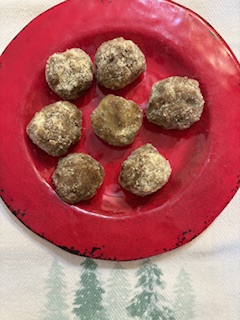
Tamari’s favorite treat is one of the world’s oldest recipes: Tiger Nut Sweets, a delicacy recorded on an Egyptian pot dating back to 1600 BC. Tiger nuts are making a comeback due to their unique nutritional properties, and are now widely available. Despite their name, tiger nuts are not nuts at all but tubers produced by a plant in the sedge family. You can substitute walnuts or pecans to achieve a similar texture and flavor.
Ingredients:
1 cup dried pitted dates
1 tbs cinnamon (or to taste)
2 tbs roughly chopped tiger nuts (or pecans or walnuts)
2 tbs honey (more if needed)
2 tbs finely ground almonds
· In a food processor, grind the dates with splash of water to form a sticky paste.
· Place the honey and almond meal in separate shallow bowls
· Transfer the date paste to a bowl and add the cinnamon (to taste), and chopped tiger nuts (or walnuts or pecans).
· Mix thoroughly with your hands and roll the paste into small balls.
· Coat balls in honey and then almond meal and serve.
Easy peasy, and a potential new Christmas tradition in your home!
May each day of Advent bring you peace, joy, and special blessings. KD Holmberg






 Sandra Merville Hart