Stuffed Baked Fish

Today’s post is by talented editor and fellow author, Pegg Thomas. Welcome back to Historical Nibbles, Pegg!

My story in The Great Lakes Lighthouse Brides collection, Anna’s Tower, is set on Thunder Bay Island near Alpena, Michigan. There was a thriving fishing village there in the 1800s, so I went looking for a fish recipe that might have been enjoyed by Anna and the rest of the characters living at Thunder Bay Lighthouse in 1883.

From Cement City Cookbook, Alpena, Michigan, 1910

STUFFED BAKED FISH

After cleaning fish, wipe out inside and rub in a little salt. Make a dressing of raw potatoes, chopped fine, and season with salt, pepper, onion and poultry savory. Stuff the fish with this dressing, sew it up and dredge with flour. Pepper and salt the whole and put pieces of pork or butter over the top, and 1 cup of water. Bake slowly 1 1/2 hours. Garnish the whole with chip potatoes or lemon.

My first challenge was finding a whole fish. It seems that not one single grocery or market in the county sells whole fish. That left one option … catching our own.

A call to our friend, Steve Benedict, resulted in a Friday evening spent on a pontoon at Lake Winyah. My husband caught a 16” small mouth bass, and Steve caught a 20” walleye. I caught a perch that was, ahem, a little under optimum size. Two fish were more than enough.

I’ve never been very good at following recipes. I view them as loose guidelines. To be historically accurate, we should have left the heads on the fish. But today’s diner has a bit of an aversion to an entrée that stares back from the platter. So the heads were removed. I grated the potatoes instead of chopping fine. It was faster. I have no idea what poultry savory is, so I used salt, pepper, and a little rubbed sage. The recipe doesn’t say whether or not to cover the roasting pan, so I did. A slow oven is about 325 degrees, and that worked out perfectly at an hour and a half.

Then, just to be bold and daring, I invited Steve and his wife plus another couple from church to come to dinner and be guinea pigs. Because if I’m going to have an epic fail, I want witnesses. Thankfully―it wasn’t! It was very tasty. If I ever do it again, I’ll omit dredging the fish in flour. And, to be honest, I’d probably fillet the fish and sew the two fillets together. I’m spoiled. I like the bones removed before the fish is cooked. Still, it was fun to play with this recipe from yesteryear.

-Pegg Thomas

Anna’s Tower is Pegg’s novella, part of The Great Lakes Lighthouse Brides collection.

 Blurb:

Anna’s dream of running the lighthouse was difficult enough to achieve, but then a Russian stowaway was left on the island, and that complicated everything.

Amazon

 About Pegg

Pegg Thomas lives on a hobby farm in Northern Michigan with Michael, her husband of *mumble* years. A life-long history geek, she writes “History with a Touch of Humor.” When not working or writing, Pegg can be found in her barn, her garden, her kitchen, or sitting at her spinning wheel creating yarn to turn into her signature wool shawls. Connect with Pegg on her blog at https://peggthomas.com/.


Civil War Romance Novel Releasing Next Week!

R E L E A S I N G   N O V E M B E R   8 t h ! ! !

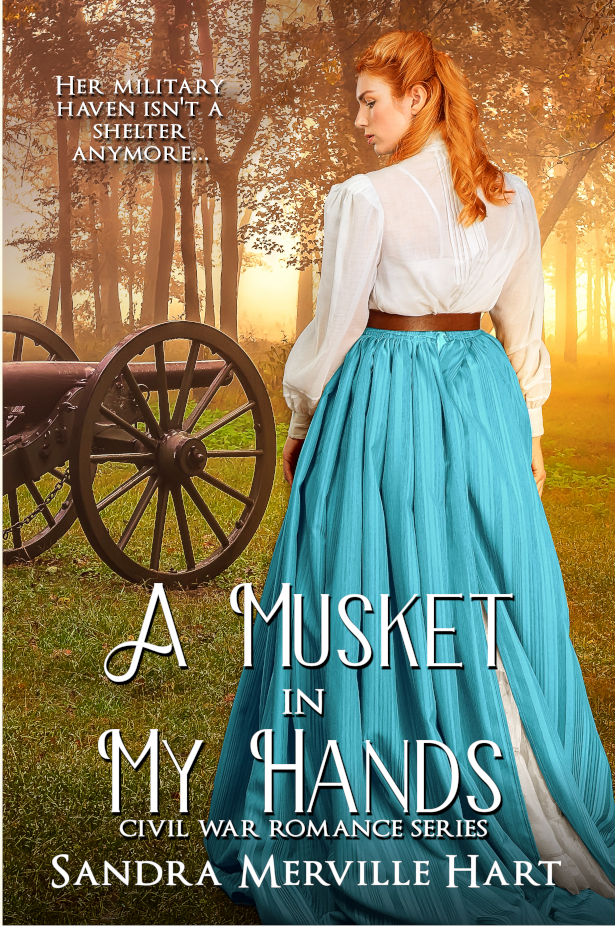
Sandra Merville Hart’s newest Civil War romance, A Musket in My Hands , follows two sisters as they disguise themselves as soldiers and join the men they love in the Confederate army—just in time for the war to grow progressively difficult for Southern soldiers. Tough marches lead them to the Battle of Franklin. How can anyone survive?

Can I count on you in times of great need?”

 Callie Jennings reels from her pa’s decision that she must marry his friend, a man older than him. Her heart belongs to her soldier hero, Zach Pearson, but Pa won’t change his mind. Callie has no place to hide. Then her sister, Louisa, proposes a shocking alternative.

Zach still hears his pa’s scornful word—quitter. He’s determined to make something of himself as a soldier. He’ll serve the Confederacy until they win the war. If they win the war.

Callie and Louisa disguise themselves as soldiers and muster into the Confederate army in the fall of 1864. Times are tough and getting tougher for their Confederacy. For Callie, shooting anyone, especially former countrymen, is out of the question—until truth and love and honor come together on the battlefield.

So thrilled that A Musket in My Hands received such a glowing endorsement from Civil War historian, Kevin Spencer:

Sandra Hart, author of the acclaimed A Stranger on My Land and A Rebel in My House has done it again with her third and best novel to date, A Musket in My Hands.  In this brilliant historical fiction, Sandra has sat against the backdrop of Confederate General John Bell Hood’s Tennessee Campaign a study of the little known but genuine phenomenon of women masquerading as men to serve and fight in the opposing armies of the Civil War.  An excellent and well-researched read, this is one of the first books I’ve read to put a touchingly human face on the horrendously bloody Battle of Franklin. 

-Kevin Spencer – author of “ON THIS DAY in North Carolina History”

Buy today on Amazon  for preorder prices!


Ways that Women Civil War Soldiers were Discovered

Women fighting as Civil War soldiers—whatever their reasons—kept their guard up constantly. There are about four hundred known cases of female soldiers fighting on either side. Many others likely joined for a short time and then donned a dress to quit without detection. Still, it was challenging for the women to remember their pretense twenty-four hours a day. Some were discovered.

A Wisconsin woman, Sarah Collins, donned her stockings and shoes the way a woman did and, before her regiment left town, was sent home.

It’s unclear what Mary Burns did, but she was probably recognized even wearing a uniform. She was arrested in Detroit—her company hadn’t left town yet.

“Charles Norton,” a female private in the 141st Pennsylvania Infantry, stole an officer’s boots. When her identity was discovered, she was quickly mustered out.

Two women soldiers got drunk on apple jack while on a foraging expedition. In their drunken state, they fell into a river. Comrades saved them from drowning. Their rescuers were shocked to discover they were women.

Comrades tossed apples to two female soldiers in the 95th Illinois. The women reached for their nonexistent aprons to catch the apples and were immediately discharged.

A female soldier from Rochester, New York, tried to don pants by pulling them over her head.

A pregnant corporal in a New Jersey regiment was promoted to sergeant for her bravery at the Battle of Fredericksburg in December of 1862. She hid her pregnancy by wearing an over-sized coat. On January 19, 1863, she went into labor on picket duty and complained of feeling unwell. Her complaints were ignored until her pain increased. Comrades carried her to a farmhouse where her healthy baby was born. Everyone learned the news but protected her by not mentioning her real name or her alias. Her name is still unknown today.

The most common way of discovery happened when women were wounded.

A girl from Brooklyn wanted to be the second Joan of Arc. Her family, desiring to save her, sent “Emily” to an aunt in Michigan. She ran away and joined the Army of the Cumberland as a drummer. Her identity was discovered when she was mortally wounded on Lookout Mountain.

Mary Owens enlisted with a man she secretly wed during their eighteen months in the army. She was wounded in the battle that took his life.

Malinda Pritchard Blalock, an excellent shooter, enlisted when her husband, Keith, was forced to muster into the 26th North Carolina Infantry. She pretended to be Keith’s brother, Sam. Her identity was discovered when she was wounded.

In my Civil War novel, A Musket in My Hands, two sisters have no choice but to disguise themselves as men to muster into the Confederate army in the fall of 1864—just in time for events and long marches to lead them to the tragic Battle of Franklin.

-Sandra Merville Hart

Sources

Abbott, Karen. Liar, Temptress, Soldier, Spy: Four Women Undercover in the Civil War, Harper, 2014.

Blanton, DeAnne and Cook, Lauren M. They Fought Like Demons, Louisiana State University Press, 2002.

Massey, Mary Elizabeth. Women in the Civil War, University of Nebraska Press, 1966.

Silvey, Anita. I’ll Pass for Your Comrade: Women Soldiers in the Civil War, Clarion Books, 2008.


The Army of Tennessee by Stanley F. Horn

A Military History

This nonfiction resource book traces the history of the Confederate Army of Tennessee from the beginning of the Civil War in 1861 to its ending in 1865.

When Tennessee voted to secede from the Union on June 1, 1861, volunteer military organizations were already in training. Drums and fifes played in the streets. Bands played Dixie and Bonnie Blue Flag.

This excellent book, published in 1941, provided many fascinating details not easily found in later publications.

For instance, I loved learning more about Sherman’s takeover of Atlanta. When he expelled the citizens from the city, the Army of Tennessee assisted the exiles as much as possible.

Excellent book for Civil War research and history lovers.

-Sandra Merville Hart

Blog Tour Stop on Lena Nelson Dooley’s Blog

Book giveaway!
Leave a comment on Lena Nelson Dooley’s blog  by Friday, November 2nd, for a chance to win a free copy of A Musket in My Hands!
Click on the link above to read a bit about me and my writing. I am thrilled to be a guest on multi-published author Lena Nelson Dooley‘s blog today. I was honored that Lena endorsed my novel. In a note to her readers, she said that “this book grabbed my heart, because the characters were so real to me…”
Thanks for your encouraging words, Lena.

Spoon Biscuit Recipe

There is a scene my Civil War romance, A Musket in My Hands, where spoon bread is a great treat for Confederate soldiers in the Army of Tennessee. A spoon bread recipe from Confederate Home Cooking uses cornmeal, not flour as this biscuit recipe from Buckeye Cookery and Practical Housekeeping cookbook does. The bread recipe also begins with scalding the milk, which the Buckeye Cookery cook (Mrs. A.B. Morey) does not mention for making the biscuits.

Flour was pretty scarce in most of the South after the Civil War started. By 1864—when my story begins—corn meal was a staple for most of the breads for Southerners.

Pour 2 cups of buttermilk into a medium-sized mixing bowl. Stir in one teaspoon of baking soda and one teaspoon of salt.

Melt 2 tablespoons of shortening and stir into the mixture.

Then Mrs. Morey advises adding enough flour to achieve a stiff batter. This was 2 ½ cups of flour for me.

These were dropped by spoon into a gem pan. These pans resemble modern muffin pans. I sprayed my mini muffin pan with cooking spray and dropped the thick batter into the small slots.

Bake the biscuits at 400 degrees until lightly browned, about twenty minutes—longer if using larger muffin pans.

The biscuits were good but somewhat bland. It seemed that this type of bread was probably spread with jellies, jams, and fruit butters such as apple butter. I tried it with apple butter and liked it much better. Though my husband liked them plain, I’m thinking of making sausage gravy to go with the leftover biscuits from this batch. Yum!

I had extra batter so I baked the spoon biscuit dough in a small loaf pan. This made a thick, hearty loaf of bread.

I’d love to hear if you try it.

-Sandra Merville Hart

Sources

Compiled from Original Recipes. Buckeye Cookery and Practical Housekeeping, Applewood Books, 1877.

Mitchell, Patricia B. Confederate Home Cooking, 1991.


Civil War Novel Releasing in Two Weeks!

Sandra’s third Civil War romance, A Musket in My Hands, follows two sisters as they disguise themselves as soldiers and join the men they love in the Confederate army–just in time for the war to grow progressively difficult for Southern soldiers. Tough marches lead them to the Battle of Franklin. How can anyone survive? 

This novel releases on November 8, 2018!

So honored to receive the following endorsement from such a well-known and  talented author:

I don’t always read Civil War novels, because I’m not into graphic battle scenes. Sandra Merville Hart’s A Musket in My Hands is a wonderful book. The characters grab your heart right from the beginning and they take you through a unique story line right into battles, where I followed willingly. The book isn’t battle-driven. It’s character driven, and the reader becomes intimately acquainted with these people who had to face things they never dreamed about happening. This is my favorite Civil War novel. I highly recommend it.

Lena Nelson Dooley – bestselling, multiple-award-winning author of 12 Gifts of Christmas, Esther’s Temptation, and Great Lakes Lighthouse Brides.

Available for preorder on Amazon – buy today for prerelease prices!


Challenges Faced by Women Civil War Soldiers

Loreta Janeta Velazquez as Civil War soldier Lieutenant Harry T. Buford

The Civil War kindled patriotic feelings in men and women on both sides of the conflict. Women who desired to serve their country as soldiers had to disguise themselves as men. They also faced challenges in camp life and in marching with men.

The first thing a woman had to do was sew or buy men’s clothing. She’d need trousers, a coat, shoes, and men’s blouses. Padding strategically sewn on undergarments helped mask female curves. Loreta Velazquez, who disguised herself as Confederate Lieutenant Harry T. Buford, used wire net shields to hide her shape.

The women also had to cut their long hair. Short hair and men’s clothing enabled her to pass as a soldier.

As the war progressed, requirements for physical examinations relaxed. The army needed soldiers and didn’t want to find reasons not to accept them. They had to have teeth so they could tear cartridges open. They needed a trigger finger to fire muskets and rifles.

Life in army camps were challenging. Women used the privacy of the woods for nature calls instead of latrines.

Poor nutrition, long marches, intense physical activities, and weight loss might have caused the women’s menstruation to cease, especially during tough campaigns.

Soldiers slept fully clothed, wearing coat and shoes, so this helped the women’s disguise. Bathing was infrequent yet there were men who also preferred privacy when the opportunity for bathing arose.

Women claimed to be younger than they were to explain the lack of whiskers. They kept their coats buttoned all the way to hide the missing Adam’s apple.

They had to remember to talk like a man.

They carried at least thirty pounds of equipment in addition to their haversack (which held their food) and a knapsack (which held clothing and personal belongings.)

And then there were the challenges of battle. The fear. The chaos. Officers shouting orders. When the noise of battle was too loud for soldiers to hear their officers shout orders, buglers and drummers played them. Soldiers had to know what the tunes meant.

No matter the reason for joining, women who served as Civil War soldiers were courageous.

In my Civil War novel, A Musket in My Hands, two sisters have no choice but to disguise themselves as men to muster into the Confederate army in the fall of 1864—just in time for events and long marches to lead them to the tragic Battle of Franklin.

-Sandra Merville Hart

Sources

Blanton, DeAnne. “Women Soldiers of the Civil War,” National Archives, 2018/09/29 https://www.archives.gov/publications/prologue/1993/spring/women-in-the-civil-war-1.html.

Blanton, DeAnne and Cook, Lauren M. They Fought Like Demons, Louisiana State University Press, 2002.

Massey, Mary Elizabeth. Women in the Civil War, University of Nebraska Press, 1966.

Silvey, Anita. I’ll Pass for Your Comrade: Women Soldiers in the Civil War, Clarion Books, 2008.

Velazquez, Loreta Janeta. The Woman in Battle: The Civil War Narrative of Loreta Velazquez, Cuban Woman & Confederate Soldier, The University of Wisconsin Press, 2003. (Previously published 1876)

Fort Donelson’s Legacy by Benjamin Franklin Cooling

War and Society in Kentucky and Tennessee, 1862-1863

This nonfiction resource book begins with the Confederate surrenders of Fort Henry and Fort Donelson in February, 1862. A few days later, the Confederates moved from Nashville to Murfreesboro.

Citizens in the middle section of Tennessee learned of this with sinking hearts. They knew tough times lay ahead. They could not have foreseen just how difficult those bad times would become.

After the Battle of Shiloh (April 6-7, 1862) Union General Grant stopped ordering his troops to protect private property regardless of owner loyalty.

This book shows what Tennessee citizens endured in 1862-1863, and how their circumstances grew progressively worse.

Excellent book for Civil War research and history lovers.

-Sandra Merville Hart

Amazon