by Sandra Merville Hart
Before Christmas lights adorned Christmas trees, candles were lit on the branches to signify the light of Jesus. The family gathered in the parlor while fathers lit the candles. Because of the fire hazard, these were quickly extinguished.
After Thomas Edison invented the light bulb, Edward Hibberd Johnson had an idea. In 1882, Johnson displayed his Christmas tree by his New York City parlor window where it was plainly visible from the street. He strung 80 light bulbs together (red, blue, and white) and arranged them around the tree which stood on a revolving pedestal. The power for the lights and pedestal came from a generator.
To ensure his lights received the public’s notice, Johnson contacted reporters. The brilliance of the lights stunned them. Folks on the street stopped to gaze in wonder. However fascinated people were, decorating with lights wasn’t feasible for most.
President Grover Cleveland helped popularize Christmas lights when he had the White House tree decorated with them in 1895.
Electricity wasn’t widely available for many years—and the lights were expensive. In 1903, a set (20 plain, 4 red, and 4 frosted bulbs) cost $12 when the average hourly wage was 22 cents!
The price dropped to $1.75 for a sixteen-foot string by 1914.
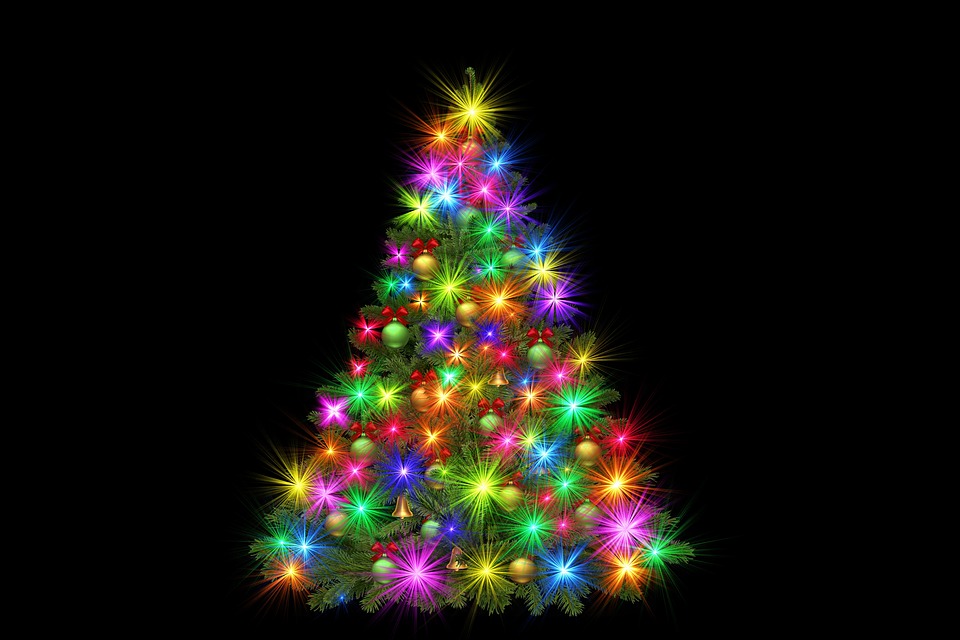
Today, Christmas lights adorn our trees and our homes. Many of us still take our families out to see special light displays during the holidays.
And we have Edward Hibbert Johnson to thank for this beautiful idea.
 Sources
Chan, Melissa. “Here’s How Christmas Lights Came to Be,” Time for Kids, 2019/08/15 https://time.com/4152307/christmas-tree-lights-history/.
Malanowski, Jamie. “Untangling the History of Christmas Lights,” Smithsonian.com, 2019/08/15 https://www.smithsonianmag.com/history/untangling-history-christmas-lights-180961140/.
Waggoner, Susan. It’s A Wonderful Christmas, Stewart, Tabori & Chang, 2004.
 Sandra Merville Hart