
United States Christian Commission


On November 14, 1861, a meeting of the Young Men’s Christian Association (YMCA) established the United States Christian Commission (USCC.) They were concerned with soldiers’ and sailors’ spiritual welfare and wanted to bring them to Christ.

Philadelphia merchant George Hay Stuart was the chairman. John A. Cole was general field agent.

Delegates of USCC helped regimental chaplains in caring for the soldiers. They gave religious tracts, hymnals, Bibles, and pocket testaments to soldiers. They held worship services, prayer meetings, and Bible Studies.

According to Chaplain William R. Eastman, 72nd New York, USCC provided a tent canvas for log chapels in the winter of 1863-64 near Brandy Station, each seating over 100 soldiers. Two daily services were held at City Point, Virginia—a 2:00 prayer meeting and 7:00 preaching service.

USCC also provided for physical needs. They carried no weapons yet went to battlefields, army camps, and hospitals. They worked as nurses. From the winter of 1863 on, they had about 100 Diet Kitchens to provide light meals. They gave stamps and stationery to soldiers for writing those important letters to loved ones back home.

They also provided coffee, a beverage dearly loved by soldiers. Their coffee wagons became popular. These wagons, traveling 8 miles per hour down rows of soldiers, supplied coffee for 1,200 men each hour. Hot coffee must have been quite a treat on a cold winter’s day.

Over 5,000 USCC volunteers traveled with the Union army throughout the South. Dwight Lyman Moody served as a volunteer. He held revival meetings at Confederate prisoner-of-war camps in Chicago, handing out pocket-sized Bibles.

-Sandra Merville Hart

Sources

Frey, Rebecca J. “U.S. Christian Commission,” Encyclopedia.com, 2018/12/28 https://www.encyclopedia.com/history/applied-and-social-sciences-magazines/us-christian-commission.

“United States Christian Commission,” Ohio History Central, 2018/12/28 http://www.ohiohistorycentral.org/w/United_States_Christian_Commission.

“United States Christian Commission,” Wikipedia, 2018/12/28 https://en.wikipedia.org/wiki/United_States_Christian_Commission.

Williams, Rachel. “The United States Sanitary and Christian Commissions and the Union War Effort,” National Museum of Civil War Medicine, 2018/12/27 http://www.civilwarmed.org/commissions/.
Civil War Women: Sarah Emma Edmonds as Franklin Thompson

At the age of sixteen in 1857, Sarah Emma Edmondson escaped an arranged marriage and an abusive father. She changed her last name to Edmonds. Emigrating to the United States from New Brunswick, she found a job more easily when disguised as a man, Franklin Thompson. When the war began, she lived in Flint, Michigan. Strong Union views led her to enlist in the 2nd Michigan Infantry as a male field nurse named Franklin Flint Thompson.

Emma nursed her comrades at such battles as the Battle of Antietam. She worked as a hospital attendant. She was also a mail carrier for her regiment, a dangerous job that often required horseback rides of over 100 miles.

A recurrence of malaria struck Emma in the spring of 1863. She requested a furlough, which was denied. Since she dare not visit the army’s medical staff for fear of discovery, she left camp in the middle of the night—Frank Thompson became a deserter.

Emma boarded a train to Oberlin, Ohio, where she recovered in a boarding house as Frank. Then she became a female nurse with the United States Christian Commission, where she served until the war ended. She wrote her memoirs in Nurse and Spy in the Union Army, first published in 1864.

There are no official records of Emma acting as spy for the Union army. She seems to have been talented at disguises. While a spy, she pretended to be Charles Mayberry, a Southern sympathizer; Cuff, a black man; and Bridget O’Shea, an Irish peddler.

After the war, Emma applied for a military pension. An Act of Congress finally cleared Franklin Thompson of desertion and she received the pension in 1884.

In 1897, Emma became the only woman admitted into the Grand Army of the Republic.

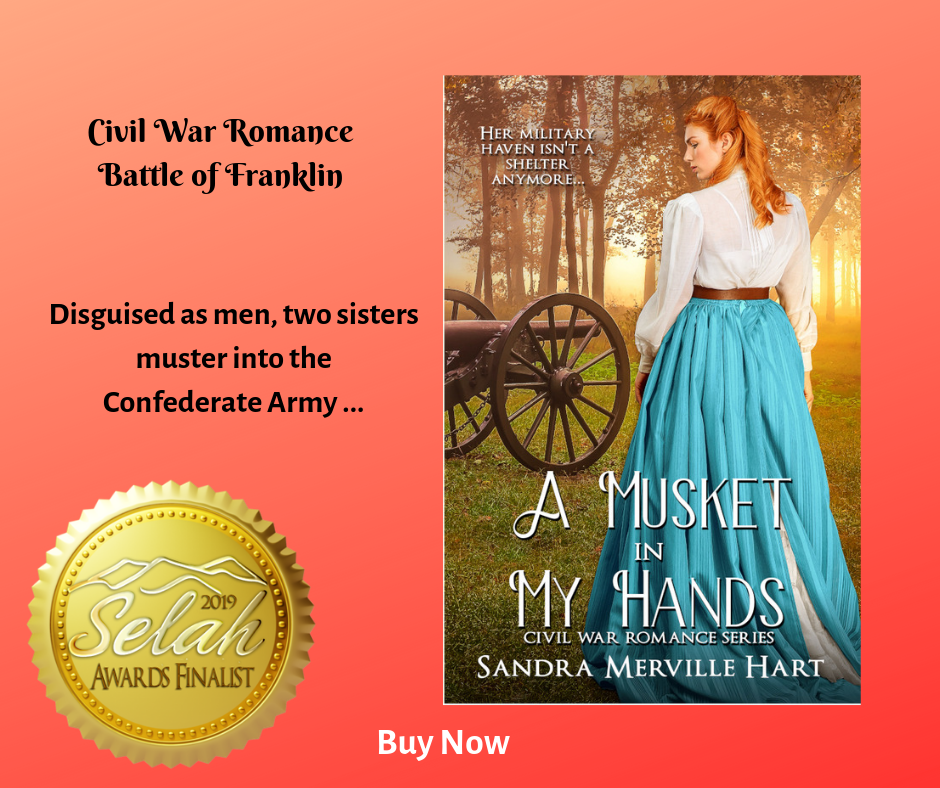
Emma left home to escape an arranged marriage, much as one of the sisters faced in my Civil War novel,  A Musket in My Hands. Two sisters disguise themselves as men and muster into the Confederate army in the fall of 1864—just in time for events and long marches to lead them toward the tragic Battle of Franklin.

-Sandra Merville Hart

Sources

Abbott, Karen. Liar, Temptress, Soldier, Spy: Four Women Undercover in the Civil War, Harper, 2014.

Blanton, DeAnne and Cook, Lauren M. They Fought Like Demons, Louisiana State University Press, 2002.

Massey, Mary Elizabeth. Women in the Civil War, University of Nebraska Press, 1966.

“Sarah Emma Edmonds,” Civil War Biography, 2018/12/10 https://www.battlefields.org/learn/biographies/sarah-emma-edmonds.

“Sarah Emma Edmonds,” National Park Service, 2018/12/10 https://www.nps.gov/people/sarah-emma-edmonds.htm.


Civil War U.S. Christian Commission

The War Between the States began in 1861. To meet the spiritual needs of Federal soldiers facing death, the Young Men’s Christian Association (YMCA) established the United States Christian Commission on November 14, 1861.

The Commission distributed thousands of New Testaments and prayer books to Union soldiers. They gave tracts and pamphlets. They operated portable libraries for the men. The organization also furnished free envelopes with their stamp and “Soldier’s letter” in one corner.

Commission workers were not paid. More than 5,000 gave freely of their time to serve as field volunteers to aid the chaplains ministering to soldiers. Citizens stitched clothes, raised money, and put kits together for Northern and Southern soldiers.

The Commission raised $3,000,000. Commission delegates requested donations of supplies.

Christian Commission workers provided medical supplies to field hospitals and were at Gettysburg after the battle.

The Ladies Christian Commission started in 1864. Louisa May Alcott, author of Little Women, was one of these workers. Georgia McClellan also served on this commission. Georgia’s sister, Jenny Wade, had been killed during the Battle of Gettysburg.

-Sandra Merville Hart

Sources

Billings, John D. Hard Tack and Coffee, George M. Smith & Co., 1887.

“Civil War Christian Commission Was Formed,” Christianity.com, 2017/07/04  http://www.christianity.com/church/church-history/timeline/1801-1900/civil-war-christian-commission-was-formed-11630528.html.

Davis, William C. The Illustrated Encyclopedia of the Civil War: The Soldiers, Generals, Weapons, and Battles, The Lyons Press, 2001.

“United States Christian Commission,” Wikipedia, 2017/07/04 https://en.wikipedia.org/wiki/United_States_Christian_Commission.