Civil War in Washington DC: The Willard Hotel

by Sandra Merville Hart

City Hotel, located at 1401 Pennsylvania NW in Washington DC, was expanded after Henry Willard leased it in 1847. He soon brought his brother, Joseph, into to the business and changed the name to Willard Hotel. They built a six-floor hotel on the southwest corner of 14th and F Streets. The brothers purchased a Presbyterian Church on F Street and converted it to a meeting hall with an auditorium called Willard Hall.

Henry went the extra mile to make his hotel successful. He greeted hotel guests as they stepped out of the stage. He was at the Central Market before dawn to select the highest quality of products available to serve for in his hotel’s dining rooms. Henry donned a white apron to carve meats at the dining table.

By the Civil War, the hotel was a center of activity for the bustling capital then known as Washington City. Luxurious gentlemen’s and ladies’ dining rooms could accommodate 2,500 diners daily. Elegant parlors invited guests to linger after a meal before retiring to their rooms.

The hotel also boasted of a 150-foot ballroom, where it hosted lavish events like the Napier Ball, given as a farewell on February 17, 1859, to the British Ambassador Lord Francis Napier and Lady Anne Napier. Eighteen hundred guests paid an expensive price of $10 each to attend. The ball’s success boosted the hotel’s prestige.

Willard’s boasted another honor—both Franklin Pierce and Abraham Lincoln stayed at their hotel before their presidential inaugurations.  

After the war began, Union regiments poured into the city for further training and the hotel lobby became a common meeting place for Union officers to make their reports.

One of these regiments, the 11th New York Infantry, was made up of firemen under Colonel Elmer F. Ellsworth. The entire regiment wore red shirts, gray breeches, gray jackets, and red caps, so they stood out in a crowd.

On May 9, 1861, the Willard brothers had cause to be grateful for Ellsworth’s Zouves when fire engulfed Samuel Owen’s tailor shop, which adjoined their hotel. With equipment borrowed from local firehouses, Ellsworth’s men helped the Washington Fire Department extinguish the blaze. His entire regiment was eventually called to fight the fire and Ellsworth, using the fire chief’s trumpet, took command until the crisis ended.

Henry Willard was so pleased with the results that he invited them all to breakfast. Undoubtedly, the situation would have been much worse without so many capable firefighters.

Union soldiers training for the Civil War battlefields faced a familiar battle that day.  

There is a scene at the Willard Hotel when characters in my novel, Avenue of Betrayal, Book 1 of my “Spies of the Civil War” series, dine there. I was thrilled to use such an important location in the story.  
Sources

“11th New York Infantry Regiment,” Wikipedia, 2022/02/25 https://en.wikipedia.org/wiki/11th_New_York_Infantry_Regiment.

“A Ball at Willard’s,” White House Historical Association, 2022/02/25 https://www.whitehousehistory.org/photos/a-ball-at-willards.

Epstein, Daniel Mark. Lincoln and Whitman: Parallel Lives in Civil War Washington, Ballantine Books, 2004.

Selected by Dennett, Tyler. Lincoln and the Civil War In the Diaries and Letters of John Hay, Dodd, Mead & Company, 1939.

“The Willard Hotel,” White House History, 2020/06/11 https://www.whitehousehistory.org/the-willard-hotel.

“The Willard Hotel in the 19th Century,” Streets of Washington, 2020/06/11 http://www.streetsofwashington.com/2012/07/the-willard-hotel-in-19th-century.html.

Waller, Douglas. Lincoln’s Spies, Simon & Schuster, 2019.

“Willard Hotel,” National Park Service, 2020/06/11 https://www.nps.gov/nr/travel/wash/dc36.htm.

“Willard InterContinental Washington,” Wikipedia, 2020/06/11 https://en.wikipedia.org/wiki/Willard_InterContinental_Washington.
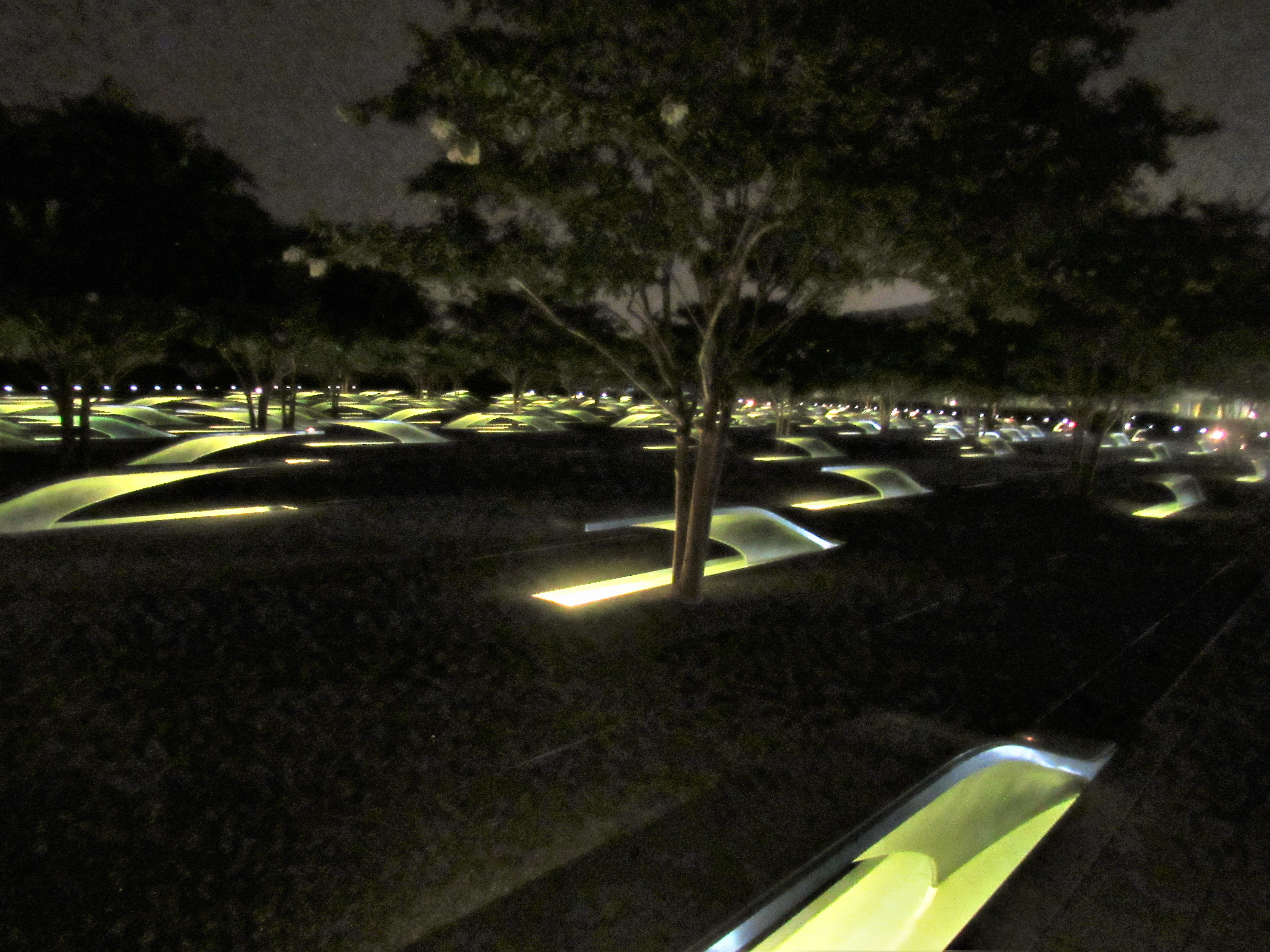
Pentagon Memorial

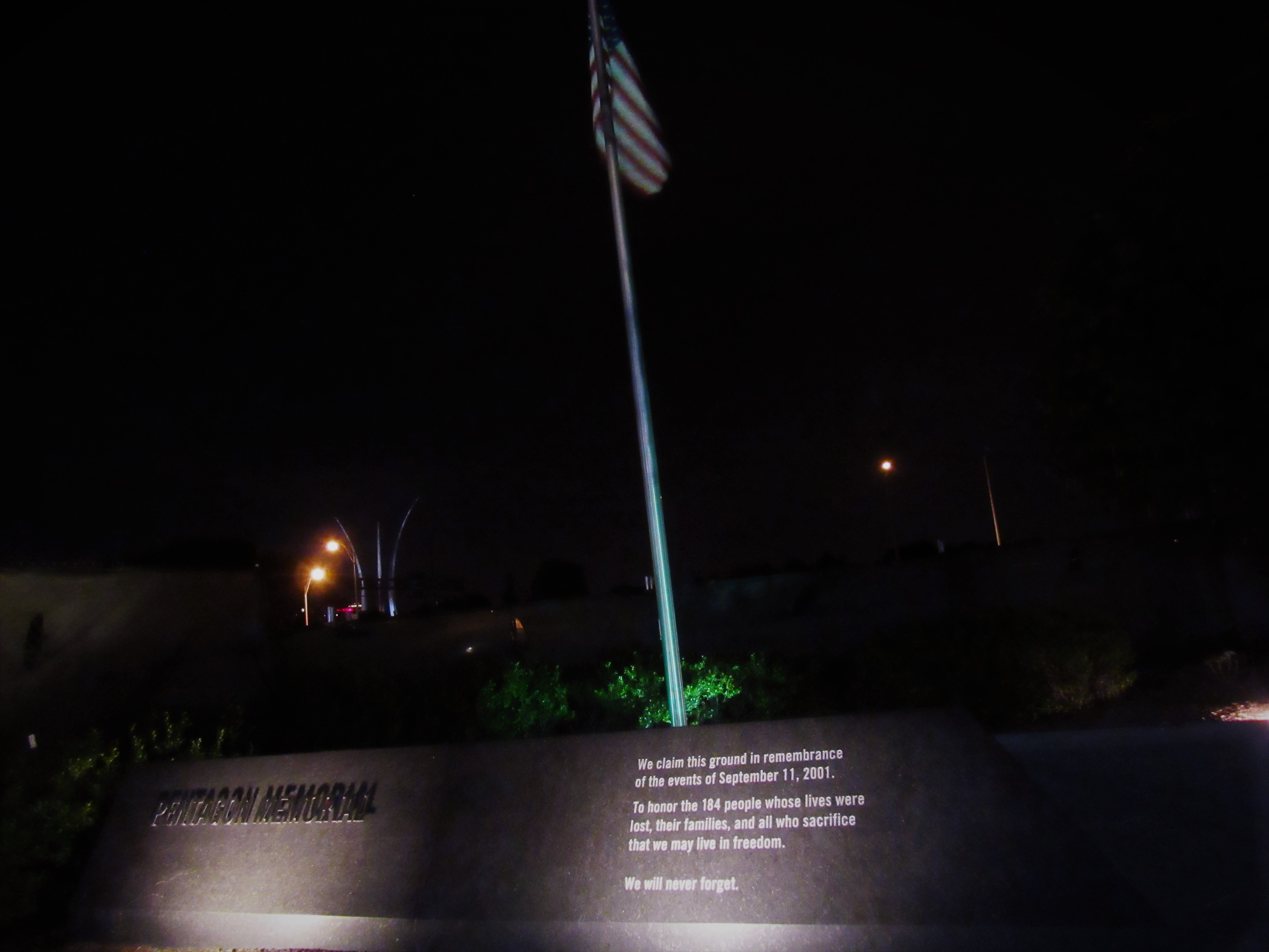
On a recent trip to Washington, DC, I visited the Pentagon Memorial. It was late in the evening and there were only a handful of visitors at the memorial. As I looked at the benches—184 of them—with lighted pools of water flowing underneath, I was struck once again by the tragedy of September 11, 2001.

No American alive that day can forget its horror. Four commercial airplanes were hijacked in coordinated attacks on specific targets and tragic loss of innocent lives resulted.

Five hijackers boarded American Airlines Flight 77 to Los Angeles from Dulles International Airport that sunny morning. The flight, delayed 10 minutes, departed at 8:20 am with 58 passengers and a crew of 6. What the crew didn’t know was that armed hijackers were among the passengers.

While flying over eastern Kentucky, hijackers took control of the plane, possibly between 8:51 and 8:54 am. It’s believed that one of them piloted the plane. None of the radio messages sent to the pilot after that time were answered.

It crashed into the Pentagon at 9:37 am, bringing a tragic end to 184 innocent lives.

The Pentagon Memorial, in remembrance of those who died there, opened on September 11, 2008. Architects Julie Beckman and Keith Kaseman along with engineer Buro Happold designed the memorial in a timeline, from the youngest victim (Dana Falkenberg at 3) to the oldest victim (John D. Yamnicky at 71), both on Flight 77.

Victims’ names have been placed on cantilevered benches with pools of flowing water underneath, which are lit at night. The designers put a lot of thought into the placement of the benches. Visitors read the names of those who perished in the Pentagon with that building behind it. Names face the sky where the plane approached for those from Flight 77.

Beautiful Crepe Myrtles, 85 of them, will eventually grow to height of 30 feet, giving shade to the Memorial in future years.

The Age Wall starts at a height of 3 inches for the youngest victim and builds to 71 inches for the oldest.

It’s a beautiful, well-designed unique memorial.

May we never forget.

-Sandra Merville Hart

Sources

“Pentagon Memorial,” The National 9/11, 2019/09/05 https://pentagonmemorial.org/.

“Pentagon Memorial,” National Geographic, 2019/09/05 https://www.nationalgeographic.org/media/pentagon-memorial/.


J.E.B. Stuart’s June 1863 Raid into the North

From Observation Tower at Oak Ridge, Gettysburg Battlefield

Confederate General J.E.B. Stuart left Salem Depot with three brigades on June 25, 1863, at 1 a.m. Brig. General Fitzhugh Lee, Brig. General Wade Hampton, and Colonel John R. Chambliss led the brigades.

Captain John Esten Cooke, Stuart’s chief of ordnance, wrote of his experiences on the raid. Stuart shouted orders to “Ho! for the Valley!” while in the villagers’ hearing. Once out of sight, he changed course to head eastward. They bivouacked under pine trees that night. The following evening, they skirted around Union General Hooker’s rear force in Manassas.

The cavalry passed abandoned cabins and debris near Fairfax Station where they must have found supplies because Captain Cooke laughed to recall that every Southerner wore a white straw hat and snowy cotton gloves. A bale of smoking tobacco or drum of figs rested on the pommel of every soldier’s saddle. They held ginger cakes.

Each cavalry man held aloft a case, shell, or solid shot with fixed cartridge when crossing the Potomac River on June 28th at 3 a.m. to keep the ammunition dry.

As Stuart’s cavalry approached Rockville, Maryland, from the south, a Federal wagon train of nearly 200 wagons entered from the east. The new and freshly painted wagons, each drawn by six sleek mules, stretched out for miles. Stuart’s men chased the fleeing wagons and captured them within sight of Washington D.C. Cooke believed he saw the dome of the Capitol.

Stuart captured Union prisoners, set fire to some of the wagons, and seized the rest of them.

The Southerners reached Brookville that night, where beautiful girls fed them from baskets filled with cakes, meat, and bread. They offered huge pitchers of iced water. Stuart paroled hundreds of the wagon train prisoners at Brookville before riding on.

On June 29th, Stuart’s men arrived at Westminster. They clashed with Union cavalry and chased them along the Baltimore road, causing Baltimore citizens to panic.

They left Westminster and bivouacked in the rain. They reached Pennsylvania the next day.

Stuart’s cavalry scattered Union Brig. General Judson Kilpatrick’s cavalry near Hanover. Kilpatrick rallied and drove the Southerners out of town.

Still traveling with a long wagon train they confiscated, Cooke writes that they “rode, rode, rode” perhaps all night because he does not mention them camping. They paroled more prisoners at Dover, which they reached around sunrise.

On the evening of July 1st, Stuart’s cavalry arrived at the Federal army post of Carlisle. A short assault ended when General Lee ordered Stuart to Gettysburg. He arrived there on the afternoon of July 2nd, the second day of the famous battle.

-Sandra Merville Hart

Sources

Gragg, Rod. The Illustrated Gettysburg Reader: An Eyewitness History of The Civil War’s Greatest Battle, Regnery History, 2013.

“J.E.B. Stuart,” A&E Television Networks, LLC, 2017/05/03 http://www.history.com/topics/american-civil-war/j-e-b-stuart.

“J.E.B. Stuart,” Wikipedia, 2017/05/03 https://en.wikipedia.org/wiki/J._E._B._Stuart.