InA Spring at The Greenbrier, Book 7 in Romance at the Gilded Age Resorts Series, Marilla, our heroine, works at The Greenbrier. This historic resort had been purchased from previous owners in 1910, who renamed it “The White”. Guests who had been returning for long stays year after year chose to affectionately refer to the hotel as “The Old White”.
Three churches held Sunday services at The Greenbrier around the time it changed hands. St. Thomas’ Episcopal Chapel had been built in 1885. Local residents had built a Methodist church in 1855, and it was largely attended by guests as well as townspeople. From its high position on the resort, St. Charles, Church of Rome, offered breathtaking views to churchgoers.
The grounds had changed little for fifty years before the new owners took over in 1910. Dramatic changes were made in the remodeling and not only in the addition of wings.
New walkways were laid on the center of the grounds after the old dining room was torn down. Romantic trails were created in the woods, giving couples plenty of choices—Lover’s Walk, Hesitance Row, Lover’s Leap, Courtship Maze, Rejection Row, and Acceptance Way to Paradise.
Although the needs of her family has forced Marilla, our heroine in A Spring at The Greenbrier, to push aside dreams of a husband and family, she still longs to walk the romantic trails with a handsome beau.
Sources
Conte, Robert S. The History of The Greenbrier: America’s Resort, Pictorial Histories Publishing Co., 1989.
McDowell, Aubin Aydelotte. Greenbrier White Sulphur Springs: White Sulphur Springs as known in History and Tradition, W.F. Roberts & Co, 1909.
I purchased this book to discover the history for The Greenbrier, the beautiful resort in White Sulphur Springs, West Virginia. I was researching the background for my book, A Spring at The Greenbrier, Book 7 in Romance at the Gilded Age Resorts Series. Not only does my heroine work there in the new Bath Wing but also her younger sister needs to bathe in the spring waters to possibly help her.
This book is well-written and easy to read. It traces the history of the health resort from its humble beginning.
Lots of tidbits, historical facts, and stories about early guests make this a delightful read. Because the resort soon catered to wealthy guests who stayed for weeks at a time, there were many famous visitors, including United States Presidents.
Recommended for readers of American history and those interested in learning the sulphur springs.
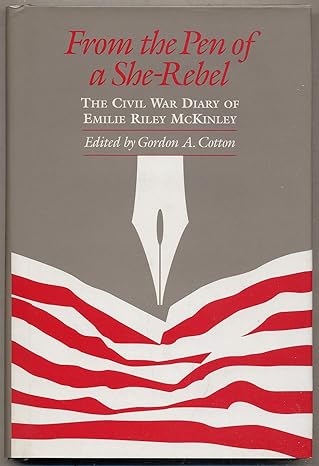
From the Pen of a She-Rebel: The Civil War Diary of Emilie Riley McKinley
This is the Diary of Emilie Riley McKinley, who lived a few miles outside of Vicksburg. It spans 10 months—from May 1863 to March 1864, covering the Siege of Vicksburg, the surrender, of part of occupation of Vicksburg.
Emilie lived on a plantation. Groups of Union soldiers came to the home and took away livestock, pistols, and rifles. They continued to come, and took the family’s meat and produce away in the family’s wagons without payment, despite the owner’s protests.
Sometimes different groups of soldiers came several times a day. This happened before the Battle of Vicksburg, during the Siege of Vicksburg, and continued after the surrender.
Soldiers and others, armed with weapons, searched homes for valuables and dug up hidden treasures like silver. These were taken.
As I read the book, I was shocked at what one family and their neighbors endured. The account held my attention.
I purchased this book to discover the history for the siege.
Recommended for readers of American Civil War history and American history.
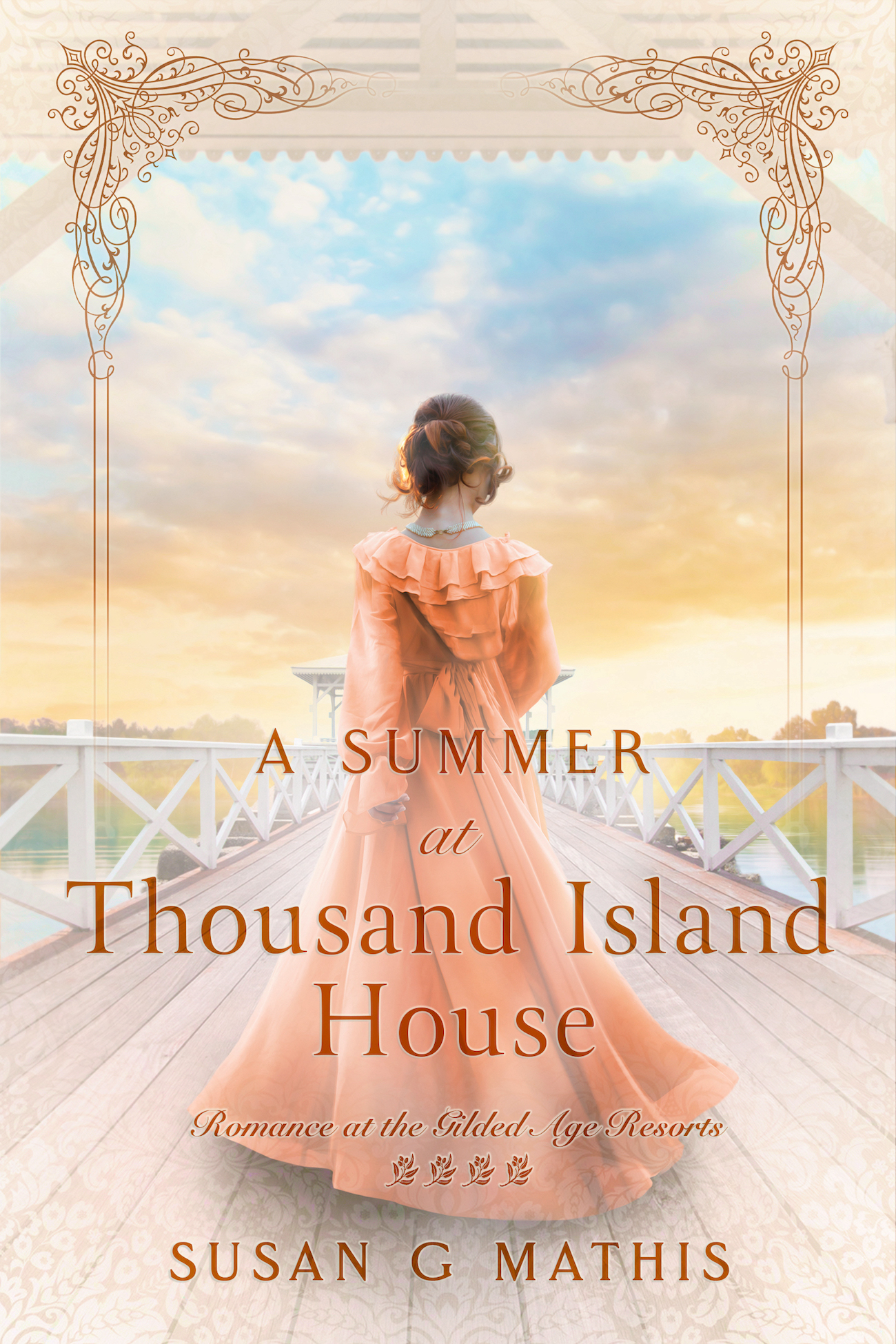
Welcome Susan G. Mathis, fellow author at Wild Heart Books, back to Historical Nibbles! Susan shares some historical background for her latest release, A Summer at Thousand Island House. Welcome back, Susan!
More than 1800 islands, known as The Thousand Islands, lay between New York state and Ontario, Canada, where Lake Ontario narrows and becomes the St. Lawrence River. Here the Great Lakes and the St. Lawrence River intersect to become the world’s largest inland navigation system. Huge freighters pass by tiny islands along the main channel and share the waterway with all kinds of boats including kayaks and canoes!
In 1872, George M. Pullman invited President Ulysses S. Grant to visit his small island during the reelection campaign, as well as several Civil War heroes including General Sheridan. When President Grant and his entourage came, the Thousand Islands became a national event. The press touted the Thousand Islands as THE place to summer for the rich and famous and common man alike.
In so doing—and thanks to excited journalists—he launched The Thousand Islands Gilded Age season of the rich and famous buying islands and lots along the mainland and building castles, mansions, and magnificent summer homes. Those islands, those homes have delightful, intriguing, and often poignant stories to tell. And I aim to tell a lot of those stories, including Katelyn’s Choice that tells the Pullman Island story and now, ten other stories including my latest, A Summer at Thousand Island House.
From 1872 until 1914 the Thousand Islands Gilded Age brought tens of thousands of visitors to the enchanting summer resort. Grand hotels popped up. The rich scooped up islands and built fancy mansions and castles they called cottages and hunting lodges. The middle class bought small parcels of land along the mainland and built simple cottages.
And tourism took off.
The railroad expanded to bring in tourists and landowners. Large side-paddle steamboats toured passengers around the islands, and distinguished visitors made it the summer resort to visit. They came from New York City, Chicago, Cleveland, Pittsburgh, and many other places.
Several of the amazing castles and beautiful summer homes you can still tour today including Boldt Castle and “The Towers” on Dark Island (now called Singer Castle) which is the setting for Devyn’s Dilemma, and many others.
About A Summer at Thousand Island House
By Susan G Mathis
She came to work with the children, not fall in love.
Part-nanny, part entertainer, Addison Bell has always had an enduring love for children. So what better way to spend her creative energy than to spend the summer nannying at the renowned Thousand Island House on Staple’s Island? As Addi thrives in her work, she attracts the attention of the recreation pavilion’s manager, Liam Donovan, as well as the handsome Navy Officer Lt. Worthington, a lighthouse inspector, hotel patron, and single father of mischievous little Jimmy.
But when Jimmy goes missing, Addi finds both her job and her reputation in danger. How can she calm the churning waters of Liam, Lt. Worthington, and the President, clear her name, and avoid becoming the scorn of the Thousand Islands community?
ABOUT SUSAN:
Susan G Mathis is an international award-winning, multi-published author of stories set in the beautiful Thousand Islands, her childhood stomping ground in upstate NY. Susan has been published more than twenty-five times in full-length novels, novellas, and non-fiction books. She has ten in her fiction line including, The Fabric of Hope, Christmas Charity, Katelyn’s Choice, Devyn’s Dilemma, Peyton’s Promise, Sara’s Surprise, Reagan’s Reward, Colleen’s Confession, Rachel’s Reunion,Mary’s Moment andA Summer at Thousand Island House.Her book awards include two Illumination Book Awards, three American Fiction Awards, two Indie Excellence Book Awards, and four Literary Titan Book Awards. Reagan’s Reward is a Selah Awards finalist. Susan is also a published author of two premarital books, two children’s picture books, stories in a dozen compilations, and hundreds of published articles. Susan makes her home in Colorado Springs and enjoys traveling around the world but returns each summer to enjoy the Thousand Islands. Visit www.SusanGMathis.com/fiction for more.
It was fun to invite readers on this book’s journey with an aspiring writer and a female telegraph operator!
To those who lived in the 1880s, venturing into the newly-settled and largely-unsettled West had become much safer—though not without danger—with the system of railroads already in place. I enjoyed taking readers to Chicago, Omaha, Oakland, Ogden, and Sacramento, as well as frontier towns along the journey such as Cheyenne.
Our heroine is a telegraph operator. She temporarily leaves her job to escort a little girl to her ailing mother in San Francisco.
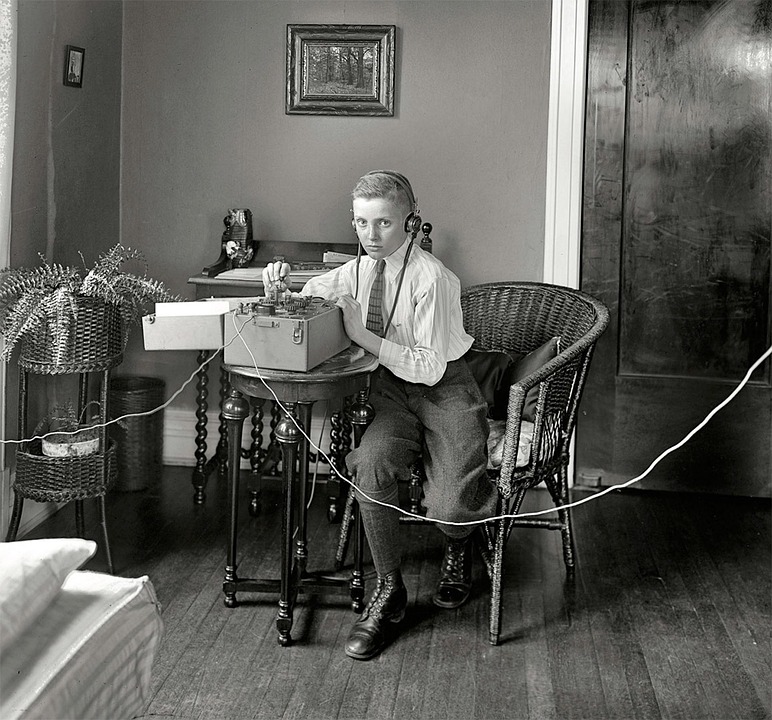
My research about telegraph jobs taught me quite a bit of terminology.
For example, a clatter arises when another operator “calls.” The call begins with something like “B m—X n”, which means the B m is the station receiving the call and X n is the caller.
B m must signal a reply that she’s ready to receive the call.
The Sounder receives sounds of the alphabet in dots and dashes. Some operators sent messages too rapidly to understand. When this occurs, the receiving operating asks for it again with a Break (she opens her “key” to break the circuit) and interrupts with “Please repeat.”
“G.A. the—” means “Go ahead” and “the” was the last word she understood.
Operators end every message with his/her own private “call” as well as the office’s call and “O.K.” at the end of each message.
Wired Love, which was written by telegraph operator Ella Cheever Thayer in 1879, provided many insights about the job’s daily tasks.
One of them was the lack of privacy on the lines. She can hear the messages sent to other wires but only offices on the same wire. In Wired Love, operators heard messages sent to and from twenty offices.
By the way, the public grew so fascinated with the role of women in telegraphy that it became the topic of romance novels and short stories, creating a new genre called “telegraphic romance” in the latter 1800s. That’s a little-known fun fact for you!
The heroine in my recent release, A Not So Peaceful Journey, Book 3 in my “Second Chances” series is a telegrapher in Hamilton, Ohio. I researched to find out about the daily activities required by the job in 1884.
Female telegraph operators had been hired for the job as early as the 1840s. In 1846, Sarah Bagley performed that job in Lowell, Massachusetts. Three years later, Phoebe Wood accepted the position in Albion, Michigan.
During the Civil War, the need for telegraphers heightened when the men enlisted in the military for both sides, putting more women in the industry. Training for female telegraphers became more available when Western Union opened a school for them in 1869. A year later, 4% of the telegraphers were female and that number continued to rise.
One fun thing I learned in my research was that the increased number of women in the profession sparked public interest. This led to novels and stories being written about them.
A new literary genre, telegraphic romance, was born. In these stories, young women found romance with operators they “met” in the course of their job.
Desiring to learn more about the day-to-day job of the telegraphers, I read Wired Love: A Romance of Dots and Dashes by Ella Cheever Thayer. It was published in 1880 and it provided all those daily details—and more—that I needed for my story.
In the novel, Feisty Nattie Rogers is a telegraph operator. She meets the mysterious “C”, a telegraph operation in another station on her wire. He refuses to tell her his full name and they develop a friendship over the wire that soon has her dreaming of love.
Nattie tells her fellow boarders all about “C” and they can’t wait for the two of them to meet. But the course of true love meets some hurdles.
This book is written in the omniscient viewpoint. The reader knows what everyone is thinking all the time. Written in 1880, this story has the long conversations prevalent in writings of that day. I confess that I skimmed over some of those, but still enjoyed the story.
What was important to me wat that the author gives a thorough overview of a telegrapher’s job in the story.
What fun that this occupation inspired a new genre in the late 1800s!
I have wanted to write a story set in Cincinnati, Ohio, in the 1880s for several years. It seems that it was on my heart to write even when writing was but a dream for me.
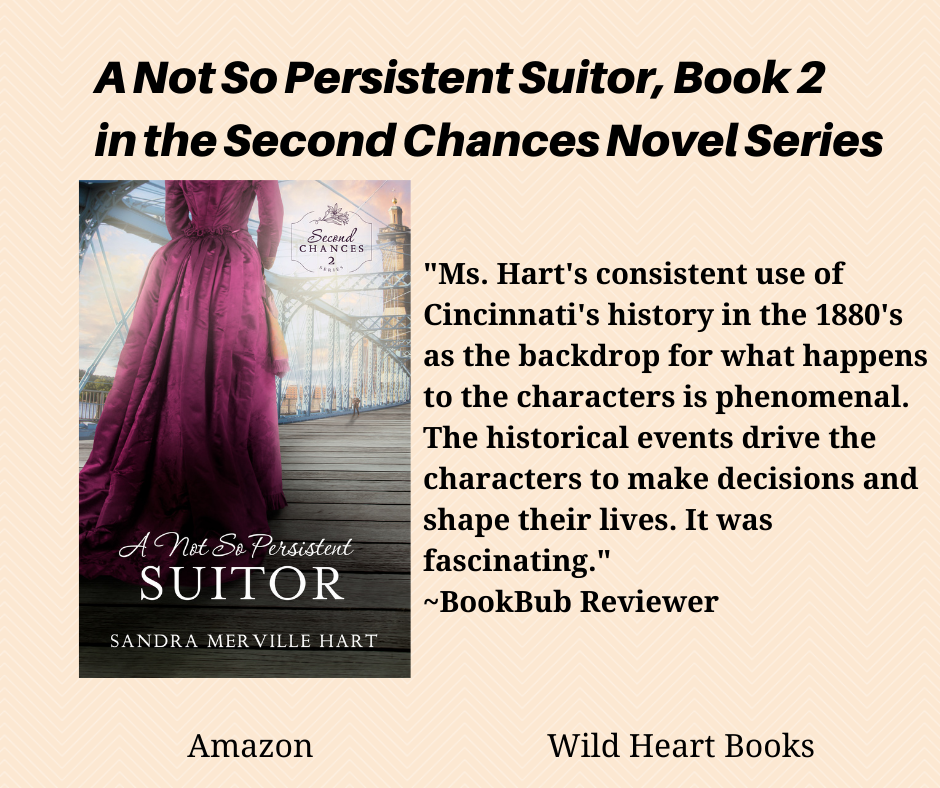
In A Not So Persistent Suitor, Book 2 in my Second Chances Novel Series, twins Cora and John had been living on their family’s farm before moving to Cincinnati to attend college. John went rogue on me (he does that in Book 3 too 😊) and got a job at a newspaper working with Ben, and decided not to go to college. Meanwhile, Ben begins to court Cora.
When our story begins, Cora is in her second and final year at the Cincinnati Kindergarten Training School. Kindergarten is still in its infancy in 1883, when our story begins. In fact, the demand for kindergartens grew in the 1870s. There were about four hundred kindergartens by 1880, and the need to train teachers for them was a natural part of that growth.
A training school in Cincinnati was organized in March of 1880. At first, kindergarten students (aged four – six) learned the 3 R’s –reading, writing, and arithmetic. Before long, principals in higher grades complained that kindergartners also needed a basic knowledge of music, drawing, and manual training.
This led to greater training for kindergartener teachers, who learned teaching tools that included games, songs, and handwork.
I imagine that incorporating games, songs, and activities engaged the children’s interest in a new and fun way for them.
Part of my research included The Songs and Music of Friedrich Froebel’s Mother Play by Fro. Bel. Friedrich. Early training schools used Friedrich Froebel’s writing extensively in their training so I mentioned his Mother Play book within the story.
Though demand for kindergartens was growing, most schools didn’t address the needs of these four to six-year-old children by providing a kindergarten class. Cora has to fight for a local school to start a new class to open the fall after she graduates.
Another fun thing about this novel is the places I’ve included that the modern reader familiar with Cincinnati will recognize: Fountain Square, the Suspension Bridge, St. Peter’s Cathedral, and the Zoological Gardens to name a few.
Follow characters you’ve grown to love in A Not So Convenient Marriage, Book 1 in the “Second Chances” series into A Not So Persistent Suitor, Book 2!
More about A Not So Persistent Suitor
He’s fighting for his career…She’s bent on achieving her own goals…Will their love survive a second chance at happily ever after?
Cora Welch dreams of a future teaching kindergarten, which is in its infancy, and marriage to Ben Findlay, her beau and her twin brother’s best friend. But she returns to college from summer break to learn of Ben’s unwise choices in pursuit of his career—choices that destroy her trust in the man she thought she knew and loved.
Ben is working hard toward his dream to become the best reporter in the city. He’s no stranger to fighting for a goal against all odds, ever since he was orphaned at age thirteen. Even though Cora has captured his heart, he makes the mistake of escorting the boss’s daughter to a fancy banquet to further his career—with far-reaching repercussions. Now he’s hurt Cora and botched his career goals.
Winning Cora’s trust again proves harder than Ben expects, especially as they both face struggles of their own. When events spiral out of their control, catapulting them into hardship and even danger, only God can restore their dreams—though the outcome may look far different than either of them planned.
My husband and I recently joined a group of author friends for a fun day of learning about the Underground Railroad in Ripley, Ohio.
We started out with lunch at the Cohearts Riverhouse. This restaurant is on Front Street, which borders the Ohio River. Friendly staff, a cozy atmosphere, and good food made for a wonderful experience.
Next, we went about a half mile to John Rankin House. John Rankin, a Presbyterian minister, built his home high on a hill. He kept a lantern lit in his front home where it was visible across the Ohio River to the slave state of Kentucky.
Rankin, his wife, and his children helped hundreds of escaped slaves, escorting them on their way to that next station on the Underground Railroad. Although there were many times when sheriffs and slave catchers sneaked onto the Rankin homestead in the middle of the night, accompanied by gunfire, in pursuit of fugitives, no one was ever caught. None of the family members were killed and all of the fugitives made it safely to the next station.
We were all impressed by the success and sacrifices of the entire Rankin family as we traveled less than half a mile to the Parker House, a man equally as inspiring.
John P. Parker was born into slavery and was sold away from his mother. He ended up at a doctor’s home where the doctor’s sons taught him how to read. John ran away repeatedly but was always caught. Eventually he was sold to a woman who agreed to allow him to buy his freedom for $1,800. He accomplished this and bought his freedom in less than 2 years.
He eventually ended up in Ripley, Ohio. John’s hatred of slavery spurred him to take many trips into Kentucky at night to help fugitives to freedom—journeys filled with danger for, if caught, John would have been hung.
Docent Dewey Scott made the story come alive in his presentation.
We learned a lot that afternoon at both museums. The Rankin and Parker families are an inspiration.
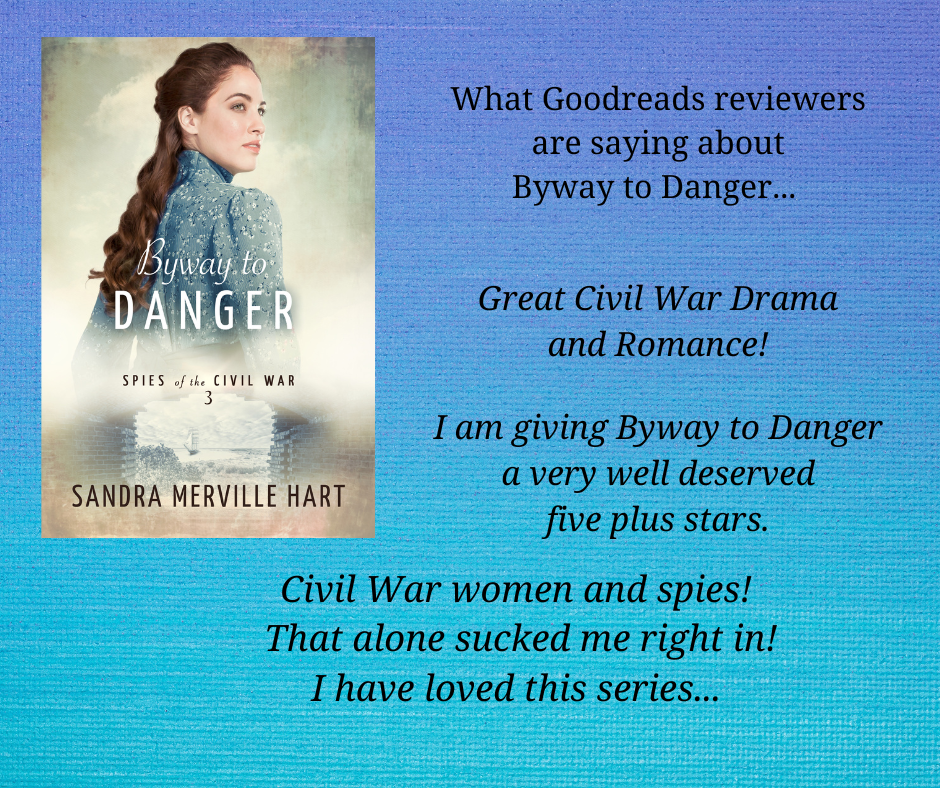
I found this whole afternoon especially inspiring because one of the characters in Byway to Danger, Book 3 in my “Spies of the Civil War” series, has a station on the Underground Railroad in Richmond.
Sources
“John P. Parker House,” National Park Service, 2022/08/08
Henry “Box” Brown earned his unusual nickname in a surprising way. Wishing to escape slavery in a Richmond tobacco factory, Brown mailed himself to Philadelphia.
Brown’s wife, Nancy, was also enslaved by Samuel Cottrell and lived with their children on an adjacent plantation. Brown developed skills at the factory that enabled him to earn money. Cottrell charged Brown $50 a year to not sell his family. Brown paid it but Cottrell sold his pregnant wife and three children anyway in 1848.
His grief spurred him to escape. Brown, a Christian, sang in the choir at the First African Baptist Church. He prayed for guidance about his escape and the answer came to get in a box and mail himself.
Brown turned to James Caesar Anthony Smith, a free black choir friend, for help. James knew a white sympathizer, Samuel Alexander Smith, who agreed to help for a price. Samuel arranged for Henry to be shipped via Adams Express Company to James Miller McKim of the Philadelphia Anti-Slavery Society who also participated in the Underground Railroad.
On March 23, 1849, Henry traveled in a 3 feet long, 2 feet wide, and 2 ½ feet deep wooden box labeled “Dry Goods” and “This Side Up.” The box was lined with coarse wool cloth. With one air hole cut into the box, a few biscuits and water, Henry traveled by train on the Richmond, Fredericksburg, and Potomac Railroad to a steamboat on the Potomac River.
His box was turned upside down and Henry felt like he wasn’t going to survive the trip. Then two men who needed a seat turned his box the right way to sit on it, possibly saving Henry’s life.
When he finally arrived 26-27 hours later, four men opened his box. Henry recited a psalm about waiting patiently on the Lord. Then he sang the psalm, which touched the men who helped him.
Instead of keeping his escape methods to himself, as Frederick Douglass suggested, Henry began speaking to audiences about his experiences two months later. He also performed for them the psalm he had sung. The Narrative of Henry Box Brown written by Charles Stearns was published in 1849, and Brown and Stearns sold them at lectures.
The Fugitive Slave Act of 1850, requiring slaves to be returned to their owners even when in a free state, passed on September 18th, and Henry feared he’d be captured and taken back to Richmond. He fled to England with Smith.
Henry lived there for 25 years. During those years he performed for audiences as a mesmerist. When he returned to the United States with his wife and daughter, he also performed as a magician.
Henry “Box” Brown is remembered for the creative way he escaped to the North, inspired by the prayers of a man of faith.
Brown and others inspired me in my writing. One of the characters in Byway to Danger, Book 3 in my “Spies of the Civil War” series, has a station on the Underground Railroad in Richmond.
Shadrach Minkins was about twenty-eight years old when he escaped slavery in the home of John DeBree in Norfolk, Virginia, in May of 1850. It’s likely that a schooner took him. He arrived in Boston that same month. Shadrach went by the name of Frederick while there.
Not long after his arrival, Minkins spotted William H. Parks, a white man who had worked with him in Norfolk. Instead of turning him in, Parks gave him a job. Then Minkins was hired by upscale restaurant, Cornhill Coffee House and Tavern, where he waited tables.
The Fugitive Slave Act of 1850, requiring slaves to be returned to their owners even when in a free state, passed on September 18th, and this eventually affects Minkins.
Many citizens were outraged by the law, including folks in Boston. In October, a community of African Americans established the League of Freedom to rescue fugitives. Another group, The Committee of Vigilance and Safety, was formed by mostly white citizens with the same goal.
John DeBree hired a slave catcher John Caphart to bring Minkins back to Norfolk. Caphart, a man known for his violent history, arrived in Boston on February 12, 1851. Minkins was arrested at the Cornhill Coffee House and Tavern three days later and taken to the courthouse.
Six lawyers offered to represent Minkins. One helped him write his name.
Between 100 – 150 people, many of them black, crowded the courtroom within thirty minutes. Hundreds more gathered outside. A charge of about twenty black men broke through the outer and inner doors and took Minton away.
His rescuers hid him in various locations, including the home of Reverend Joseph C. Lovejoy. Minton made it to Leominster and then traveled along the Underground Railroad. He arrived in La Praire, Quebec, Canada four days later.
Minton wrote a letter thanking his friends in Boston. He signed the letter as Frederick Minton.
His story has a happy ending. He met and married Mary, an Irish woman, and they had four children. Minton returned to his former name of Shadrach Minton. In Old Montreal, he owned barbershops, inns, and restaurants.
One of the characters in Byway to Danger, Book 3 in my “Spies of the Civil War” series, has a station on the Underground Railroad in Richmond.







 Sandra Merville Hart