The Battle of the Alamo

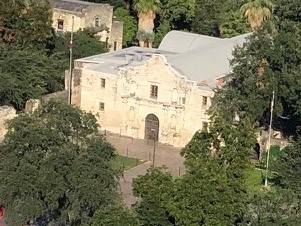
The Alamo, originally Mission San Antonio de Valero, was built as a Spanish mission in the 1700s and later was used by the Spanish as a fort. They called it the “Alamo,” a word for a poplar tree, especially the cottonwood trees growing in the area.

In 1835, the area which is now Texas was under Mexican rule. American pioneers were allowed to own land there if they were Catholic. Some converted to purchase the land yet remained Protestant in practice.

Leading up to this time, Mexico had gained independence from Spain and then changed Presidents several times. President General Antonio Lopez de Santa Anna was the current leader. There was a lot of unrest and Texans wanted their freedom.

Two hundred Texas volunteers attacked Mexican troops in San Antonio de Bexar under General Martin Perfecto de Cos and at the Alamo a quarter mile away on December 5, 1835. Cos surrendered, signing documents that gave all the arms, public property, and money in San Antonio de Bexar to the Texans and left. Some of the Texas volunteers moved into the fort while others went home.

Santa Anna marched his army (historical accounts vary on whether he had 1,500 or 8,000 soldiers) toward the Alamo in retaliation.

Anticipating the coming attack, Lieutenant Colonel William B. Travis and Colonel James Bowie took command of the Alamo by February. Though there was friction between the two leaders, Bowie led the volunteers and Travis commanded the regular army.

Travis sent repeated letters requesting men and supplies. The well-known David Crockett and 14 Tennessee Mounted Volunteers were among the few men who arrived at the Alamo in advance of the battle. By the time  Santa Anna’s army began cannon and rifle fire on February 23, 1836, about 180 – 190 men protected the Alamo.

Texans bravely held their ground for 13 days. At dawn on March 6th, they held off the first two charges by Santa Anna’s army. On the third charge, they went over the walls. Santa Anna’s orders were to take no prisoners. It was hand-to-hand combat but the Texan soldiers, being outnumbered, were killed. There were only a few survivors—a few family members of the soldiers.

There were casualties in the Mexican army. Many historians estimate this number at about 600.

While this was a great tragedy, the battle bought time for Sam Houston’s 800 men to be ready to fight Santa Anna at San Jacinto on April 21, 1836, where they captured Santa Anna and defeated his army. That battle guaranteed the independence of Texas.

As they fought, Houston’s men shouted, “Remember the Alamo!”

-Sandra Merville Hart

Sources

“Battle of the Alamo,” Wikipedia, 2020/01/03 https://en.wikipedia.org/wiki/Battle_of_the_Alamo.

History.com Editors. “The Alamo,” A&E Television Networks, 2020/01/03 https://www.history.com/topics/Mexico/alamo.

Nelson, Ken. “US History: The Battle of the Alamo for Kids.” Ducksters, Technological Solutions, Inc. (TSI), http://www.ducksters.com/history/us_1800s/battle_of_the_alamo.php. Accessed 3 January 2020.

Paul, Lee. “The Alamo: 13 Days of Glory,” HistoryNet, 2020/01/03 https://www.historynet.com/battle-of-the-alamo.


Milton Hershey

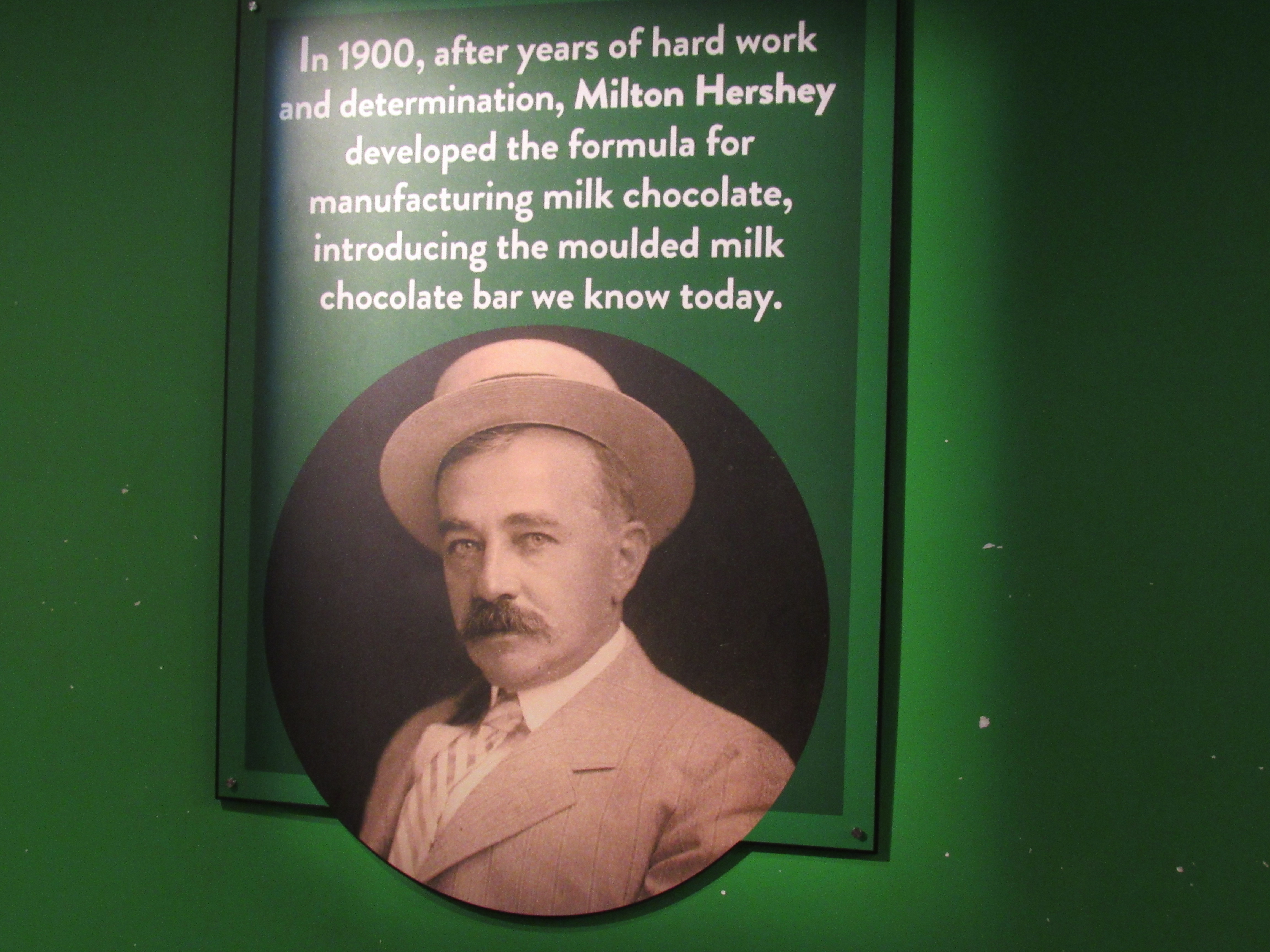
Milton Hershey was born in Derry Township, Pennsylvania, in 1857. A few years later, the Civil War started. He heard cannons from miles away at the Battle of Gettysburg.

His parents separated when he was ten. Five years later he became an apprentice for Joseph Royer, a candy maker in Lancaster. He learned to make fudge, peppermint, and caramels and loved being a confectioner.

At nineteen, he borrowed $150 from his aunt and opened a candy business. Though he worked hard, the business failed.

He moved to Denver where he worked for candy maker who used fresh milk to make caramel, furthering his skills. Milton then opened a business in Chicago. It failed. A new business he started in New York failed. He returned to Lancaster in 1883 and launched the Lancaster Caramel Company. This one was a success.

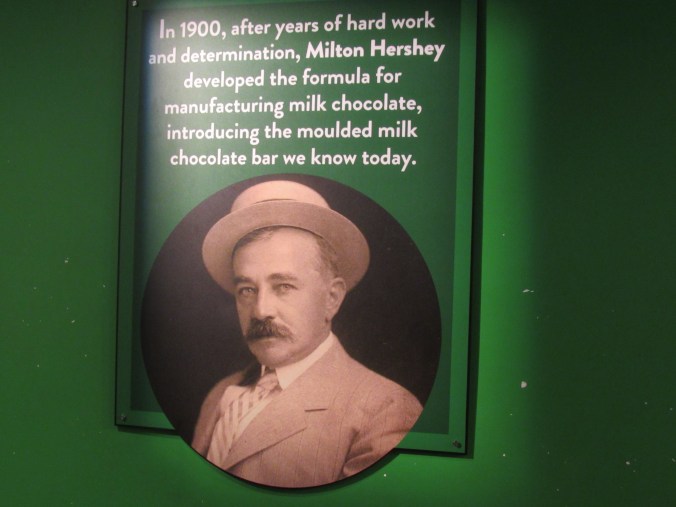
Ten years later, The World’s Columbian Exposition in Chicago educated him about making chocolate. He then established Hershey Chocolate Company and focused on a recipe for milk chocolate that was delicious and affordable. In 1900, he sold Lancaster Caramel Company for $1,000,000 to focus on the chocolate.

Hershey built a new candy factory in Derry Church, Pennsylvania, that opened in 1905. There were plenty of dairy farms in the area to supply milk for the chocolate. Yet his factory workers needed a place to live so he built houses, churches, schools, parks, and a post office to establish a new town—Hershey.

Learning from past failures, Hershey focused on one product—a milk chocolate candy bar. His factory made many of them and sold them at prices everyone could afford.

Unable to have children, Milton and his wife, Catherine, established the Hershey Industrial School for orphaned boys. Catherine died in 1915. Three years later, long before his death in 1945, Milton transferred his ownership in Hershey Chocolate Company to Hershey Trust, which funded the school.

When the Great Depression settled over the country, Hershey put his fellow townsmen to work by constructing new offices for his company, a hotel, and a community building. While the rest of the country struggled to make ends meet, the town of Hershey thrived.

World War II started a few years later. Hershey sent chocolate bars (Ration D Bars and Tropical Chocolate Bars) to our military.

Hershey’s giving spirit still lives on. Today Hershey Industrial School, now known as Milton Hershey School, also includes girls. Around 1,900 girls and boys attend annually.

Milton and Catherine Hershey left a lasting legacy in the town that bears their name. Had he given up after those many early failures, jobs for countless people wouldn’t have been available, a town wouldn’t exist, and a school for orphaned boys wouldn’t have opened.

What an inspiration to persevere in the face of difficulties … and perhaps help a neighbor along the way.

-Sandra Merville Hart

Sources

Biography.com Editors. “Milton Hershey Biography,” The Biography.com, 2020/01/02 https://www.biography.com/business-figure/milton-hershey.

Nelson, Ken. “Biography for Kids: Milton Hershey.” Ducksters, Technological Solutions, Inc. (TSI), www.ducksters.com/biography/entrepreneurs/milton_hershey.php. Accessed 2 January 2020.

“Who was Milton Hershey?” The Hershey Story, 2020/01/02 https://hersheystory.org/milton-hershey-history/

 

Ford’s Theatre

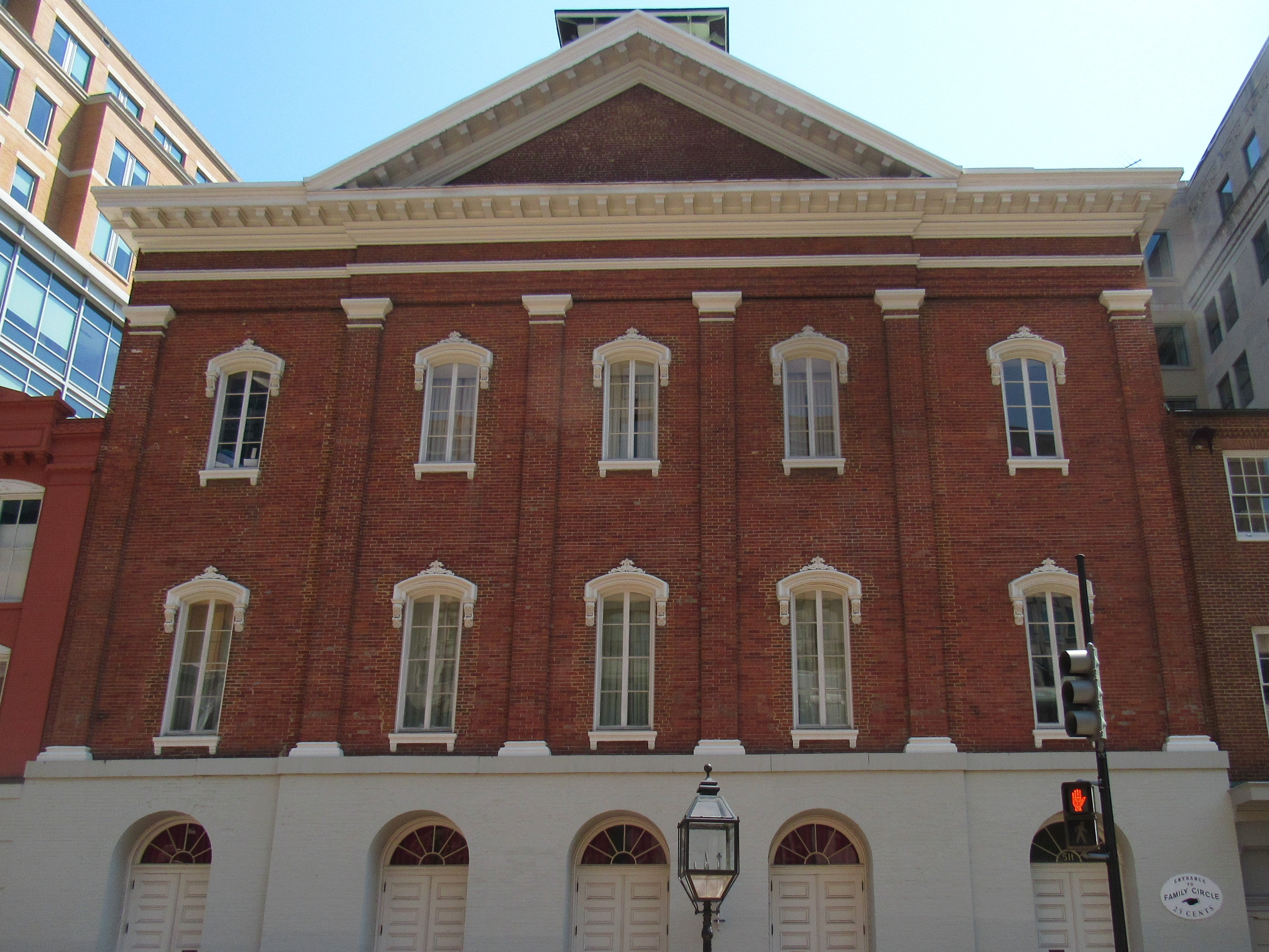
John T. Ford, a successful theatrical entrepreneur, leased the First Baptist Church on Tenth Street in 1861. He turned it into a music hall. The building burned in December of 1862. Ford raised money to rebuild and the first performance in the new Ford’s Theatre was August 27, 1863.

President Abraham Lincoln and Mrs. Mary Todd Lincoln arrived at Ford’s Theatre around 8:30 pm with their guests, Major Henry Reed Rathbone and Clara Harris, on April 14, 1865. Our American Cousin was playing and Lincoln enjoyed going to the theater.

This night was different.

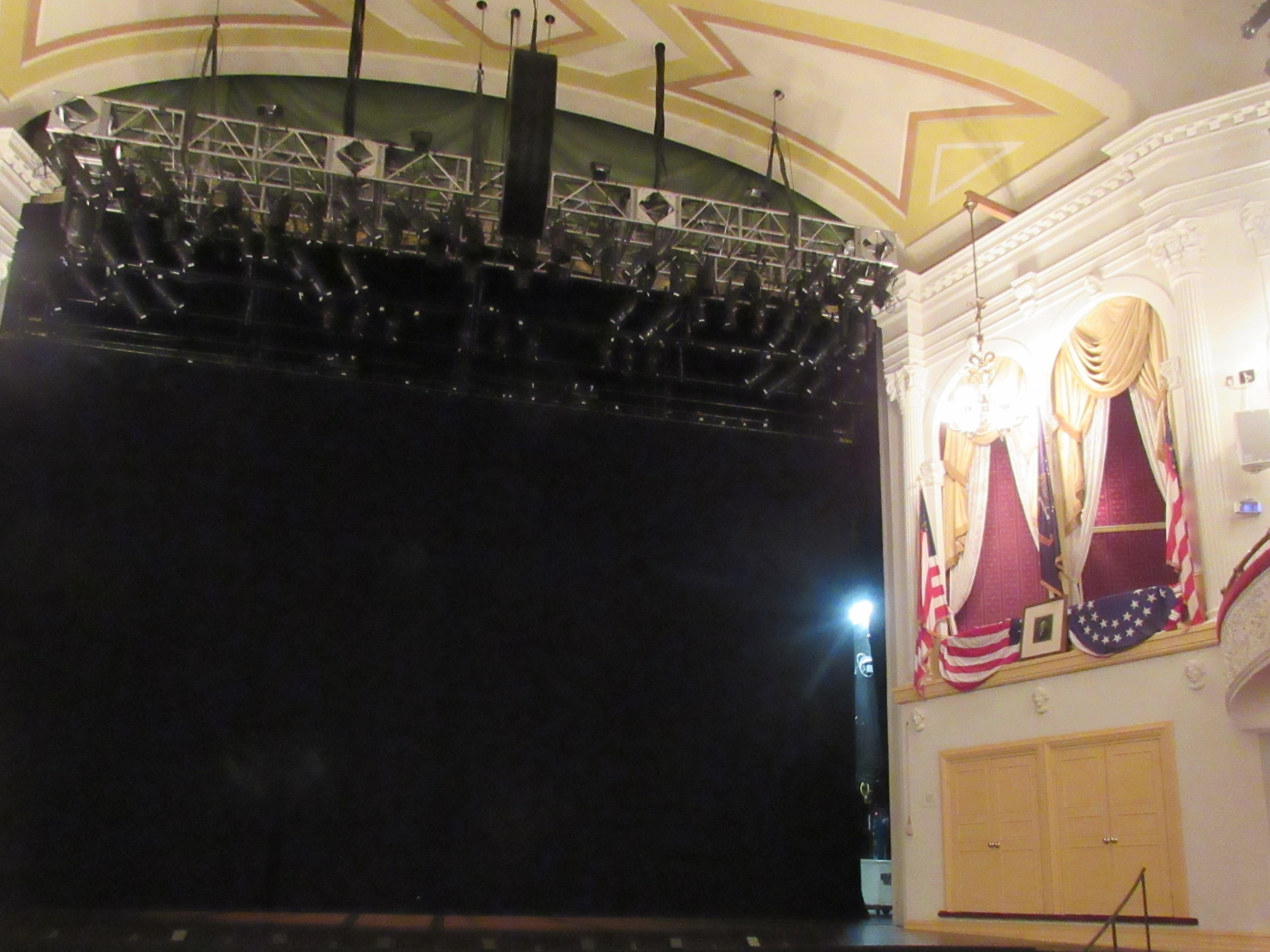
John Wilkes Booth stepped into the Presidential Box around 10:15 pm and shot Lincoln. Booth stabbed Major Rathbone and then leaped onto the stage and escaped.

Dr. Charles Augustus Leale was the first person inside the box. He removed a blood clot from Lincoln’s head wound to release pressure and allow him to breathe. Dr. Leale knew it was a mortal wound.

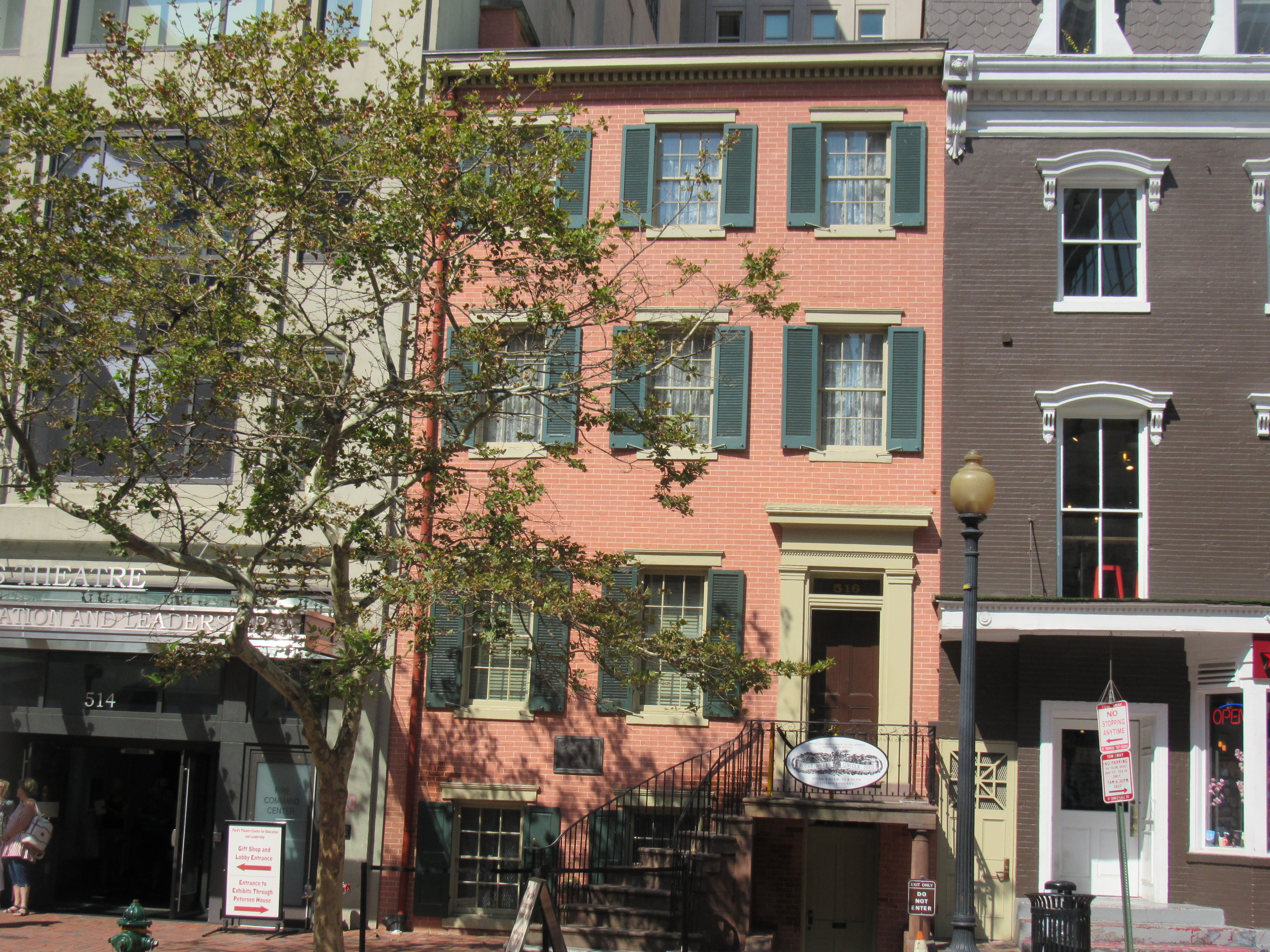
Soldiers carried their President down the stairs and onto Tenth Street. William and Anna Petersen’s boarding house was across the street. They placed the dying President in Willie Clark’s room, who was out celebrating the war’s ending.

It was a dark, gloomy morning. It had started to rain earlier. Large groups of people gathered outside the Petersen house, praying for Lincoln to live … yet fearing the worst.

Throughout that long, tragic night, First Lady Mary Lincoln sometimes sat beside her dying husband with her oldest son nearby. Other times she went to the Front Parlor. Neither family member was in the crowded room when Lincoln died at 7:22 am.

The country that had seen so much death and dying for the past four years experienced a deep tragedy. Leaders turned their attention to apprehending John Wilkes Booth, the assassin, and his conspirators.

Ford’s Theatre was closed by the federal government for the investigation. The owner received permission to reopen after the trial. When threats were made if the theatre reopened, the War Department closed it. They leased the building, in August of 1865, to convert it to an office building and bought it a year later.

Three interior floors collapsed in 1893. Twenty-two clerks were killed and sixty-eight people injured. It was repaired and used again by the government for offices.

Today, about 650,000 visitors tour Lincoln’s Museum, Ford’s Theatre, the Petersen House, and Aftermath Exhibits each year.

Ford’s Theatre still has performances and tours are closed during rehearsals and matinees.

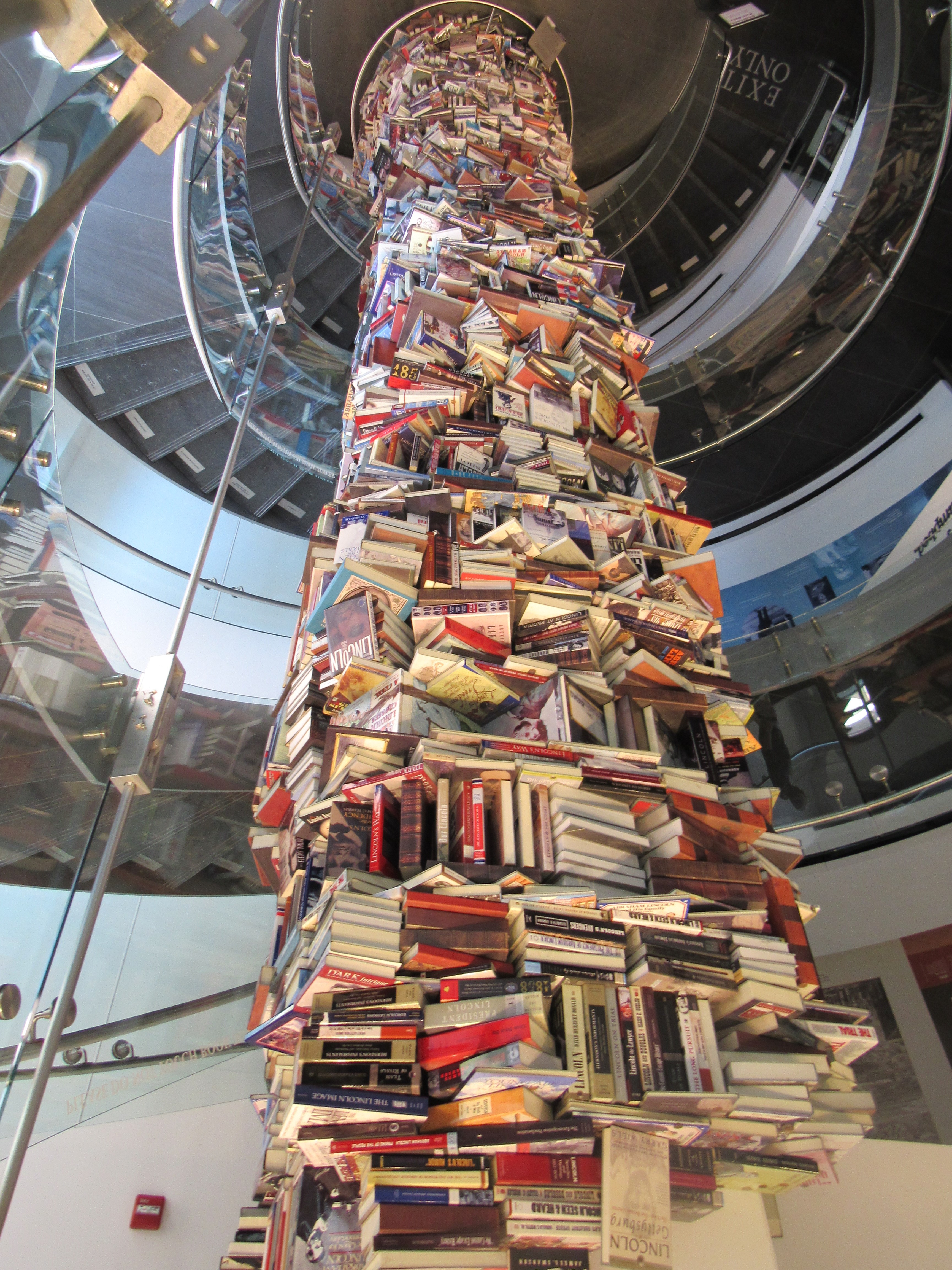
Lincoln has inspired many authors to write books about him. A 34-foot tower of these books stands beside a winding staircase at The Ford’s Theatre Center for Education and Leadership.

-Sandra Merville Hart

Sources

“Ford’s Theatre,” National Park Service, 2020/01/02 https://www.nps.gov/foth/index.htm.

“Ford’s Theatre Yesterday and Today,” Ford’s Theatre Pamphlet, Last Updated 2008.

“Lincoln’s Death,” Ford’s Theatre, 2020/01/01 https://www.fords.org/lincolns-assassination/lincolns-death/.

Lincoln Memorial

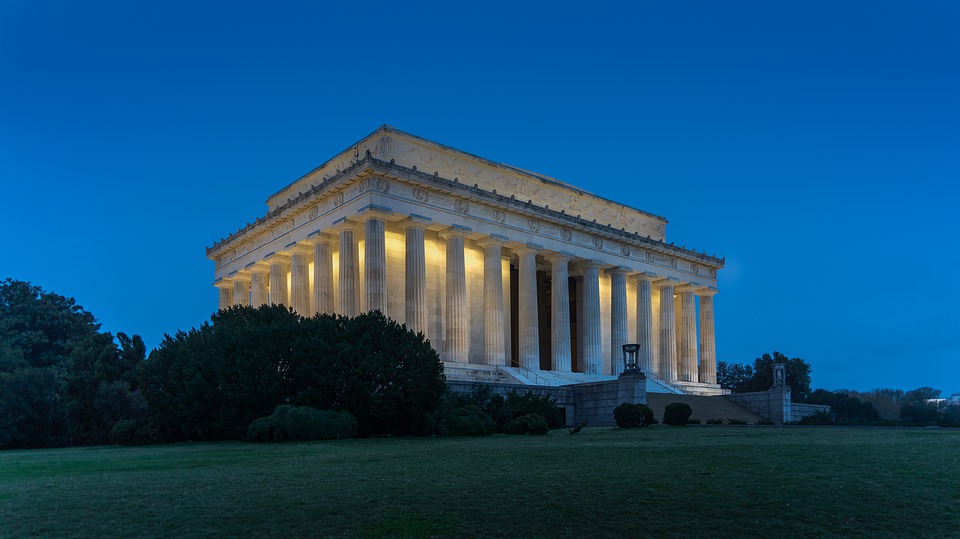
On a recent trip to Washington, DC, I visited the National Mall late on a rainy evening. The view of the Lincoln Memorial at night is spectacular.

Talk of building a memorial to President Abraham Lincoln began soon after his death. In 1867, a proposal for a commission to plan the monument didn’t get very far. The country, recovering from war, didn’t have the money to build it. The early design was for 31 pedestrian and 6 equestrian statues with a statue of Lincoln in the center.

Construction on the memorial began years later in 1914, and took about 4 years to build. Styled after a Greek Temple, the memorial was designed by Henry Bacon. It has 36 fluted Doric columns to represent the states in the Union during the Civil War.

The memorial is 188 feet long and nearly 80 feet tall. There are 58 steps on the memorial. There are 87 steps from the reflecting pool to the memorial.

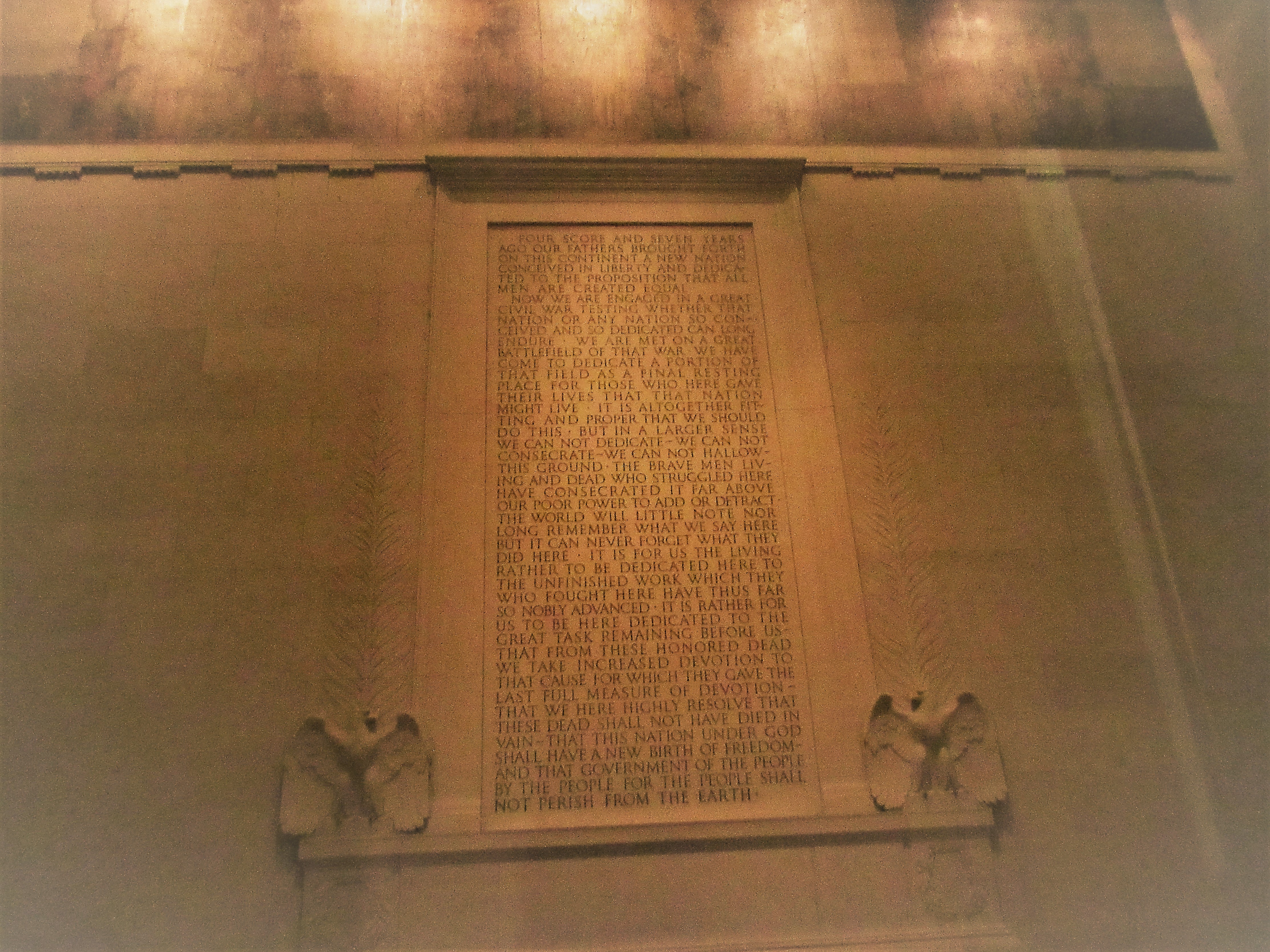
Lincoln’s second inaugural speech is on the North Wall. His famous Gettysburg Address is etched on the South Wall.

Construction was finally completed in 1922. On May 30, 1922, Civil War veterans were among the 50,000 people attending the dedication service.

Robert Todd Lincoln, our 16th president’s only surviving son, attended the dedication. He was 78.

Forty-one years later, a March on Washington, led by Martin Luther King, Jr., ended at the Lincoln Memorial. On August 28, 1963, he spoke to a large crowd from the steps of the memorial. His “I have a Dream” speech spoke of his dreams for America, resonating with his listeners and the nation.

Trolley Tours and Big Bus Tours are an easy way to visit the monument. We took the Metro and walked the National Mall. Whatever way you decide to tour the monument, it is well worth the effort.

-Sandra Merville Hart

Sources

“Lincoln Memorial,” Lincoln Memorial, 2020/01/02 http://lincoln-memorial.org/.

“Lincoln Memorial,” National Park Service, 2020/01/02 https://www.nps.gov/nr/travel/wash/dc71.htm.

“Lincoln Memorial,” Wikipedia, 2020/01/01 https://en.wikipedia.org/wiki/Lincoln_Memorial.

“The Abraham Lincoln Memorial,” American History For Kids, 2020/01/02 https://www.americanhistoryforkids.com/abraham-lincoln-memorial/.

Civil War Women: Clara Judd, Confederate Spy

Clara Judd, a Northerner, had moved to Winchester, Tennessee, in 1859 with her husband and eight children. He and one of their children was killed in an accident two years later. The widow found jobs at a government factory for her older sons.

Union armies controlled Winchester five times during the first two years of the Civil War (1861-1862) and Clara hosted them. A Union officer warned her that they’d been ordered to destroy her crops “except enough to last six weeks” and that she should leave.

Losing her possessions probably embittered her toward the Union soldiers.

She eventually ended up leaving her children with her sister in Louisville. Obtaining Union passes to travel to Atlanta to visit her son and Louisville to visit her youngest children enabled Clara to learn troop movements and other military information for the Confederacy.

Confederate Brig. Gen. John Hunt Morgan, while planning his famous raid, contacted Clara in December of 1862. He asked her to discover Union troop locations and strength of those controlling the railroad. She agreed.

While traveling north, she was stopped in Murfreesboro and had to wait three days for a pass to Nashville. Unable to find transportation, she walked.

Delos Thurman Blythe, a Northern counterespionage agent posing as Southern paroled prisoner, offered her a ride in his buggy. Blythe’s pass into Nashville was accepted but not Clara’s. He overheard a Confederate soldier giving her information about getting through Union lines and became suspicious.

Clara received a pass to visit her children and then told Blythe everything. He promised to help her.

His pretense of loyalty to the South had worked. He reported her to Union authorities yet advised them to give her the passes she requested.

They traveled north by train. Clara, from her window, asked folks at each station about troops in the area. In Louisville, Blythe escorted her in all her errands and took her to dinner. She fell in love with him. Meanwhile, Blythe asked the authorities to arrest him and Clara in Mitchelsville, Tennessee.

On their return trip, military police arrested them in Mitchelsville. Goods and drugs for the Confederate army were found in her bags—quinine, nitrate of silver, and morphine.

Placed under guard in a Nashville hotel shortly before Christmas, Clara told her captors that Blythe was innocent. She didn’t know that he had already been released or that loving her had been an act.

Charged with espionage, she went to prison in Alton, Illinois for about eight months before being paroled due to poor health.

-Sandra Merville Hart


Sources

McCurry, Stephanie. “Clara Judd and the Laws of War,” HistoryNet, 2019/08/16 https://www.historynet.com/clara-judd-laws-war.htm.

Winkler, H. Donald. Stealing Secrets, Cumberland House, 2010.


Washington Monument

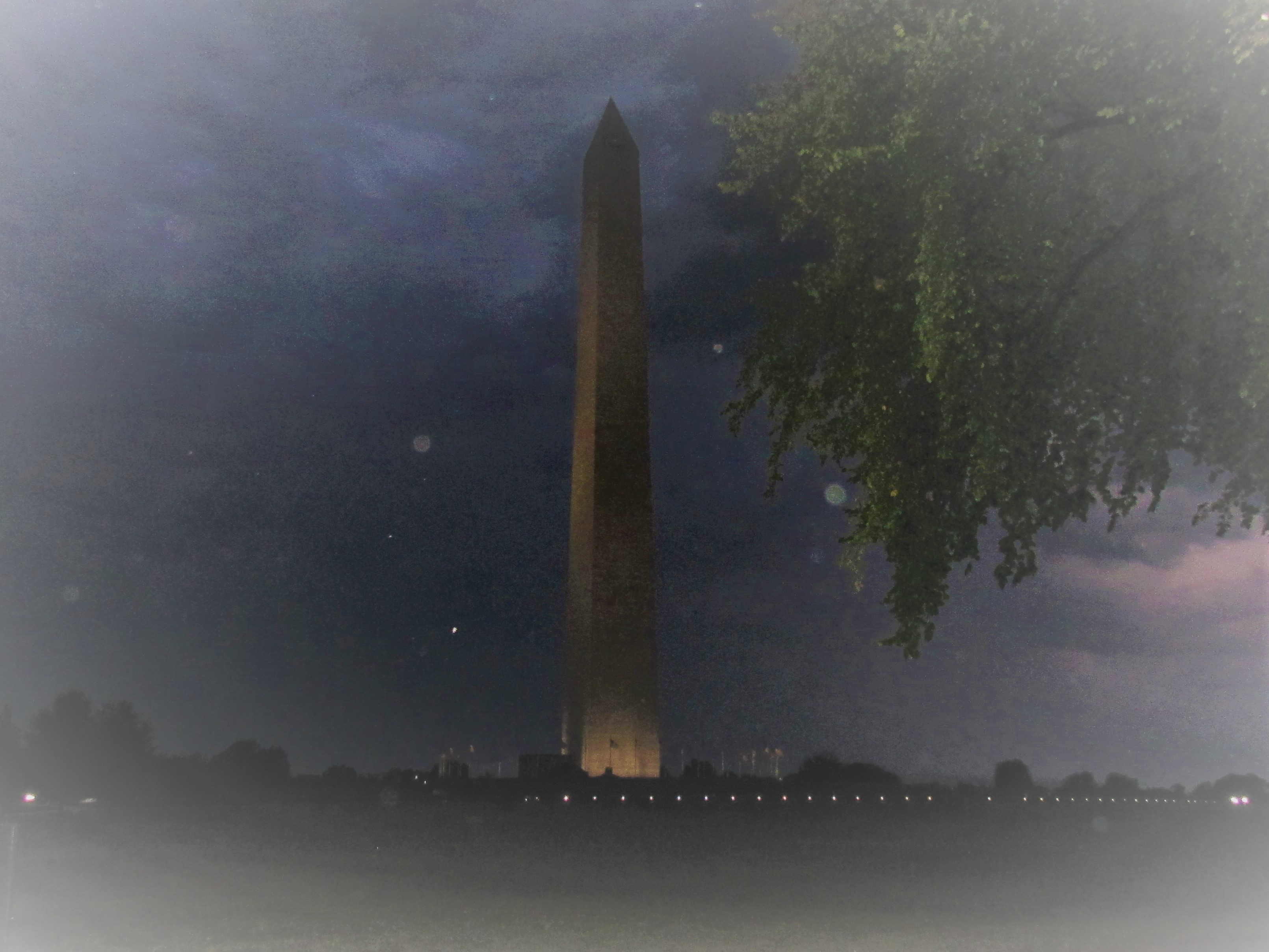
On a recent trip to Washington, DC, I visited the National Mall late on a rainy evening. Though I didn’t go into the Washington Monument, the view at night was spectacular.

Early Americans wanted to build a monument to honor George Washington. Not only had he defeated the British as commander of the Continental Army, he paved the way for future leaders by serving as our first president.

The Washington National Monument Society began asking for donations to the monument in 1833. This private organization collected money and chose Robert Mills’ design in 1845.

On July 4, 1848, construction began with a ceremony to lay the cornerstone. President James K. Polk attended with about 20,000 citizens, including three future presidents—Buchanan, Lincoln, and Johnson.

Problems arose when the Society was taken over by the Know-Nothing Party. Building the monument stopped when the money ran out in 1854.

The nation had more pressing concerns with the Civil War looming and the monument stood idle, about a third completed.

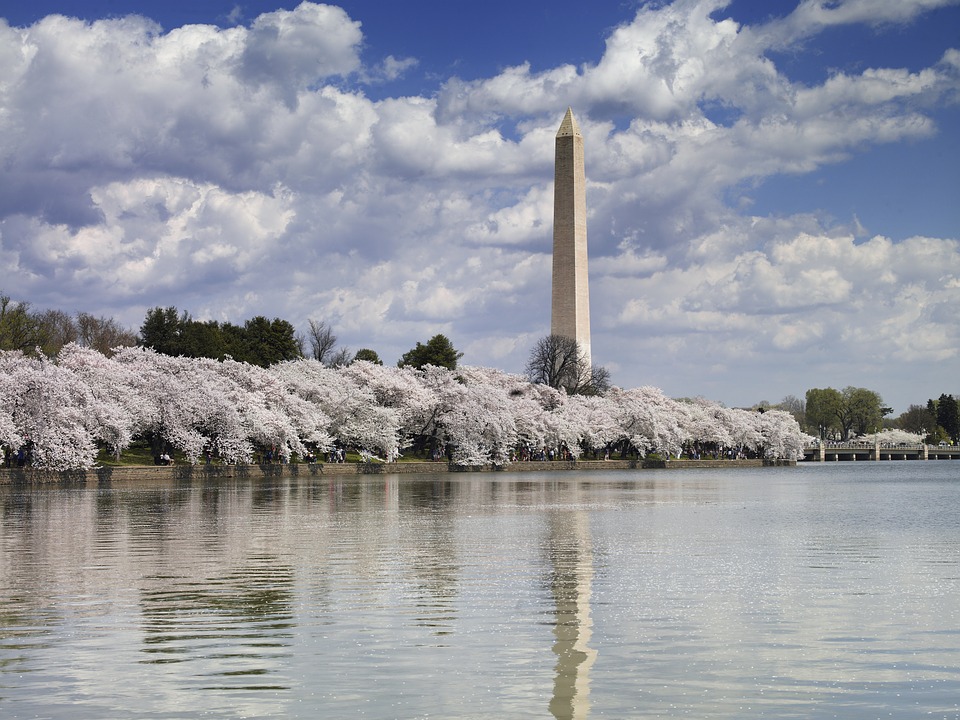
Congress took over the funding of the monument in 1876. After this, Lt. Col. Thomas Lincoln Casey led the Army Corps of Engineers to complete the monument with a few changes to Mills’ original design. He did away with a ring of columns around the monument and adjusted the height from 600 feet to 555 feet. One of the inscriptions on the east face of the aluminum cap topping the Washington Monument is Laus Deo, Latin for “Praise be to God.”

Citizens, groups, cities, states, and other countries donated commemorative stones that are inset into the walls of the building dedicated on February 21, 1885. It was the tallest building in the world at its dedication.

Another fun fact about the monument is that the original elevator took 10-12 minutes to ascend to the top.

-Sandra Merville Hart

Sources

“Guide to Visiting the Soon-to-be Reopened Washington Monument,” Washington DC, 2019/09/05 https://washington.org/dc-guide-to/washington-monument.

“Washington Monument,” NPS, 2019/09/05 https://www.nps.gov/wamo/index.htm.


Korean War Veterans Memorial

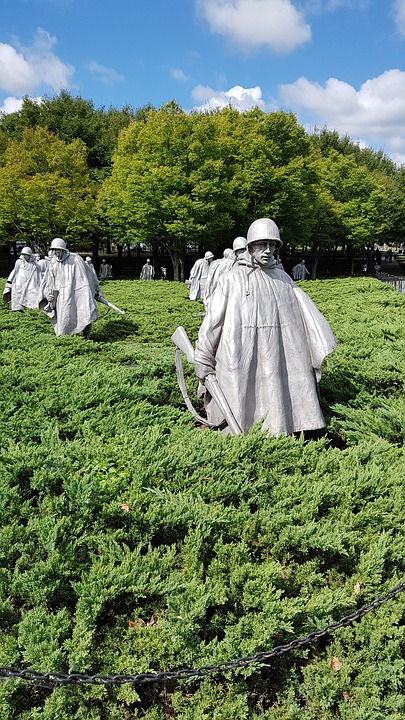
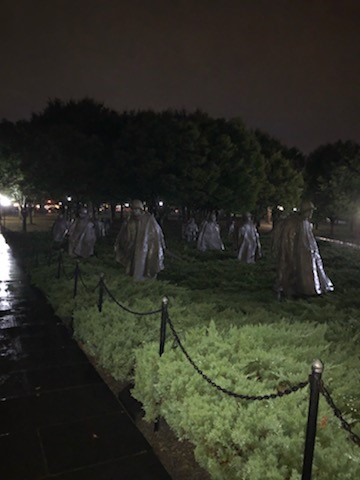
On a recent trip to Washington, DC, I visited the Korean War Veterans Memorial. It was a dark, rainy evening for my first view of these rugged American soldiers wearing ponchos. The soldiers in the field face different directions so one of the statues is looking at you from any of three sides. When I returned home, I discovered more about this memorial located on the National Mall.

American served in the Korean War from June 25, 1950 to July 27, 1953. Of 5.8 million who served, 54,246 Americans died, 8,200 went missing in action, and 103,284 were wounded.

The Korean War Veterans Memorial, dedicated on July 27, 1995, honors Army, Marine Corps, Navy, Air Force, and Coast Guard on a Mural Wall.

The United Nations Wall honors the 22 nations that sent troops to Korea.

A Pool of Remembrances offers a reflective place to sit.

Most impressive are the 19 seven-foot tall statues standing among juniper bushes and separated by granite strips that symbolize Korea’s rice paddies. Each represents duties filled by the Army, Air Force, Marine Corps, and Navy. Above the Lead Scout is a Dedication Stone with the saying:

     Our Nation honors her sons and daughters

     who answered the call to defend a country

     they never knew and a people they never met

-Sandra Merville Hart

Sources

“Korean War Memorial,” American Battle Monuments Commission, 2019/09/05 https://www.abmc.gov/about-us/history/korean-war-memorial.

“Korean War Veterans Memorial,” Washington DC, 2019/09/05 https://washington.org/find-dc-listings/korean-war-veterans-memorial.

“The Korean War Veterans Memorial,” The Korean War Veterans Memorial, 2019/09/05 http://www.koreanwarvetsmemorial.org/the-memorial/.


Iwo Jima Memorial

The World War II Battle of Iwo Jima between the U.S. Marines and the Imperial Army of Japan lasted five weeks, beginning in February of 1945. The Japanese under General Tadamichi Kuribayashi had camouflaged their artillery and at first caused significant casualties for the Marines under the command of Holland M. “Howlin’ Mad” Smith.

Over the next few days, about 70,000 U.S. Marines soon outnumbered the 21,000 Japanese forces. The battle eventually claimed the lives of nearly 7,000 Marines. The losses for the Japanese were far greater—only about 200 survived the battle.

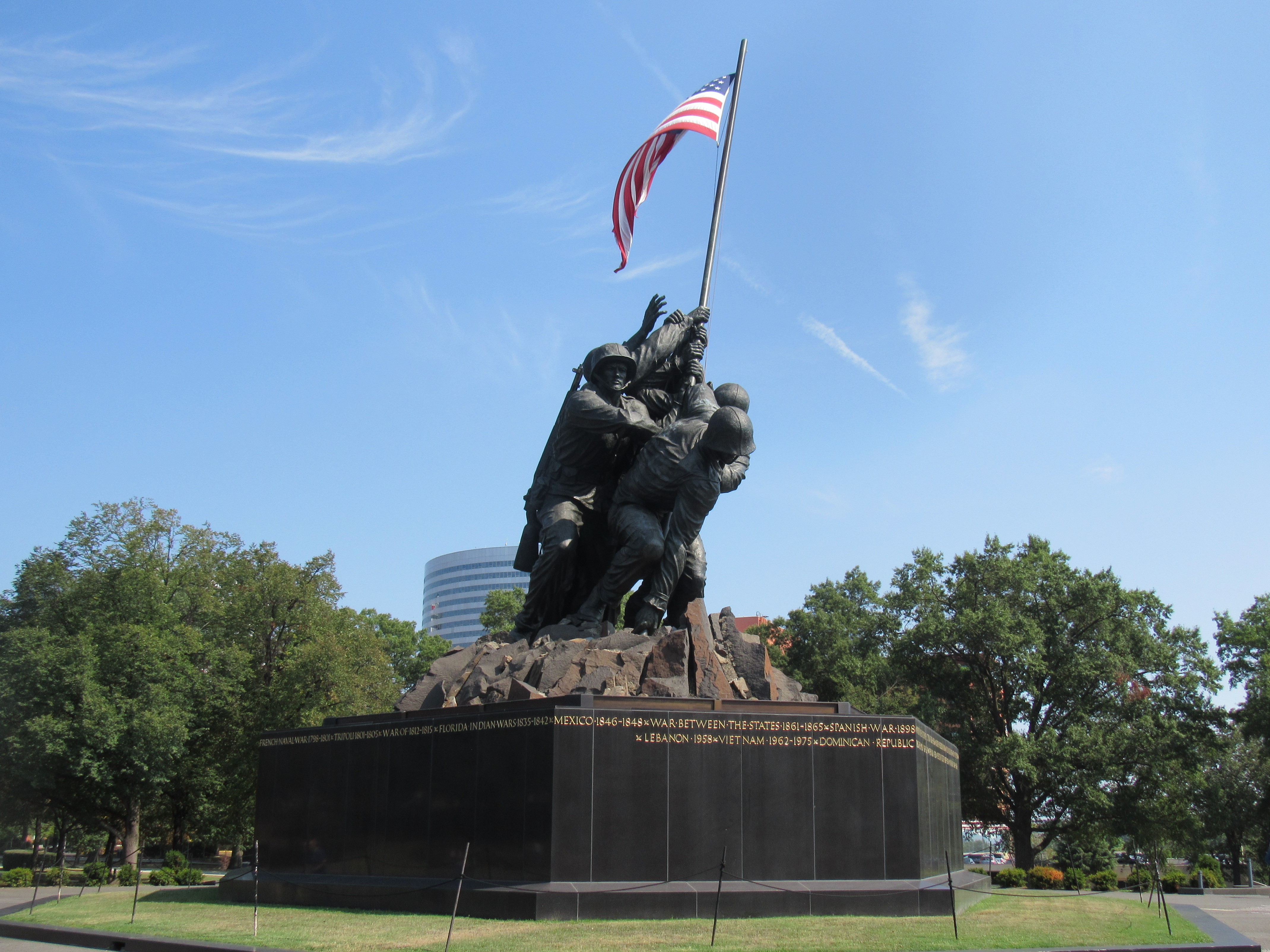
Marines of the 28th Regiment, 5th Division, were ordered to capture Iwo Jima’s Mount Suribachi. About 10:30 am, a U.S. flag was raised on February 23, 1945—four days after the battle began. A larger flag was raised that afternoon. The afternoon flag raising was the image taken for the iconic photograph by Joseph Rosenthal, Associated Press.

The photo inspired Sculptor Felix W. de Weldon to make a life size image that three of the six flag raisers—Ira Hayes, Rene Gagnon, and John Bradley—posed for. Sadly, the others were killed.

The Marine Corps War Memorial, also called Iwo Jima Memorial, was dedicated by President Dwight D. Eisenhower on November 10, 1954.

Because there were two actual historic flag raisings that day, doubt arose regarding the identity of one man in the photo. The Marines conducted an investigation. They discovered that though John Bradley had been one of the six men who raised the first flag, Private First Class Harold Schultz actually replaced him in the second flag raising.

The six flag raisers in the iconic photo are: Corporal Harlon Block, Private First Class Rene Gagnon, Private First Class Ira Hayes, Private First Class Harold Schultz, Private First Class Franklin Sousley, and Sergeant Michael Strank.

-Sandra Merville Hart

Sources

“History of the Marine Corps War Memorial,” NPS.gov, 2019/09/05 https://www.nps.gov/gwmp/learn/historyculture/usmcwarmemorial.htm.

History.com editors. “Iwo Jima,” History, 2019/09/05 https://www.history.com/topics/world-war-ii/battle-of-iwo-jima.

“USMC Statement on Iwo Jima Flag Raisers,” Marines, 2019/09/05 https://www.marines.mil/News/News-Display/Article/810457/usmc-statement-on-iwo-jima-flagraisers.


Pentagon Memorial

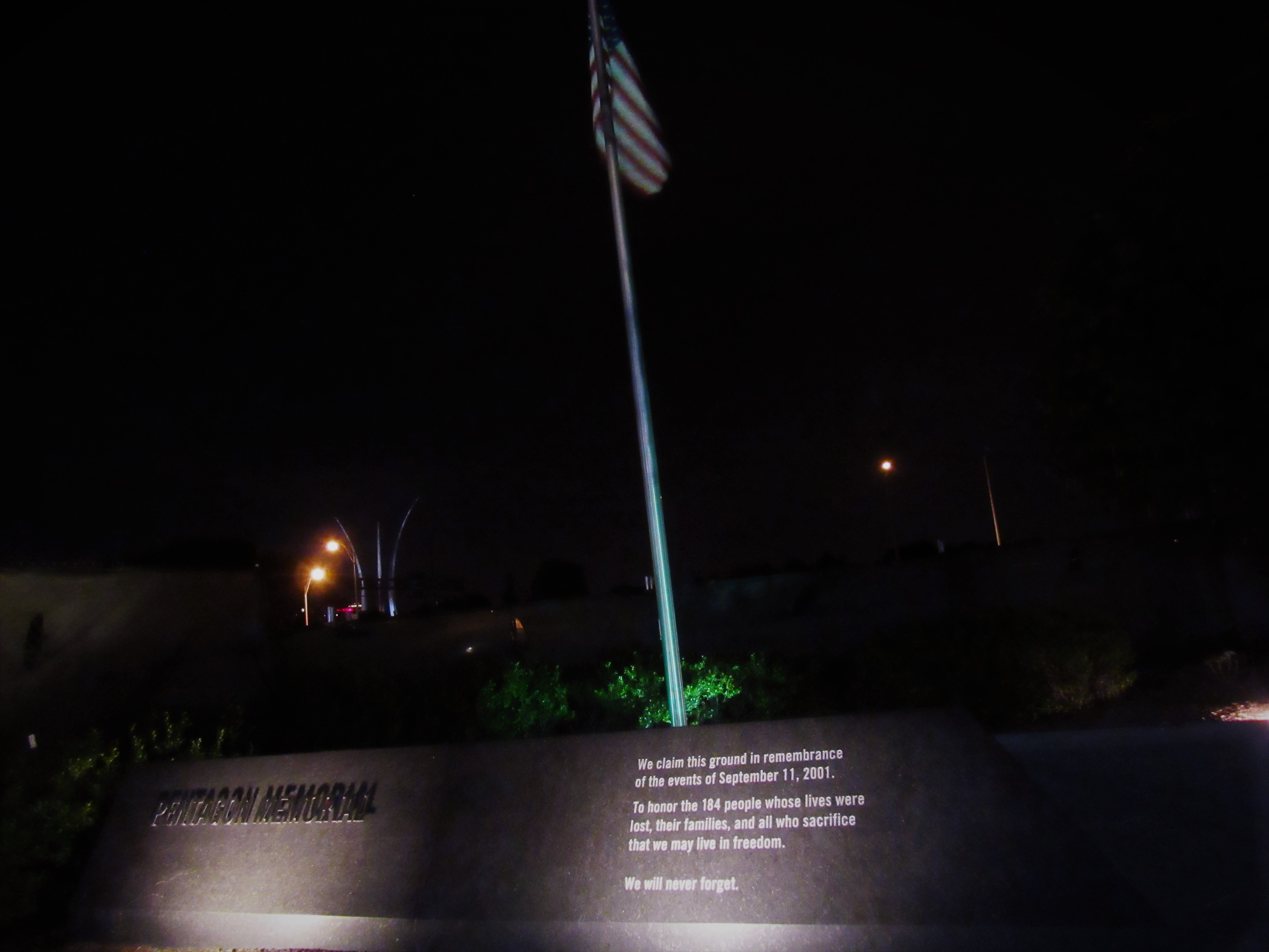
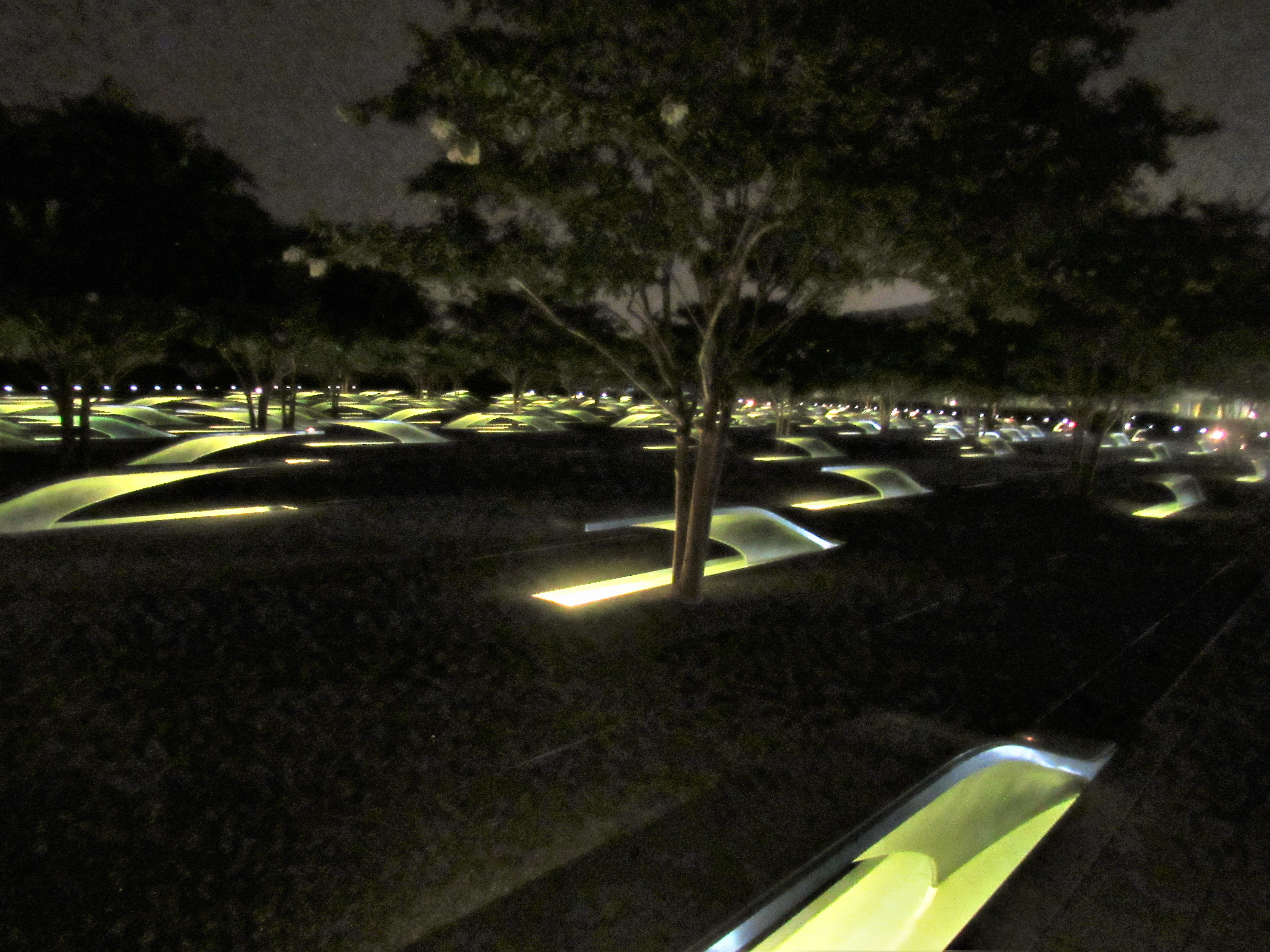
On a recent trip to Washington, DC, I visited the Pentagon Memorial. It was late in the evening and there were only a handful of visitors at the memorial. As I looked at the benches—184 of them—with lighted pools of water flowing underneath, I was struck once again by the tragedy of September 11, 2001.

No American alive that day can forget its horror. Four commercial airplanes were hijacked in coordinated attacks on specific targets and tragic loss of innocent lives resulted.

Five hijackers boarded American Airlines Flight 77 to Los Angeles from Dulles International Airport that sunny morning. The flight, delayed 10 minutes, departed at 8:20 am with 58 passengers and a crew of 6. What the crew didn’t know was that armed hijackers were among the passengers.

While flying over eastern Kentucky, hijackers took control of the plane, possibly between 8:51 and 8:54 am. It’s believed that one of them piloted the plane. None of the radio messages sent to the pilot after that time were answered.

It crashed into the Pentagon at 9:37 am, bringing a tragic end to 184 innocent lives.

The Pentagon Memorial, in remembrance of those who died there, opened on September 11, 2008. Architects Julie Beckman and Keith Kaseman along with engineer Buro Happold designed the memorial in a timeline, from the youngest victim (Dana Falkenberg at 3) to the oldest victim (John D. Yamnicky at 71), both on Flight 77.

Victims’ names have been placed on cantilevered benches with pools of flowing water underneath, which are lit at night. The designers put a lot of thought into the placement of the benches. Visitors read the names of those who perished in the Pentagon with that building behind it. Names face the sky where the plane approached for those from Flight 77.

Beautiful Crepe Myrtles, 85 of them, will eventually grow to height of 30 feet, giving shade to the Memorial in future years.

The Age Wall starts at a height of 3 inches for the youngest victim and builds to 71 inches for the oldest.

It’s a beautiful, well-designed unique memorial.

May we never forget.

-Sandra Merville Hart

Sources

“Pentagon Memorial,” The National 9/11, 2019/09/05 https://pentagonmemorial.org/.

“Pentagon Memorial,” National Geographic, 2019/09/05 https://www.nationalgeographic.org/media/pentagon-memorial/.


Civil War Women: Bettie Duvall, Confederate Spy

Washington D.C. resident Rose O’Neal Greenhow had been asked to discover troop movements and battle plans. She had information that Union troops had been ordered to attack Manassas. As a Confederate spy, she had a network of folks to deliver the coded message to Confederate General Beauregard. She gave the information to sixteen-year-old Bettie Duvall. (One source spelled her name “Betty.”)

On July 9, 1861, Bettie, a beautiful Southerner, disguised herself by selling buttermilk and sweet cream at the city market. She left the city, alone, on a farm cart. She rode past the 1st Massachusetts Infantry headquarters. A dirt lane led her to a friend’s plantation near Langley where she stayed for the night.

The next morning, she relinquished the farm cart. Dressed in a stylish riding habit, Bettie rode horseback to her intended destination—the village of Fairfax Court House. Manassas was ten miles from the village.

She met Confederate soldiers at an outpost near Vienna. At her request to speak with Brig. Gen. Milledge Bonham, they took her to his headquarters in Fairfax Court House. Beauregard had just taken over command, but Bonham was his top aide.

At first, Bonham refused to meet her. Upon learning that the beautiful woman was prepared to take the message to General Beauregard herself, he agreed to talk with her.

He recognized her “sparkling blue eyes, perfect features, glossy black hair” as a Southern lady from the spectator gallery at Congress. He agreed to forward on her message.

To his astonishment, she removed the combs from her hair knot. Shaking her beautiful hair loose, she untied a small silk package about the size of a silver dollar from the long strands and gave it to him.

Beauregard learned from the message that an attack was ordered within a week.

The advance warning led to a Confederate victory at the First Battle of Bull Run.

-Sandra Merville Hart

Sources

Monson, Marianne. Women of the Blue & Gray, Thorndike Press, 2018.

Winkler, H. Donald. Stealing Secrets, Cumberland House, 2010.

Zeinert, Karen. Those Courageous Women of the Civil War, The Millbrook Press, 1998.