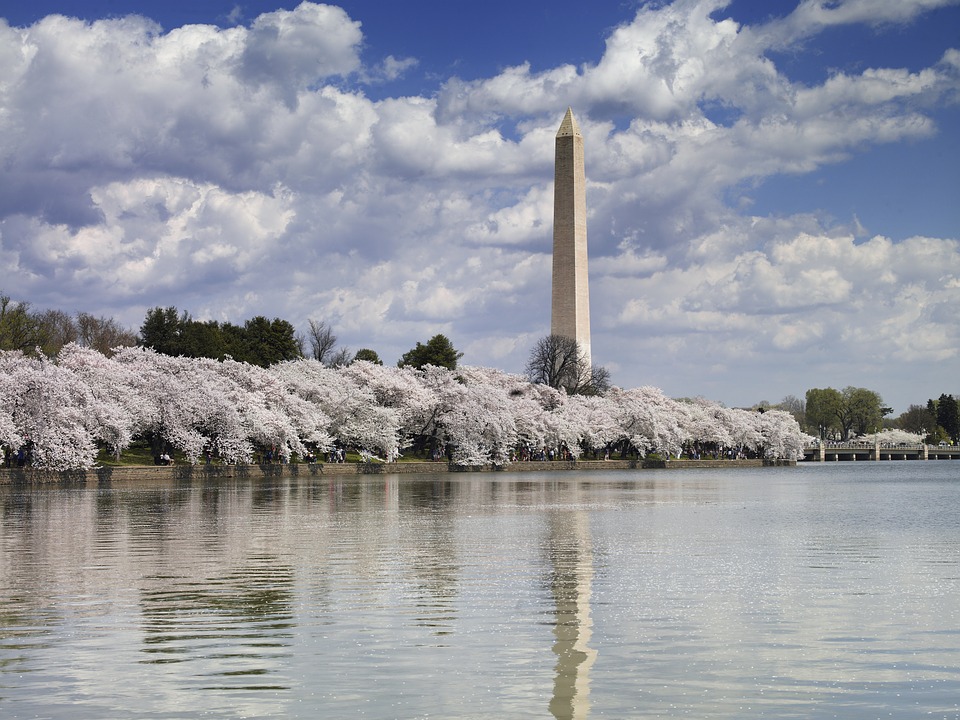
Washington Monument

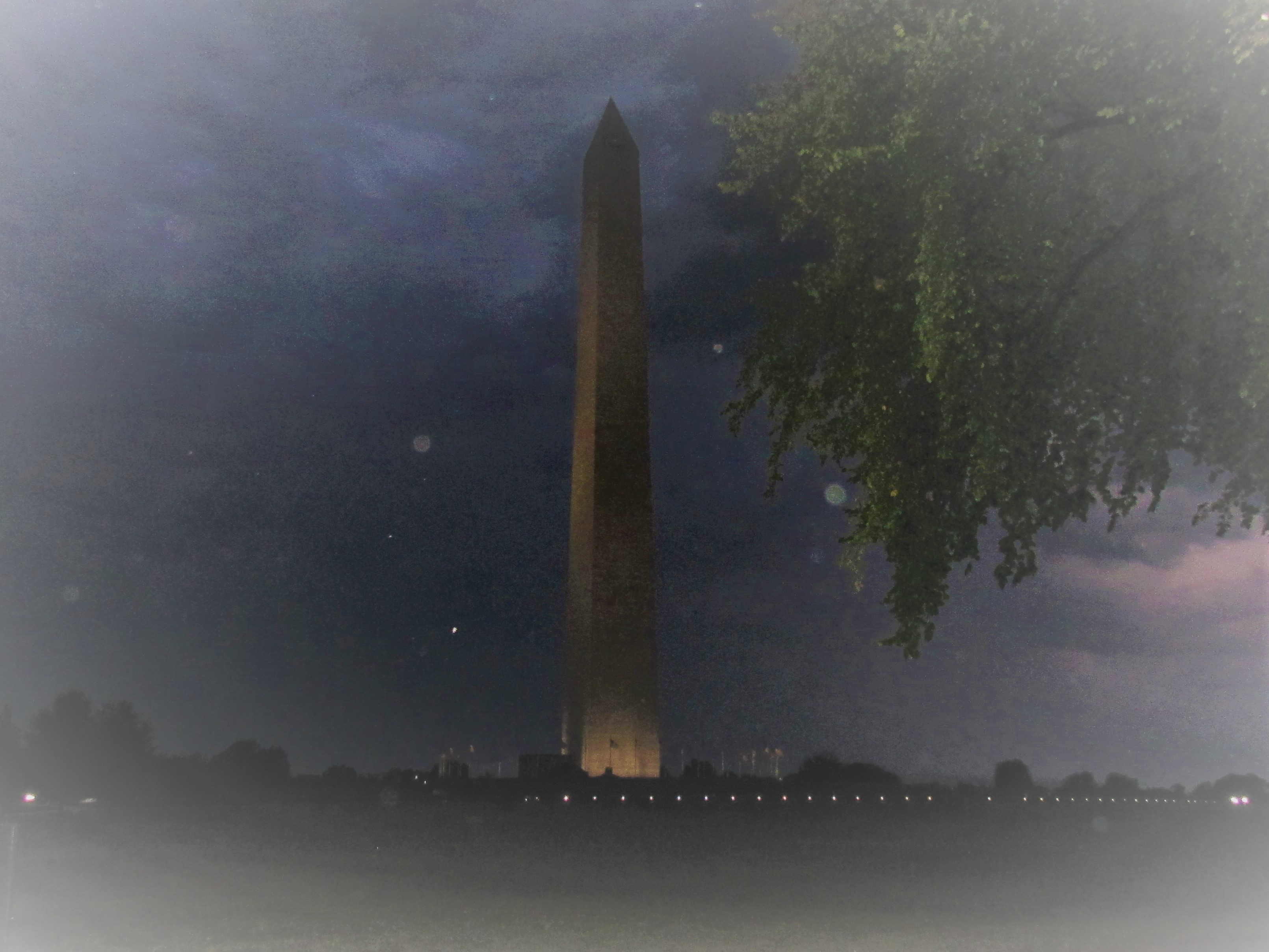
On a recent trip to Washington, DC, I visited the National Mall late on a rainy evening. Though I didn’t go into the Washington Monument, the view at night was spectacular.

Early Americans wanted to build a monument to honor George Washington. Not only had he defeated the British as commander of the Continental Army, he paved the way for future leaders by serving as our first president.

The Washington National Monument Society began asking for donations to the monument in 1833. This private organization collected money and chose Robert Mills’ design in 1845.

On July 4, 1848, construction began with a ceremony to lay the cornerstone. President James K. Polk attended with about 20,000 citizens, including three future presidents—Buchanan, Lincoln, and Johnson.

Problems arose when the Society was taken over by the Know-Nothing Party. Building the monument stopped when the money ran out in 1854.

The nation had more pressing concerns with the Civil War looming and the monument stood idle, about a third completed.

Congress took over the funding of the monument in 1876. After this, Lt. Col. Thomas Lincoln Casey led the Army Corps of Engineers to complete the monument with a few changes to Mills’ original design. He did away with a ring of columns around the monument and adjusted the height from 600 feet to 555 feet. One of the inscriptions on the east face of the aluminum cap topping the Washington Monument is Laus Deo, Latin for “Praise be to God.”

Citizens, groups, cities, states, and other countries donated commemorative stones that are inset into the walls of the building dedicated on February 21, 1885. It was the tallest building in the world at its dedication.

Another fun fact about the monument is that the original elevator took 10-12 minutes to ascend to the top.

-Sandra Merville Hart

Sources

“Guide to Visiting the Soon-to-be Reopened Washington Monument,” Washington DC, 2019/09/05 https://washington.org/dc-guide-to/washington-monument.

“Washington Monument,” NPS, 2019/09/05 https://www.nps.gov/wamo/index.htm.


Korean War Veterans Memorial

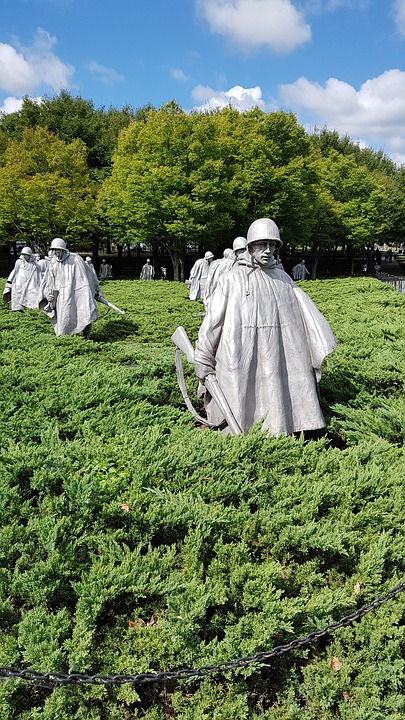
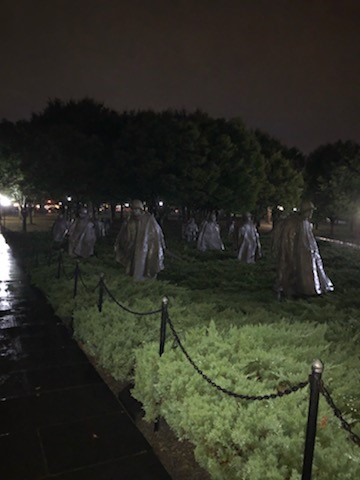
On a recent trip to Washington, DC, I visited the Korean War Veterans Memorial. It was a dark, rainy evening for my first view of these rugged American soldiers wearing ponchos. The soldiers in the field face different directions so one of the statues is looking at you from any of three sides. When I returned home, I discovered more about this memorial located on the National Mall.

American served in the Korean War from June 25, 1950 to July 27, 1953. Of 5.8 million who served, 54,246 Americans died, 8,200 went missing in action, and 103,284 were wounded.

The Korean War Veterans Memorial, dedicated on July 27, 1995, honors Army, Marine Corps, Navy, Air Force, and Coast Guard on a Mural Wall.

The United Nations Wall honors the 22 nations that sent troops to Korea.

A Pool of Remembrances offers a reflective place to sit.

Most impressive are the 19 seven-foot tall statues standing among juniper bushes and separated by granite strips that symbolize Korea’s rice paddies. Each represents duties filled by the Army, Air Force, Marine Corps, and Navy. Above the Lead Scout is a Dedication Stone with the saying:

     Our Nation honors her sons and daughters

     who answered the call to defend a country

     they never knew and a people they never met

-Sandra Merville Hart

Sources

“Korean War Memorial,” American Battle Monuments Commission, 2019/09/05 https://www.abmc.gov/about-us/history/korean-war-memorial.

“Korean War Veterans Memorial,” Washington DC, 2019/09/05 https://washington.org/find-dc-listings/korean-war-veterans-memorial.

“The Korean War Veterans Memorial,” The Korean War Veterans Memorial, 2019/09/05 http://www.koreanwarvetsmemorial.org/the-memorial/.


Iwo Jima Memorial

The World War II Battle of Iwo Jima between the U.S. Marines and the Imperial Army of Japan lasted five weeks, beginning in February of 1945. The Japanese under General Tadamichi Kuribayashi had camouflaged their artillery and at first caused significant casualties for the Marines under the command of Holland M. “Howlin’ Mad” Smith.

Over the next few days, about 70,000 U.S. Marines soon outnumbered the 21,000 Japanese forces. The battle eventually claimed the lives of nearly 7,000 Marines. The losses for the Japanese were far greater—only about 200 survived the battle.

Marines of the 28th Regiment, 5th Division, were ordered to capture Iwo Jima’s Mount Suribachi. About 10:30 am, a U.S. flag was raised on February 23, 1945—four days after the battle began. A larger flag was raised that afternoon. The afternoon flag raising was the image taken for the iconic photograph by Joseph Rosenthal, Associated Press.

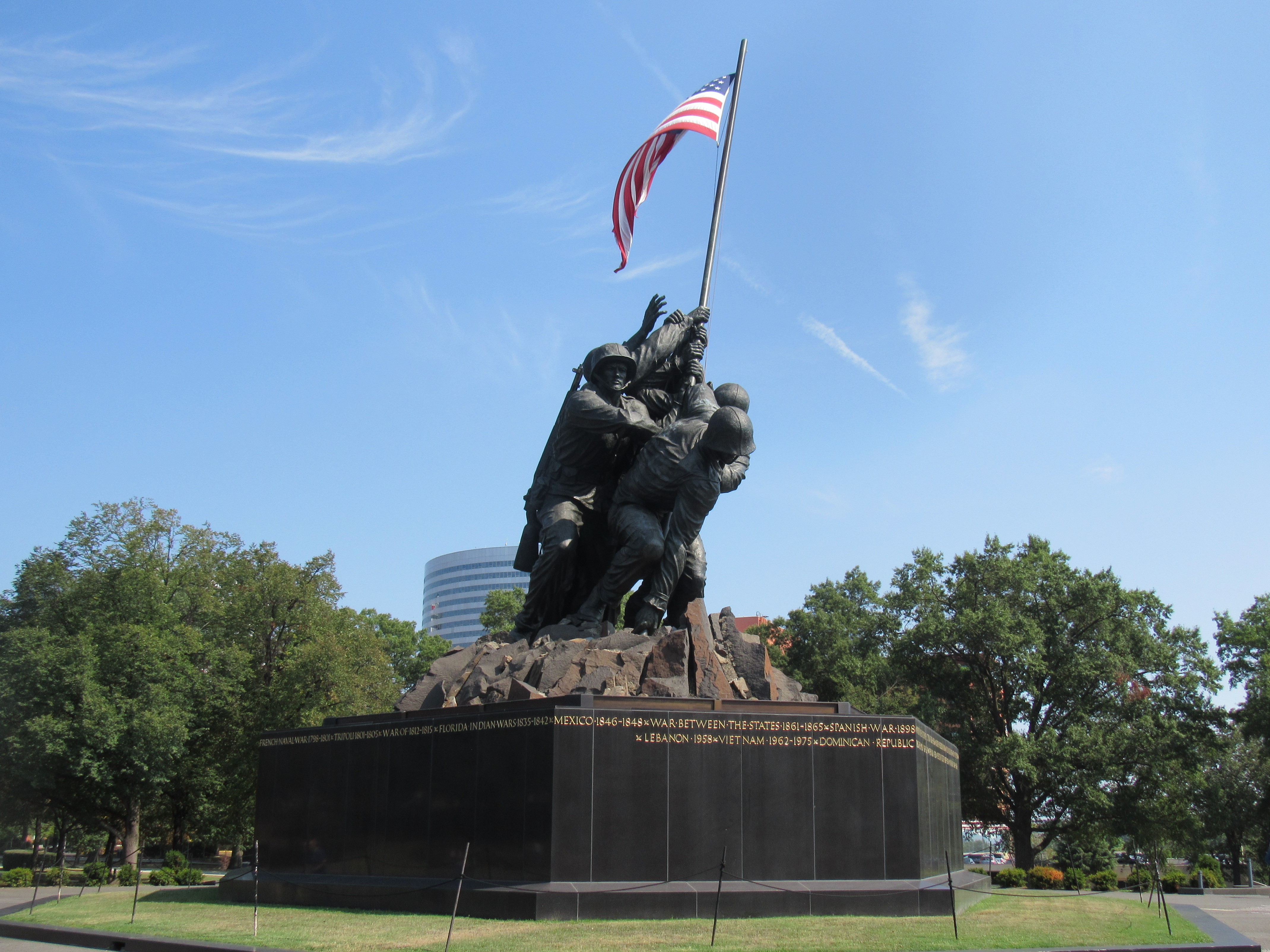
The photo inspired Sculptor Felix W. de Weldon to make a life size image that three of the six flag raisers—Ira Hayes, Rene Gagnon, and John Bradley—posed for. Sadly, the others were killed.

The Marine Corps War Memorial, also called Iwo Jima Memorial, was dedicated by President Dwight D. Eisenhower on November 10, 1954.

Because there were two actual historic flag raisings that day, doubt arose regarding the identity of one man in the photo. The Marines conducted an investigation. They discovered that though John Bradley had been one of the six men who raised the first flag, Private First Class Harold Schultz actually replaced him in the second flag raising.

The six flag raisers in the iconic photo are: Corporal Harlon Block, Private First Class Rene Gagnon, Private First Class Ira Hayes, Private First Class Harold Schultz, Private First Class Franklin Sousley, and Sergeant Michael Strank.

-Sandra Merville Hart

Sources

“History of the Marine Corps War Memorial,” NPS.gov, 2019/09/05 https://www.nps.gov/gwmp/learn/historyculture/usmcwarmemorial.htm.

History.com editors. “Iwo Jima,” History, 2019/09/05 https://www.history.com/topics/world-war-ii/battle-of-iwo-jima.

“USMC Statement on Iwo Jima Flag Raisers,” Marines, 2019/09/05 https://www.marines.mil/News/News-Display/Article/810457/usmc-statement-on-iwo-jima-flagraisers.


Pentagon Memorial

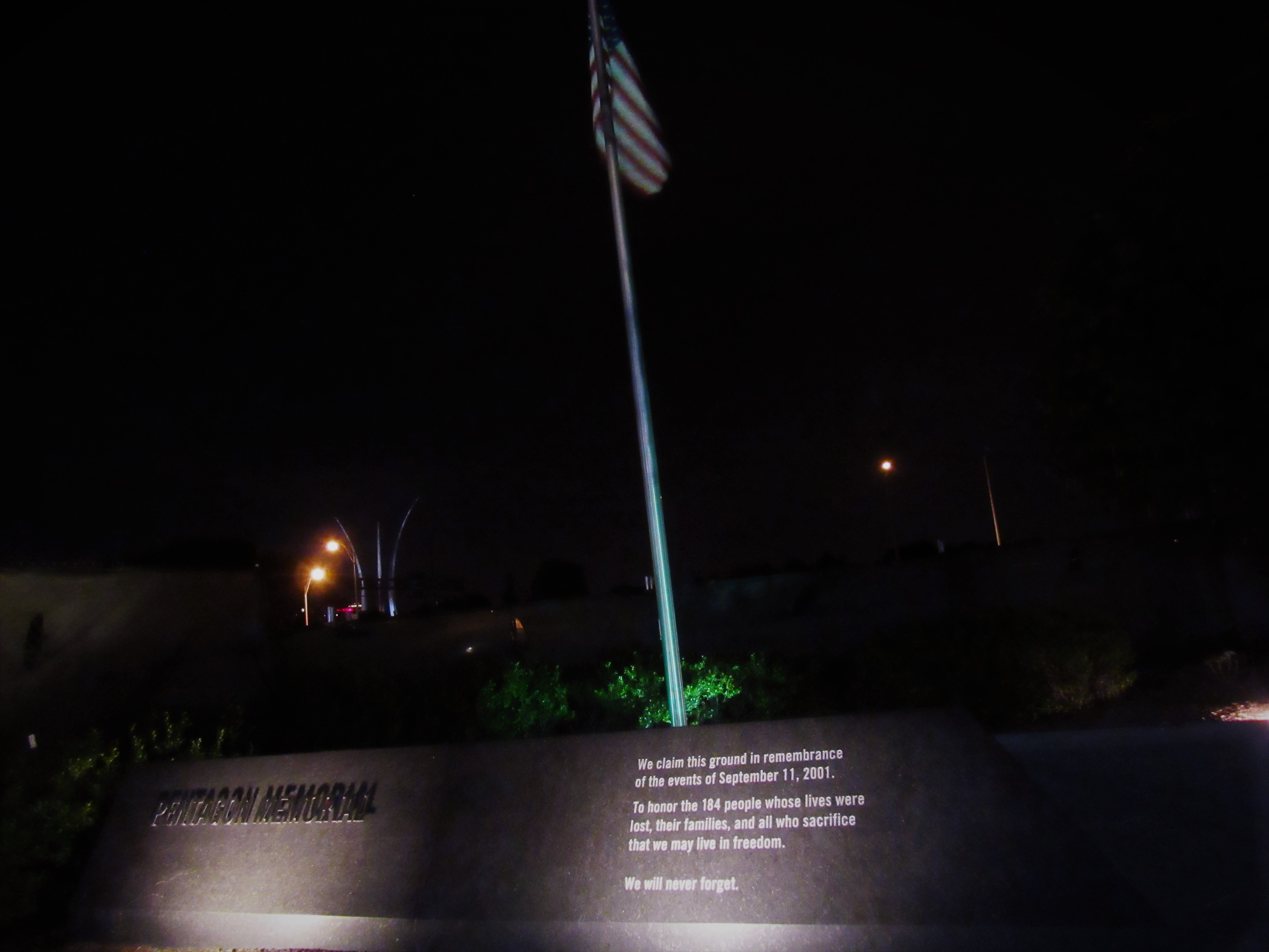
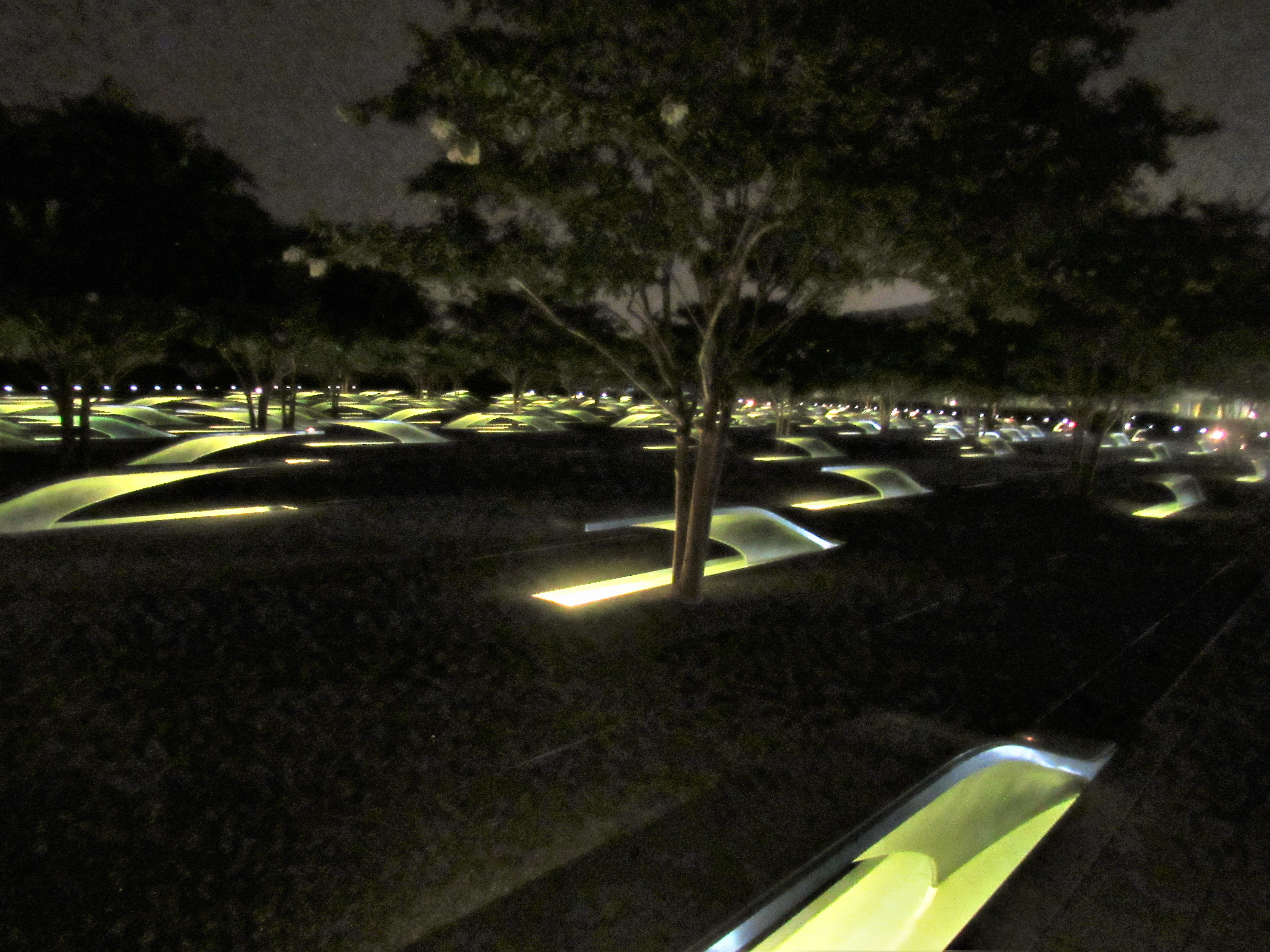
On a recent trip to Washington, DC, I visited the Pentagon Memorial. It was late in the evening and there were only a handful of visitors at the memorial. As I looked at the benches—184 of them—with lighted pools of water flowing underneath, I was struck once again by the tragedy of September 11, 2001.

No American alive that day can forget its horror. Four commercial airplanes were hijacked in coordinated attacks on specific targets and tragic loss of innocent lives resulted.

Five hijackers boarded American Airlines Flight 77 to Los Angeles from Dulles International Airport that sunny morning. The flight, delayed 10 minutes, departed at 8:20 am with 58 passengers and a crew of 6. What the crew didn’t know was that armed hijackers were among the passengers.

While flying over eastern Kentucky, hijackers took control of the plane, possibly between 8:51 and 8:54 am. It’s believed that one of them piloted the plane. None of the radio messages sent to the pilot after that time were answered.

It crashed into the Pentagon at 9:37 am, bringing a tragic end to 184 innocent lives.

The Pentagon Memorial, in remembrance of those who died there, opened on September 11, 2008. Architects Julie Beckman and Keith Kaseman along with engineer Buro Happold designed the memorial in a timeline, from the youngest victim (Dana Falkenberg at 3) to the oldest victim (John D. Yamnicky at 71), both on Flight 77.

Victims’ names have been placed on cantilevered benches with pools of flowing water underneath, which are lit at night. The designers put a lot of thought into the placement of the benches. Visitors read the names of those who perished in the Pentagon with that building behind it. Names face the sky where the plane approached for those from Flight 77.

Beautiful Crepe Myrtles, 85 of them, will eventually grow to height of 30 feet, giving shade to the Memorial in future years.

The Age Wall starts at a height of 3 inches for the youngest victim and builds to 71 inches for the oldest.

It’s a beautiful, well-designed unique memorial.

May we never forget.

-Sandra Merville Hart

Sources

“Pentagon Memorial,” The National 9/11, 2019/09/05 https://pentagonmemorial.org/.

“Pentagon Memorial,” National Geographic, 2019/09/05 https://www.nationalgeographic.org/media/pentagon-memorial/.


Civil War Women: Bettie Duvall, Confederate Spy

Washington D.C. resident Rose O’Neal Greenhow had been asked to discover troop movements and battle plans. She had information that Union troops had been ordered to attack Manassas. As a Confederate spy, she had a network of folks to deliver the coded message to Confederate General Beauregard. She gave the information to sixteen-year-old Bettie Duvall. (One source spelled her name “Betty.”)

On July 9, 1861, Bettie, a beautiful Southerner, disguised herself by selling buttermilk and sweet cream at the city market. She left the city, alone, on a farm cart. She rode past the 1st Massachusetts Infantry headquarters. A dirt lane led her to a friend’s plantation near Langley where she stayed for the night.

The next morning, she relinquished the farm cart. Dressed in a stylish riding habit, Bettie rode horseback to her intended destination—the village of Fairfax Court House. Manassas was ten miles from the village.

She met Confederate soldiers at an outpost near Vienna. At her request to speak with Brig. Gen. Milledge Bonham, they took her to his headquarters in Fairfax Court House. Beauregard had just taken over command, but Bonham was his top aide.

At first, Bonham refused to meet her. Upon learning that the beautiful woman was prepared to take the message to General Beauregard herself, he agreed to talk with her.

He recognized her “sparkling blue eyes, perfect features, glossy black hair” as a Southern lady from the spectator gallery at Congress. He agreed to forward on her message.

To his astonishment, she removed the combs from her hair knot. Shaking her beautiful hair loose, she untied a small silk package about the size of a silver dollar from the long strands and gave it to him.

Beauregard learned from the message that an attack was ordered within a week.

The advance warning led to a Confederate victory at the First Battle of Bull Run.

-Sandra Merville Hart

Sources

Monson, Marianne. Women of the Blue & Gray, Thorndike Press, 2018.

Winkler, H. Donald. Stealing Secrets, Cumberland House, 2010.

Zeinert, Karen. Those Courageous Women of the Civil War, The Millbrook Press, 1998.


Civil War Women: Kate Cumming, Confederate Nurse and Diarist

In the 1840s, Kate Cumming’s family emigrated from Scotland when she was a child, eventually settling in Mobile, Alabama.

Her mother and two sisters went to England when the Civil War started. Kate stayed in Mobile with her father. Her younger brother enlisted in the 21st Alabama Infantry as part of Ketchum’s Battery. Kate gathered hospital supplies to support wounded soldiers.

In 1862, Reverend Benjamin M. Miller’s speech encouraging women to serve in the hospitals stirred Kate. Inspired by this speech and Florence Nightingale’s example, Kate joined forty other women in Corinth, Mississippi, to nurse Battle of Shiloh wounded—despite her family’s objections.

She briefly returned home that summer yet yearned to continue nursing the soldiers. She traveled to Chattanooga with two other women to volunteer at Newsome Hospital. Her nursing help was eventually accepted.

In September of 1862, the Confederate government began allowing nurses to be paid. Kate enlisted in the Confederate Army Medical Department. Despite her personal sadness at watching soldiers die and battling poor hospital conditions, she worked as matron with Dr. Samuel Stout, medical director for Army of Tennessee, in various locations in Alabama, Tennessee, and Georgia.

As a matron, Kate managed hospital departments, nursed soldiers, foraged for supplies, cooked, sewed, wrote letters, and supervised other workers.

She also maintained a detailed diary. This honest account of day-to-day nursing tasks and the men she served also shows tragedies Southerners faced in increasing measure as the war progressed.

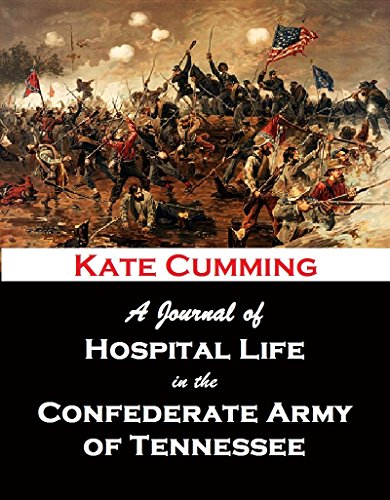
After the war, Kate published her diary, A Journal of Hospital Life in the Confederate Army of Tennessee from the Battle of Shiloh to the End of the War: With Sketches of Life and Character, and Brief Notices of Current Events During that Period.

The author’s introduction was written in 1865—before publication. Kate is bitter about treatment from the North after the war’s end and urges all to unite. Her hope in publishing her diaries is to show Northerners how all have suffered. She wants reconciliation.

-Sandra Merville Hart

Sources

Cumming, Kate. Edited by Harwell, Richard Barksdale. Kate: The Journal of a Confederate Nurse, Louisiana State University Press, 1959.

Hilde, Libra. “Kate Cumming,” Encyclopedia of Alabama, 2019/04/11 http://www.encyclopediaofalabama.org/article/h-1101.

“Kate Cumming,” National Park Service, 2019/04/11 ttps://www.nps.gov/people/kate-cumming.htm.

“Kate Cumming,” Wikipedia, 2019/04/11 ttps://en.wikipedia.org/wiki/Kate_Cumming.

Rohrer, Katherine E. “Kate Cumming (ca. 1830-1909).” New Georgia Encyclopedia. 08 June 2017. Web. 11 April 2019.


The Aftermath of the Battle of Gettysburg

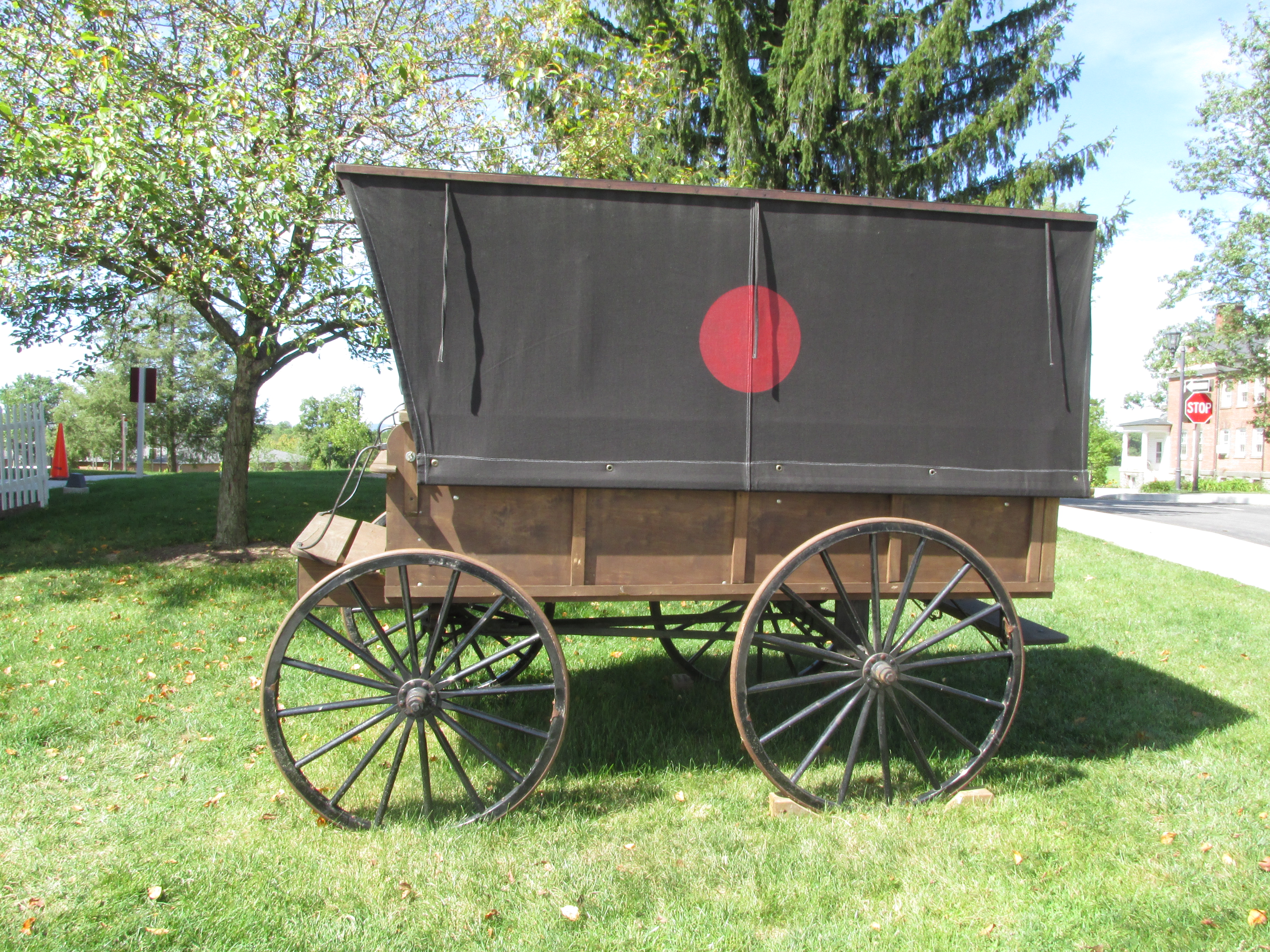
Ambulance outside Lutheran Seminary, Gettysburg.

On July 4, 1863, Confederate General Robert E. Lee began his retreat after the Battle of Gettysburg with an ambulance and wagon train that was about seventeen miles long. Nine Gettysburg men accused of spying or other suspicious activities went with them. Captured African Americans headed south along with thousands of military prisoners. Confederate sharpshooters continued to shoot at Union soldiers in town.

Confederates no longer controlled Gettysburg. The townspeople, who endured a nightmare during the battle, ventured outside their homes to a new ordeal. Their town didn’t look the same nor would it ever be the same.

Homes had been damaged by bullet holes and cannon balls. Soldiers’ discarded knapsacks, blankets, cartridge boxes, bayonets, ramrods, broken guns, food, and letters littered the streets and fields. Broken wagons, wheels, and unexploded shells remained after the battle.

Groans and shrieks from the wounded in churches, the courthouse, homes, and barns tugged at citizens’ hearts. Injured soldiers lay in tents in the fields and under blankets hung over cross-sticks.

Wounded from both sides lay on the battlefields, awaiting rescue. Some had waited since the first day of the battle.

Dead horses lay in the streets. Soldiers killed in battle needed to be buried. (Some 7,000-8,000 soldiers died—sources vary on exact numbers. See my article on Gettysburg’s numbers.) People, even in the stifling heat, closed their windows to block out the terrible odor. They treated the streets with chloride of lime. They cremated bodies of mules and horses with kerosene, adding to the smell.

The town mourned the loss of Jennie Wade, who was buried with dried dough on her hands. She’d been kneading dough when a Confederate bullet aimed at Union soldiers claimed her life.

General Lee left almost 7,000 men too wounded to travel. These soldiers ended up in area hospitals, and were transported to prisoner-of-war camps like Fort McHenry once they recovered.

Damaged rail lines were repaired about a week after the battle ended. About 800 men were then moved daily by train to larger city hospitals.

The Sanitary Commission gave food to several hospitals—10,000 loaves of bread, 11,000 pounds of poultry and mutton, 7,100 shirts, 8,500 dozen eggs, and more than 6,000 pounds of butter. The Christian Commission also gave out supplies.

Drinking water was in short supply.

The demand for food for so many extra people had local farmers charging steep prices. For example, a loaf of bread cost ten cents before the battle and seventy-five cents after it.

On July 7, 1863, Gettysburg resident Sarah Broadhead wrote, “I am becoming more used to sights of misery. We do not know until tried what we are capable of.”

-Sandra Merville Hart

Sources

Creighton, Margaret S. The Colors of Courage: Gettysburg’s Forgotten History, Basic Books, 2005.

McGaugh, Scott. Surgeon in Blue: Jonathan Letterman, the Civil War Doctor who Pioneered Battlefield Care, Arcade Publishing, 2013.

Sheldon, George. When the Smoke Cleared at Gettysburg: The Tragic Aftermath of the Bloodiest Battle of the Civil War, Cumberland House, 2003.

Slade, Jim & Alexander, John. Firestorm at Gettysburg, Schiffler Military/Aviation History, 1998.

Thomas, Sarah Sites. The Ties of the Past: The Gettysburg Diaries of Salome Myers Stewart 1854-1922, Thomas Publications, 1996.


Before the Battle of Gettysburg-Rumors

View from Lutheran Seminary cupola, Gettysburg.

On June 12, 1863, Pennsylvania Governor Andrew Curtain warned citizens of his state to prepare for an attack. His warning fanned the fear of Confederates coming to Gettysburg.

Sallie Myers Stewart, who lived in Gettysburg, wrote that businesses stopped operating. Merchants sent their goods to cities like Philadelphia. Bankers sent money out of town. Folks stood on street corners in groups, talking about the danger. Any news attracted crowds.

Dread hung in the air as worry mounted among residents.

Sallie’s compassion went out to the town’s 300-400 black citizens. Many packed the possessions they could carry and fled to the north. They feared that staying meant risking capture by Confederate soldiers—and slavery in the South.

Townspeople hid their horses in the hills or near the Susquehanna River. A number of men left town, leaving their wives and daughters in Gettysburg. Fannie Buehler, whose husband was an editor and postmaster, packed a bag for him, believing him to be a marked man.

Some townsmen joined seminary and college students traveling to Harrisburg. They and others united to become the 26th Pennsylvania Emergency Infantry Regiment.

On June 20th, a Union officer came to town. He warned citizens to arm themselves.

The next day, groups of men carried axes toward South Mountain to chop down trees and block roads and passes.

Multiple rumors over the war’s duration were about to become reality.

The Rebels were coming.

-Sandra Merville Hart

Sources


Creighton, Margaret S. The Colors of Courage: Gettysburg’s Forgotten History, Basic Books, 2005.


Sheldon, George. When the Smoke Cleared at Gettysburg: The Tragic Aftermath of the Bloodiest Battle of the Civil War, Cumberland House, 2003.


Thomas, Sarah Sites. The Ties of the Past: The Gettysburg Diaries of Salome Myers Stewart 1854-1922, Thomas Publications, 1996.


Battle of Gettysburg-Railroad Station

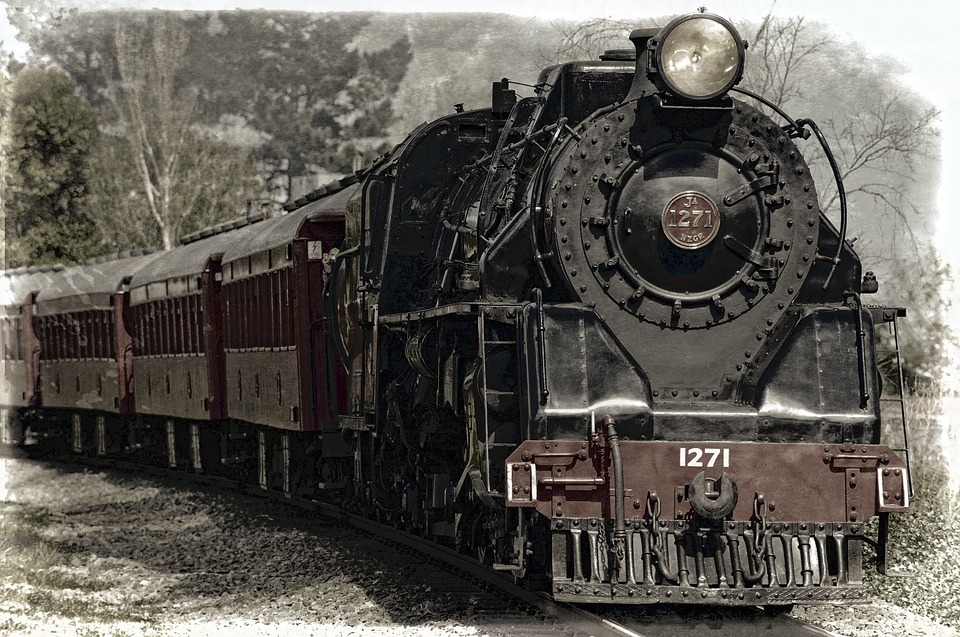
The railroad station in Gettysburg had been completed in May of 1859. It had a covered platform for passengers to enter and exit the train. As was the custom of the time, women and children had their own waiting room and men had another. A large brass bell in the cupola rang when trains departed.

Soldiers used the train almost daily throughout the war. The 10th New York Cavalry used the second floor of the station while stationed in town during the winter of 1861-62.

Teenager Daniel Skelly remembered that the last train out of Gettysburg until after the Battle of Gettysburg reached Hanover about 5 pm on June 26, 1863. Residents had received advance warning that Confederate Jubal Early’s troops were headed to town. Revenue officers, clerks, and those holding government office jobs left on that last train.

Early’s troops burned freight cars and destroyed the Rock Creek railroad bridge.

The station was one of the first buildings to become a hospital as the battle raged on July 1, 1863. Wounded from the 6th Wisconsin, part of the famous “Iron Brigade,” were among those receiving care at the station.

Gettysburg women like Sarah Montford and her daughter, Mary, nursed those at the railroad station. Patients remained there during the Confederate occupation of the town. They were moved to other hospitals beginning July 4th.

Patients able to climb to the train cupola observed the fighting from there during the battle. Private James Sullivan, 6th Wisconsin, was among the ten to fifteen men on the station roof who watched the Union win after Pickett’s Charge.

Train service was restored on July 10th, but the government controlled the rail for six weeks. Inbound were medical supplies, folks coming to help with wounded, and family members searching for loved ones. Outbound trains held wounded traveling to large city hospitals. By the end of July, almost 15,000 injured soldiers had been transported away by train.

The U.S. Government controlled the station and railroad line almost exclusively for the rest of the summer as the aftermath of the battle continued.

-Sandra Merville Hart

Sources

Bennett, Gerald. The Gettysburg Railroad Station, Gettysburg Railroad Station Restoration Project, 2008.


Sheldon, George. When the Smoke Cleared at Gettysburg: The Tragic Aftermath of the Bloodiest Battle of the Civil War, Cumberland House, 2003.


Civil War Women: Sarah Morgan Dawson, Confederate Diarist

Sarah Morgan Dawson was twenty when she began writing in her diary on March 9, 1862. The Civil War raged near her family’s home in Baton Rouge, Louisiana. Her family had already known hard times. In 1861, illness claimed her father’s life and a duel claimed a brother’s life.

War threatened to divide her family. Three brothers fought for the Confederacy and another, though he sided with the Union, refused to fight against his brothers.

Baton Rouge fell into Union hands. Most citizens ran for their lives, including Sarah’s family. She returned a few times to gather possessions from her home, but found that the Union soldiers who occupied the city had ransacked it. The home was unrecognizable on her last trip—the soldiers had plundered valuables and destroyed what they left behind. Sarah didn’t return to her childhood home until after the war.

Made homeless by the war, her family wandered from Baton Rouge, staying with friends and strangers.

Food supplies dwindled. Sarah had money to purchase food yet some places had none for sale.

They stayed near the Confederate army, making friends with many soldiers. Sarah did all she could to help them. Her family had escaped with few clothes … and everyone else was in the same predicament.

A serious buggy accident injured Sarah’s back. The injury prevented her from walking more than a few steps. She clung to her faith throughout the difficulties that mounted almost daily.

Her Union-sympathizer brother urged them to stay with him in New Orleans, which was now under Union control. They had little choice. A hard train ride and then a schooner took them to New Orleans.

Upon their arrival, they had to take an oath of allegiance to the Union. A Southerner at heart, taking the oath broke Sarah’s spirit. Even worse, Sarah’s mother complained so passionately to the Union soldiers of all she’d suffered at their hands that she was almost arrested. Sarah’s brother smoothed things over and took them into his home.

At the beginning of 1864, Sarah’s heart broke to discover that two of her brothers died. They’d lost so much to the war that she hated the Union.

General Lee surrendered on April 9, 1865. Sarah’s diary entries stopped on June 15, 1865.

It was published and inscribed: “To those who endured and forgave”.

Sarah read her diary many years later and wanted people to know that through it all, God never failed her. “Whatever the anguish, whatever the extremity, in His own good time He ever delivered me. So that I bless Him to-day for all of life’s joys and sorrows—for all He gave—for all He has taken—and I bear witness that it was all Very Good.” –Sarah Morgan Dawson, July 23rd, 1896, Charleston, South Carolina.

-Sandra Merville Hart

Sources

Dawson, Sarah Morgan. A Confederate Girl’s Diary: Civil War Centennial Series, Indiana University Press, 1960.