Civil War Women: Kate Cumming, Confederate Nurse and Diarist

In the 1840s, Kate Cumming’s family emigrated from Scotland when she was a child, eventually settling in Mobile, Alabama.

Her mother and two sisters went to England when the Civil War started. Kate stayed in Mobile with her father. Her younger brother enlisted in the 21st Alabama Infantry as part of Ketchum’s Battery. Kate gathered hospital supplies to support wounded soldiers.

In 1862, Reverend Benjamin M. Miller’s speech encouraging women to serve in the hospitals stirred Kate. Inspired by this speech and Florence Nightingale’s example, Kate joined forty other women in Corinth, Mississippi, to nurse Battle of Shiloh wounded—despite her family’s objections.

She briefly returned home that summer yet yearned to continue nursing the soldiers. She traveled to Chattanooga with two other women to volunteer at Newsome Hospital. Her nursing help was eventually accepted.

In September of 1862, the Confederate government began allowing nurses to be paid. Kate enlisted in the Confederate Army Medical Department. Despite her personal sadness at watching soldiers die and battling poor hospital conditions, she worked as matron with Dr. Samuel Stout, medical director for Army of Tennessee, in various locations in Alabama, Tennessee, and Georgia.

As a matron, Kate managed hospital departments, nursed soldiers, foraged for supplies, cooked, sewed, wrote letters, and supervised other workers.

She also maintained a detailed diary. This honest account of day-to-day nursing tasks and the men she served also shows tragedies Southerners faced in increasing measure as the war progressed.

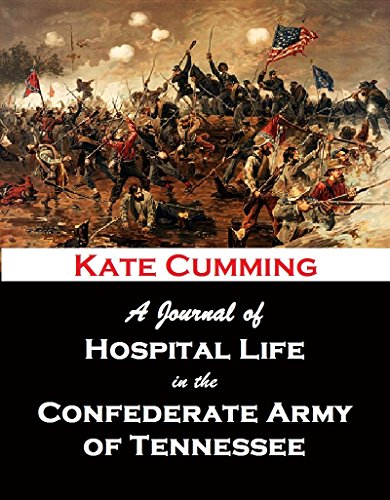
After the war, Kate published her diary, A Journal of Hospital Life in the Confederate Army of Tennessee from the Battle of Shiloh to the End of the War: With Sketches of Life and Character, and Brief Notices of Current Events During that Period.

The author’s introduction was written in 1865—before publication. Kate is bitter about treatment from the North after the war’s end and urges all to unite. Her hope in publishing her diaries is to show Northerners how all have suffered. She wants reconciliation.

-Sandra Merville Hart

Sources

Cumming, Kate. Edited by Harwell, Richard Barksdale. Kate: The Journal of a Confederate Nurse, Louisiana State University Press, 1959.

Hilde, Libra. “Kate Cumming,” Encyclopedia of Alabama, 2019/04/11 http://www.encyclopediaofalabama.org/article/h-1101.

“Kate Cumming,” National Park Service, 2019/04/11 ttps://www.nps.gov/people/kate-cumming.htm.

“Kate Cumming,” Wikipedia, 2019/04/11 ttps://en.wikipedia.org/wiki/Kate_Cumming.

Rohrer, Katherine E. “Kate Cumming (ca. 1830-1909).” New Georgia Encyclopedia. 08 June 2017. Web. 11 April 2019.


The Aftermath of the Battle of Gettysburg

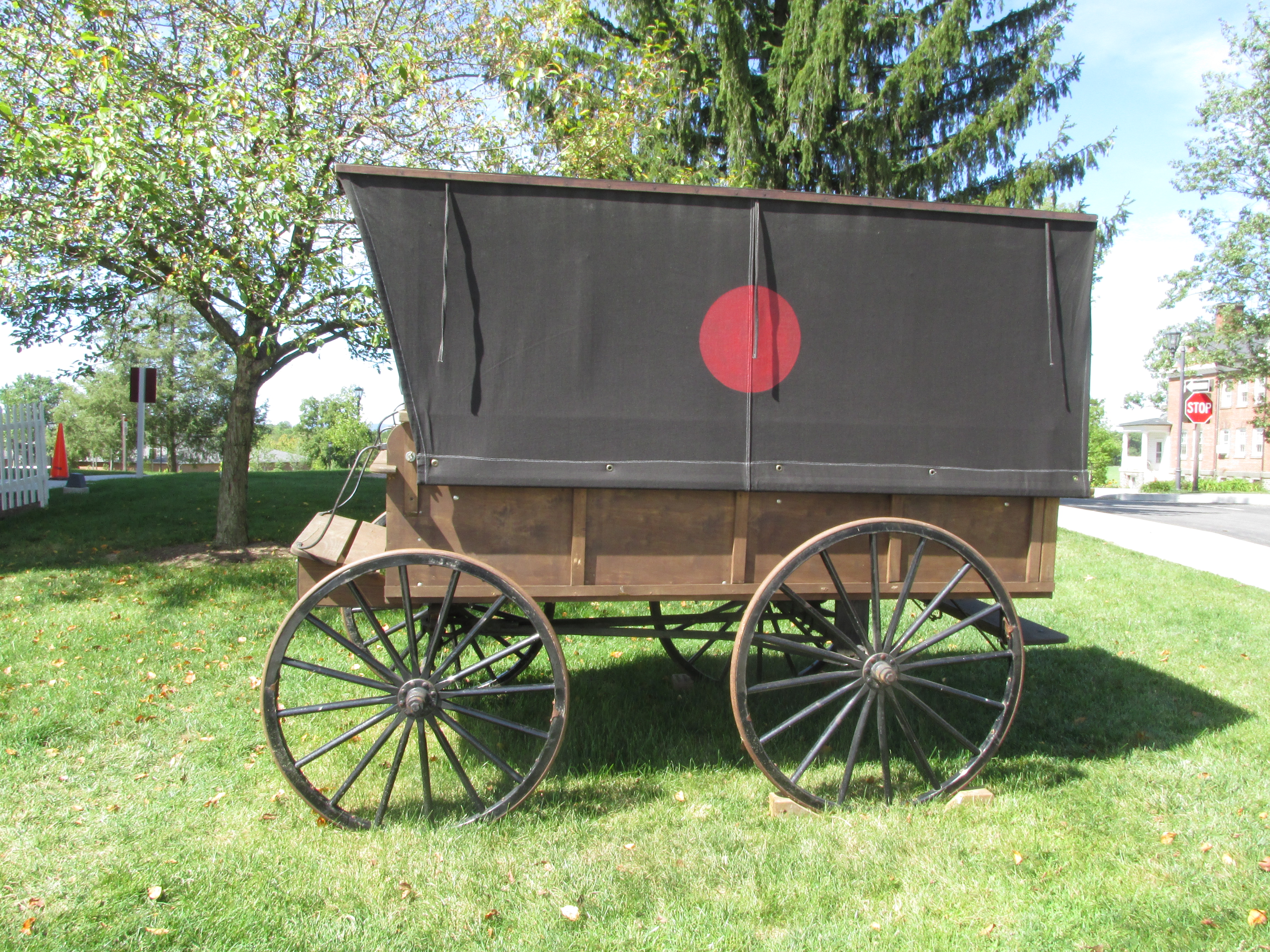
Ambulance outside Lutheran Seminary, Gettysburg.

On July 4, 1863, Confederate General Robert E. Lee began his retreat after the Battle of Gettysburg with an ambulance and wagon train that was about seventeen miles long. Nine Gettysburg men accused of spying or other suspicious activities went with them. Captured African Americans headed south along with thousands of military prisoners. Confederate sharpshooters continued to shoot at Union soldiers in town.

Confederates no longer controlled Gettysburg. The townspeople, who endured a nightmare during the battle, ventured outside their homes to a new ordeal. Their town didn’t look the same nor would it ever be the same.

Homes had been damaged by bullet holes and cannon balls. Soldiers’ discarded knapsacks, blankets, cartridge boxes, bayonets, ramrods, broken guns, food, and letters littered the streets and fields. Broken wagons, wheels, and unexploded shells remained after the battle.

Groans and shrieks from the wounded in churches, the courthouse, homes, and barns tugged at citizens’ hearts. Injured soldiers lay in tents in the fields and under blankets hung over cross-sticks.

Wounded from both sides lay on the battlefields, awaiting rescue. Some had waited since the first day of the battle.

Dead horses lay in the streets. Soldiers killed in battle needed to be buried. (Some 7,000-8,000 soldiers died—sources vary on exact numbers. See my article on Gettysburg’s numbers.) People, even in the stifling heat, closed their windows to block out the terrible odor. They treated the streets with chloride of lime. They cremated bodies of mules and horses with kerosene, adding to the smell.

The town mourned the loss of Jennie Wade, who was buried with dried dough on her hands. She’d been kneading dough when a Confederate bullet aimed at Union soldiers claimed her life.

General Lee left almost 7,000 men too wounded to travel. These soldiers ended up in area hospitals, and were transported to prisoner-of-war camps like Fort McHenry once they recovered.

Damaged rail lines were repaired about a week after the battle ended. About 800 men were then moved daily by train to larger city hospitals.

The Sanitary Commission gave food to several hospitals—10,000 loaves of bread, 11,000 pounds of poultry and mutton, 7,100 shirts, 8,500 dozen eggs, and more than 6,000 pounds of butter. The Christian Commission also gave out supplies.

Drinking water was in short supply.

The demand for food for so many extra people had local farmers charging steep prices. For example, a loaf of bread cost ten cents before the battle and seventy-five cents after it.

On July 7, 1863, Gettysburg resident Sarah Broadhead wrote, “I am becoming more used to sights of misery. We do not know until tried what we are capable of.”

-Sandra Merville Hart

Sources

Creighton, Margaret S. The Colors of Courage: Gettysburg’s Forgotten History, Basic Books, 2005.

McGaugh, Scott. Surgeon in Blue: Jonathan Letterman, the Civil War Doctor who Pioneered Battlefield Care, Arcade Publishing, 2013.

Sheldon, George. When the Smoke Cleared at Gettysburg: The Tragic Aftermath of the Bloodiest Battle of the Civil War, Cumberland House, 2003.

Slade, Jim & Alexander, John. Firestorm at Gettysburg, Schiffler Military/Aviation History, 1998.

Thomas, Sarah Sites. The Ties of the Past: The Gettysburg Diaries of Salome Myers Stewart 1854-1922, Thomas Publications, 1996.


Before the Battle of Gettysburg-Rumors

View from Lutheran Seminary cupola, Gettysburg.

On June 12, 1863, Pennsylvania Governor Andrew Curtain warned citizens of his state to prepare for an attack. His warning fanned the fear of Confederates coming to Gettysburg.

Sallie Myers Stewart, who lived in Gettysburg, wrote that businesses stopped operating. Merchants sent their goods to cities like Philadelphia. Bankers sent money out of town. Folks stood on street corners in groups, talking about the danger. Any news attracted crowds.

Dread hung in the air as worry mounted among residents.

Sallie’s compassion went out to the town’s 300-400 black citizens. Many packed the possessions they could carry and fled to the north. They feared that staying meant risking capture by Confederate soldiers—and slavery in the South.

Townspeople hid their horses in the hills or near the Susquehanna River. A number of men left town, leaving their wives and daughters in Gettysburg. Fannie Buehler, whose husband was an editor and postmaster, packed a bag for him, believing him to be a marked man.

Some townsmen joined seminary and college students traveling to Harrisburg. They and others united to become the 26th Pennsylvania Emergency Infantry Regiment.

On June 20th, a Union officer came to town. He warned citizens to arm themselves.

The next day, groups of men carried axes toward South Mountain to chop down trees and block roads and passes.

Multiple rumors over the war’s duration were about to become reality.

The Rebels were coming.

-Sandra Merville Hart

Sources


Creighton, Margaret S. The Colors of Courage: Gettysburg’s Forgotten History, Basic Books, 2005.


Sheldon, George. When the Smoke Cleared at Gettysburg: The Tragic Aftermath of the Bloodiest Battle of the Civil War, Cumberland House, 2003.


Thomas, Sarah Sites. The Ties of the Past: The Gettysburg Diaries of Salome Myers Stewart 1854-1922, Thomas Publications, 1996.


Battle of Gettysburg-Railroad Station

The railroad station in Gettysburg had been completed in May of 1859. It had a covered platform for passengers to enter and exit the train. As was the custom of the time, women and children had their own waiting room and men had another. A large brass bell in the cupola rang when trains departed.

Soldiers used the train almost daily throughout the war. The 10th New York Cavalry used the second floor of the station while stationed in town during the winter of 1861-62.

Teenager Daniel Skelly remembered that the last train out of Gettysburg until after the Battle of Gettysburg reached Hanover about 5 pm on June 26, 1863. Residents had received advance warning that Confederate Jubal Early’s troops were headed to town. Revenue officers, clerks, and those holding government office jobs left on that last train.

Early’s troops burned freight cars and destroyed the Rock Creek railroad bridge.

The station was one of the first buildings to become a hospital as the battle raged on July 1, 1863. Wounded from the 6th Wisconsin, part of the famous “Iron Brigade,” were among those receiving care at the station.

Gettysburg women like Sarah Montford and her daughter, Mary, nursed those at the railroad station. Patients remained there during the Confederate occupation of the town. They were moved to other hospitals beginning July 4th.

Patients able to climb to the train cupola observed the fighting from there during the battle. Private James Sullivan, 6th Wisconsin, was among the ten to fifteen men on the station roof who watched the Union win after Pickett’s Charge.

Train service was restored on July 10th, but the government controlled the rail for six weeks. Inbound were medical supplies, folks coming to help with wounded, and family members searching for loved ones. Outbound trains held wounded traveling to large city hospitals. By the end of July, almost 15,000 injured soldiers had been transported away by train.

The U.S. Government controlled the station and railroad line almost exclusively for the rest of the summer as the aftermath of the battle continued.

-Sandra Merville Hart

Sources

Bennett, Gerald. The Gettysburg Railroad Station, Gettysburg Railroad Station Restoration Project, 2008.


Sheldon, George. When the Smoke Cleared at Gettysburg: The Tragic Aftermath of the Bloodiest Battle of the Civil War, Cumberland House, 2003.


Civil War Women: Sarah Morgan Dawson, Confederate Diarist

Sarah Morgan Dawson was twenty when she began writing in her diary on March 9, 1862. The Civil War raged near her family’s home in Baton Rouge, Louisiana. Her family had already known hard times. In 1861, illness claimed her father’s life and a duel claimed a brother’s life.

War threatened to divide her family. Three brothers fought for the Confederacy and another, though he sided with the Union, refused to fight against his brothers.

Baton Rouge fell into Union hands. Most citizens ran for their lives, including Sarah’s family. She returned a few times to gather possessions from her home, but found that the Union soldiers who occupied the city had ransacked it. The home was unrecognizable on her last trip—the soldiers had plundered valuables and destroyed what they left behind. Sarah didn’t return to her childhood home until after the war.

Made homeless by the war, her family wandered from Baton Rouge, staying with friends and strangers.

Food supplies dwindled. Sarah had money to purchase food yet some places had none for sale.

They stayed near the Confederate army, making friends with many soldiers. Sarah did all she could to help them. Her family had escaped with few clothes … and everyone else was in the same predicament.

A serious buggy accident injured Sarah’s back. The injury prevented her from walking more than a few steps. She clung to her faith throughout the difficulties that mounted almost daily.

Her Union-sympathizer brother urged them to stay with him in New Orleans, which was now under Union control. They had little choice. A hard train ride and then a schooner took them to New Orleans.

Upon their arrival, they had to take an oath of allegiance to the Union. A Southerner at heart, taking the oath broke Sarah’s spirit. Even worse, Sarah’s mother complained so passionately to the Union soldiers of all she’d suffered at their hands that she was almost arrested. Sarah’s brother smoothed things over and took them into his home.

At the beginning of 1864, Sarah’s heart broke to discover that two of her brothers died. They’d lost so much to the war that she hated the Union.

General Lee surrendered on April 9, 1865. Sarah’s diary entries stopped on June 15, 1865.

It was published and inscribed: “To those who endured and forgave”.

Sarah read her diary many years later and wanted people to know that through it all, God never failed her. “Whatever the anguish, whatever the extremity, in His own good time He ever delivered me. So that I bless Him to-day for all of life’s joys and sorrows—for all He gave—for all He has taken—and I bear witness that it was all Very Good.” –Sarah Morgan Dawson, July 23rd, 1896, Charleston, South Carolina.

-Sandra Merville Hart

Sources

Dawson, Sarah Morgan. A Confederate Girl’s Diary: Civil War Centennial Series, Indiana University Press, 1960.


Future President Abraham Lincoln Visits Cincinnati

September 17, 1859 was a warm, sultry Saturday night in Cincinnati. Drummers played. Rockets glared reddish-yellow above Fifth Street residences. A Union flag waved above the Fifth Street Market House. Youngsters fed several bonfires to light the night for a crowd of over 4,000 who gazed at a man speaking from a 2nd floor balcony.

Abraham Lincoln of Illinois spoke from a building on the north side of the street where the Federal Courthouse stands. Earnest and, at time, humorous, Lincoln spoke against the expansion of slavery.

Reverend Moncure Conway was used to political gatherings. This one was a campaign specifically for Cincinnati attorney William Dennison who was running for Governor. Yet there was something compelling about Lincoln. He said that slavery was wrong. In that border city where slavery was legal across the Ohio River into Kentucky, a few folks in the crowd hissed their disapproval.

Lincoln waited for outbursts to subside a little. Then he replied that everyone was born with two hands and a mouth to be fed and he inferred it was the job of those two hands to feed that mouth.

The Republicans didn’t ask Lincoln to be their nominee until six months later on May 23, 1860. When someone in the Cincinnati crowd asked who Lincoln recommended they vote for, he didn’t have a choice for candidate. His advice was to vote for a man who’d fight slavery’s expansion.

Front-Porch Campaigns of the era preferred that presidential candidates allow the Republican Party to give their message to citizens.

Seventeen months later on February 18, 1861, President-elect Abraham Lincoln, on his way to Washington, was back in Cincinnati. City buildings were decorated in red, white, and blue bunting. Wearing black with a gray shawl over his shoulders, Lincoln smiled at the train station’s enthusiastic crowd. Cannons boomed in welcome on his procession to center of the city. Young girls sang “The Star-Spangled Banner” and “Hail Columbia.” Officials made patriotic speeches. He went to Cincinnati’s Burnet House while there but it’s not clear where these speeches were made.

-Sandra Merville Hart

Sources

Tucker, Louis Leonard. Cincinnati during the Civil War, Ohio State University Press, 1962.

Wimberg, Robert J. Cincinnati and the Civil War: Off to Battle, Ohio Book Store, 1992.

“With Malice Toward None: The Abraham Lincoln Bicentennial Exhibition,” Library of Congress Exhibitions, 2019/04/01 https://www.loc.gov/exhibits/lincoln/the-run-for-president.html.


Civil War Women: Sister Anthony, Angel of the Battlefield

Mary O’Connell’s family emigrated to Boston from Ireland in 1821 when she was about seven-years-old. After joining the Sisters of Charity, she became known as Sister Anthony.

In 1837, she began working at St. Peter’s Orphan Asylum and School for girls in Cincinnati. Later she was given charge of a new hospital, St. John’s Hotel for Invalids.

Camp Dennison, a Civil War training camp about fifteen miles from Cincinnati, required nurses for sick soldiers after the war began. Sister Anthony and five other nuns rode the train and then walked two to three miles to visit the regimental hospitals every day. To save this daily expense, the sisters stayed at a small wooden church near camp.

Requests for nurses prompted Sister Anthony and others to care for wounded on a hospital ship with Dr. George Curtis Blackman at the Battle of Shiloh. Dead and dying soldiers filled the decks. One overcrowded ship had seven hundred patients.

Because the sisters didn’t give preferential treatment, they were asked to care for wounded prisoners.

Sister Anthony helped bring wounded soldiers from the battlefield. She is credited with developing Battlefield Triage, earning President Lincoln’s praise.

After caring for wounded at Shiloh, she became known as the “Angel of the Battlefield.” Sister Anthony served at several battlefields, including Nashville, Cumberland Gap, Richmond, Lynchburg, and Culpeper Court House.

She didn’t distinguish between Union and Confederate soldiers. She knew generals on both sides and was acquainted with Confederate President Jefferson Davis.

Joseph C. Butler and Louis Worthington gave a large Cincinnati building at Sixth and Lock Street to Sister Anthony in 1866. The hospital, meant to honor her and the other sisters’ war service, had two stipulations: exclude no one because of religion or color and they were to name it “The Hospital of the Good Samaritan.”

St. Joseph Foundling and Maternity Hospital opened later that year. It’s not clear why the name changed.

-Sandra Merville Hart

Sources

“Battle Nurses,” Newspapers.com, 2019/03/30 https://www.newspapers.com/clip/18267260/civil_war_nurses_catholic_sisters_in/.

Graves, Dan, MSL. “Sister Anthony, Battlefield Heroine,” Christianity.com, 2019/03/30 https://www.christianity.com/church/church-history/timeline/1801-1900/sister-anthony-battlefield-heroine-11630652.html.

“Mary O’Connell,” Wikipedia, 2019/03/30 https://en.wikipedia.org/wiki/Mary_O%27Connell.

Wimberg, Robert J. Cincinnati and the Civil War: Off to Battle, Ohio Book Store, 1992.


Civil War Women: Susie King Taylor, Union Nurse and Teacher

Born into slavery in Georgia in 1848, Susie Baker lived with her grandmother in Savannah after turning seven. She and her younger sister and brother secretly attended school taught by black women.

In April of 1862, the Civil War had been going on for a year when Susie accompanied her uncle to Saint Catherine Island, seeking protection from the Union fleet there. They were taken, two weeks later, to Saint Simons Island. About 600 black men, women, and children lived there.

Susie received two large boxes of books and Bibles from the North. She used these to teach about 40 children on the island, making her the first black teacher in Georgia for free African American students. Several adults came to her in the evenings to learn how to read.

She married Edward King, a black noncommissioned Union officer, while on St. Simons Island.

Cases of varioloid (a form of smallpox) broke out among the soldiers. One soldier had to be quarantined in his tent with only his doctor allowed to see him. Having been vaccinated, Susie nursed him daily. She also faithfully drank sassafras tea, believing this kept her blood clean.

After the island was evacuated in October of 1862, Susie traveled with her husband and brothers’ regiment. She nursed the wounded, laundered clothes, and taught many black soldiers to read.

Shrapnel, bullets, and cannon balls wreak havoc on the human body. Susie’s compassionate heart allowed her to look past the gruesome wounds as she sought to relieve the men’s suffering. She bound wounds and gave water to the parched men, alleviating pain as much as she was able.

After the war, she and her husband returned to Savannah. She started a school for freed children. In 1866, Edward died before their first child was born. Susie had started two more schools by 1868.

A job as a domestic servant took her to Boston, where she met and married Russell Taylor.

Susie didn’t forget the soldiers. She helped organize Corps 67, a chapter of the Women’s Relief Corps, and served as President, Secretary, Treasurer, and Guard of this corps.

-Sandra Merville Hart

Sources

Butchart, Ronald E. “Susie King Taylor (1848-1912),” Georgia Encyclopedia, 2019/03/30 https://www.georgiaencyclopedia.org/articles/history-archaeology/susie-king-taylor-1848-1912.


Lardas, Mark. African American Soldier in the Civil War: USCT 1862-66, Osprey Publishing Ltd., 2006.


Taylor, Susie King. Edited by Malone, Margaret Gay. In My Own Words: The Diary of Susie King Taylor, Civil War Nurse, Benchmark Books, 2004.


Civil War Women: Harriet Tubman, Union Spy

Born into slavery on a Maryland plantation, Araminta Ross’s parents nicknamed her “Minty.” Minty later took her mother’s name, Harriet, to honor her.

At age twelve, she stepped between an overseer throwing a heavy object at a fugitive slave. It struck Harriet instead, breaking her skull. The injury caused headaches and narcolepsy that lasted all her life. She fell deeply asleep at random.

She married a free black man, John Tubman, around 1844.

Learning that she and two of her brothers were about to be sold, they escaped on September 17, 1849. Her brothers returned to the plantation, but Harriet pushed on, following safe houses on the Underground Railroad. She walked about 90 miles to freedom in Pennsylvania. Over the next few years, she rescued about 70 people, including her parents and other family members. Her husband had remarried and chose to stay in Maryland.

When the Civil War began, Harriet worked as cook, nurse, and laundress at Fort Monroe, Virginia. She assisted fugitive slaves there.

In May of 1862, soldiers and fugitives were dying of diseases when she arrived in Port Royal, South Carolina. Her knowledge of local roots helped significantly in treating their illnesses.

In 1863, Harriet, reporting directly to General David Hunter and General Rufus Saxton, commanded a team of espionage scouts searching for escape routes for slaves.

She found warehouses and ammunition and reported the locations to Colonel James Montgomery.

Late on June 2, 1863, Harriet led 150 black men, soldiers of 2nd South Carolina Battalion, on the Combahee River Raid. The surprise attack freed over 750 slaves.

After the war ended, Harriet and her family settled in Auburn, New York, and she continued to help folks in need.

-Sandra Merville Hart

Sources

Biography.com Editors. “Harriet Tubman,” A&E Television Networks, 2019/03/30 https://www.biography.com/people/harriet-tubman-9511430.

“Harriet Tubman,” History.com, 2019/03/30 https://www.history.com/topics/black-history/harriet-tubman.

“Role in the Civil War,” Harriet Tubman Historical Society, 2019/03/30 http://www.harriet-tubman.org/role-in-the-civil-war/.

The Editors of Encyclopaedia Britannica. “Harriet Tubman: American Abolitionist,” Encyclopaedia Britannica, 2019/03/30 https://www.britannica.com/biography/Harriet-Tubman.


WWII Gave Job Opportunities to Women

Today’s post was written by fellow author, Linda Shenton Matchett. Welcome to Historical Nibbles, Linda!

When I was growing up, my folks didn’t believe in “girl jobs” and “boy jobs.” Hence, my brothers learned how to cook, wash dishes, and do laundry, and my sister and I learned how to mow the yard and shovel the driveway among other chores. That philosophy is decidedly different from the cultural norms prior to WWII.

Then war came, and men began to leave the workforce in droves. Support for women to seek volunteer and employment opportunities began at the highest level. In one of his fireside chats, President Roosevelt said, “There need no longer be any debate as to the place of women in the business life of this nation. The enlarging war effort calls for the services of every qualified and able-bodied person, man or woman.”

Unfortunately, for the first eighteen months of the war, organizations and employers struggled to go against deep-seated traditions and concepts making them reluctant to hire women. As a result, there were “boy jobs” and “girl jobs.” One of the organizations where a young lady could work or volunteer without recrimination was the United Service Organization (USO). Founded in 1941 by combining the Salvation Army, YMCA, YWCA, National Catholic Community Services, National Travelers Aid Association, and the National Jewish Welfare Board, the USO had over 3,000 clubs worldwide at its height (there are only 160 day).

Despite ties to the military, the USO is not part of the government, but rather a private nonprofit organization. Therefore, fundraising was necessary to finance its operation. Thomas Dewey (FDR’s opponent in the 1944 election) and Prescott Bush (Grandfather of former President George W. Bush) spearheaded the campaign, and more than thirty-three million dollars was raised. Activities were countless: from billiards and boxing to dancing and darts. Services ranged from sewing on insignias to writing letters on behalf of the men. Candy, gum, newspapers, and other items were available for purchase.

Strict rules ensured the clubs were safe places for the junior hostesses-unmarried women typically in their mid-twenties. Senior hostesses acted as chaperones, and the younger hostesses couldn’t dance with the same man more than twice. Soldiers, sailors, and airmen could smoke at the club, but no was liquor served. In addition, formal attire was required of the girls, and the wearing of slacks was forbidden.

For more information about this worthwhile organization, visit http://www.uso.org.

-Linda Shenton Matchett


Blurb: Murder of Convenience

May 1942: Geneva Alexander flees Philadelphia and joins the USO to escape the engagement her parents have arranged for her, only to wind up as the number one suspect in her betrothed’s murder investigation. Diagnosed with Retinitis Pigmentosa, she must find the real killer before she loses her sight…or is convicted for a crime she didn’t commit.

Set in the early days of America’s entry into WWII and featuring cameo appearances from Hollywood stars, Murder of Convenience is a tribute to the individuals who served on the home front, especially those who did so in spite of personal difficulties, reminding us that service always comes as a result of sacrifice. Betrayal, blackmail, and a barrage of unanswered questions… Murder of Convenience is the first in the exciting new “Women of Courage” series.


Linda’s Bio:

Linda Shenton Matchett is an author, speaker, and history geek. Born in Baltimore, Maryland a stone’s throw from Fort McHenry, Linda has lived in historical places most of her life. A member of ACFW, RWA, and Sisters in Crime, she is also a volunteer docent at the Wright Museum of WWII and a Trustee for the Wolfeboro Public Library. Connect with Linda on her blog. 

Sign up for her newsletter newsletter and receive a free short story, Love’s Bloom!

Amazon